Imagine trying to walk across a room, only to realize that reaching your destination requires completing an infinite number of steps first. This concept is the foundation of a philosophical puzzle that has stumped brilliant thinkers for over two millennia. Seeing Zeno’s paradoxes explained reveals how ancient Greek logic can make the simple act of moving seem mathematically impossible. Devised by Zeno of Elea to support his mentor Parmenides, these arguments boldly claim that motion and physical change are nothing but stubborn illusions.
To grasp this idea, you only need to look at his most famous thought experiment, known as The Dichotomy. Zeno argued that before you can reach the end of a path, you must first arrive at the halfway point, then the quarter-point, and so on into infinity. Because you cannot possibly complete an infinite number of physical tasks in a finite amount of time, his rigorous logic dictates that you can never actually move. Examining these clever arguments forces you to challenge your fundamental assumptions about space, time, and the true fabric of reality.
Key Takeaways
- Zeno’s ancient paradoxes use strict mathematical logic to argue that physical motion is an illusion by dividing distance and time into infinite, impossible fractions.
- Modern calculus resolves these philosophical traps using the concept of limits, proving that an infinite series of shrinking steps can successfully add up to a finite distance.
- By forcing early thinkers to confront the seemingly impossible concept of infinity, these timeless puzzles laid the essential groundwork for theoretical physics and modern mathematics.
- Unchecked logic can lead to absurd conclusions when foundational premises are incomplete, serving as a powerful reminder to constantly test assumptions about space, time, and reality.
The Dichotomy And Achilles Chasing The Tortoise
Imagine you are standing at the starting line of a simple racecourse, ready to sprint to the finish. Before you can complete the full distance, Zeno argues that you must first reach the exact halfway mark. Once you hit that midpoint, you still have to cover half of the remaining distance, and then half of that new distance, continuing this process infinitely. Because any physical length can be divided into an endless number of smaller segments, you face completing an infinite number of tasks within a finite amount of time. Under this strict mathematical logic, you can never actually reach the finish line. Technically, you cannot even take your very first step.
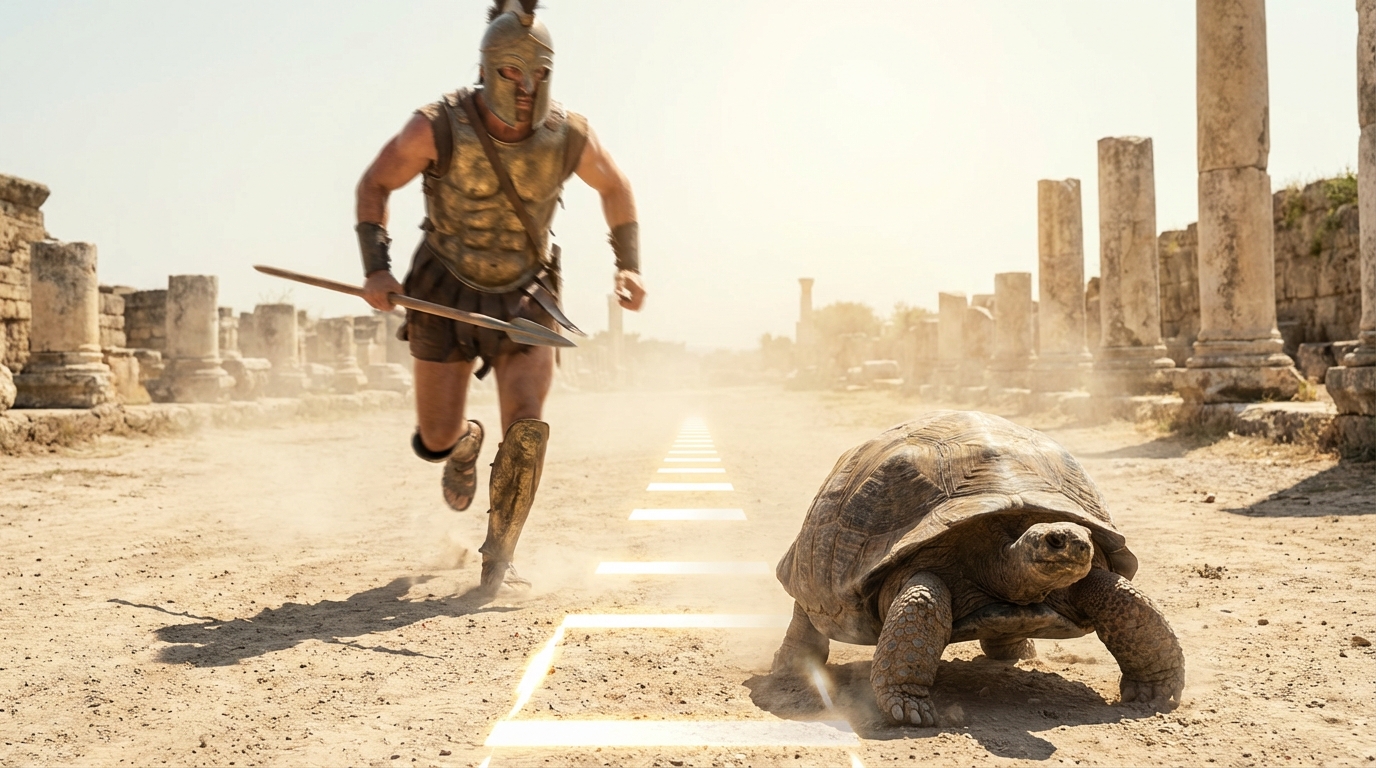
This same logic applies to Zeno’s second famous puzzle featuring the mythical Greek hero Achilles and a surprisingly elusive tortoise. Because Achilles is a legendary sprinter, he generously gives the slow reptile a small head start in their hypothetical race. By the time the mighty hero reaches the exact spot where the tortoise began, the creature has already inched slightly forward to a new position. When Achilles advances to that second location, the tortoise has moved forward yet again, creating an endless cycle of shrinking distances. No matter how fast you imagine the hero running, this ancient philosophical argument suggests he can mathematically never overtake his slow opponent.
The Flying Arrow Frozen In Time

While Zeno’s other puzzles focus on the infinite division of physical distance, the paradox of the flying arrow asks you to consider the division of time itself. Imagine standing in a field watching an archer release an arrow toward a target. As you track the projectile soaring through the air, your common sense tells you it is in continuous motion. However, Zeno challenges this everyday observation by breaking the arrow’s journey down into a series of isolated, dimensionless instants. He invites you to freeze time completely and examine exactly what is happening at any given millisecond of that flight.
When you pause the flight to look at a single, frozen snapshot of time, you will notice something peculiar. In that exact isolated moment, the arrow must occupy a physical space perfectly equal to its own length. Because the instant has no duration, the arrow simply does not have the time to move from one position to another. It is completely static within that specific frame, suspended motionless in the air just like a photograph. Zeno argues that this state of rest applies to absolutely every single instant throughout the entire duration of the journey.
The startling conclusion of this puzzle reveals itself when you stack all of these motionless snapshots together. If the flying arrow is entirely stationary at every individual moment of its flight, it cannot actually be moving at all. Zeno uses this clever logic to argue that what you perceive as continuous movement is nothing more than an elaborate illusion. This thought experiment beautifully supports the teachings of his mentor, Parmenides, who believed that true reality is singular and completely unchanging. By forcing you to question the fundamental nature of time, this ancient puzzle continues to captivate those who love exploring deep philosophical mysteries.
How Modern Calculus Resolves The Infinite
For over two millennia, Zeno’s puzzles stumped the greatest philosophers until mathematicians finally cracked the code using the modern tools of calculus. When you attempt to walk across your living room, you are not actually trapped in an impossible loop of endless halfway points. The key to escaping this ancient Greek trap lies in a mathematical concept known as the limit. Instead of viewing motion as a series of isolated and impossible tasks, calculus allows you to calculate the final outcome of an ongoing process. By using limits, mathematicians proved that you can indeed complete an infinite number of steps, provided the time it takes to complete each step shrinks at the exact same rate.
To understand exactly how this works, picture the remaining fractions of your journey across the room as a mathematical sequence. You first cover one half of the total distance, then a quarter, followed by an eighth, and so on into microscopic infinity. Zeno assumed that adding an endless number of positive quantities would naturally result in an infinitely large sum. However, infinite series calculus reveals that when each subsequent fraction gets progressively smaller, the total sum converges perfectly to a finite number. Adding up every single fraction of that shrinking distance equals exactly one whole room, proving mathematically that your journey has a definitive end.
This elegant mathematical resolution bridges the frustrating gap between abstract metaphysics and your physical reality. You no longer have to worry that the universe is just an elaborate illusion of unchanging stillness. The invention of limits provided a rigorous framework to handle the concept of infinity without breaking the laws of logic. Because the ever-shrinking fractions of distance are covered in equally shrinking fractions of time, your speed remains constant and your destination is entirely reachable. Thanks to the brilliance of modern calculus, you can confidently take your next step knowing that the infinite will not hold you back.
Discover How Zeno’s Paradoxes Unlocked Modern Calculus
Zeno of Elea may have designed his ancient puzzles to prove that motion is an illusion, but his ideas ultimately achieved something much grander. By forcing early thinkers to confront the seemingly impossible, these paradoxes laid the essential groundwork for modern calculus and theoretical physics. You can see his direct influence in how mathematicians eventually learned to calculate infinite series, perfectly solving the racecourse problem that once baffled the ancient Greeks. Philosophers and physicists alike still debate the continuous nature of space and time today, proving that these timeless brain teasers are far more than mere historical curiosities. They remain some of the greatest intellectual exercises ever conceived, continually pushing curious minds to question the fundamental fabric of reality.
The next time you walk across a room to grab a cup of coffee, take a brief moment to appreciate the miraculous nature of your movement. According to strict ancient logic, you are successfully crossing an infinite number of halfway points just to reach your destination. You are actively conquering infinity with every single stride you take, effortlessly turning a mathematical impossibility into an everyday occurrence. While modern science tells us exactly how we actually move through space, there is still something profoundly magical about experiencing this ancient philosophical puzzle in real time. Keep this fascinating concept in your back pocket, and you will never look at a simple stroll down the street the exact same way again.
Frequently Asked Questions
1. Who was Zeno of Elea and why did he create these paradoxes?
Zeno was an ancient Greek philosopher who wanted to support the radical ideas of his mentor, Parmenides. He designed these clever thought experiments to prove that our everyday perception of motion and physical change is just a stubborn illusion. By challenging your basic understanding of reality, he forces you to question what you actually see.
2. What exactly is Zeno’s Dichotomy paradox?
The Dichotomy is a famous puzzle that makes the simple act of walking across a room seem impossible. It argues that before you can reach your destination, you must first cross the halfway point, then half of the remaining distance, and so on into infinity. Because you cannot complete an infinite number of tasks in a finite amount of time, pure logic suggests you can never finish your journey.
3. How does the Achilles and the Tortoise paradox work?
Imagine the legendary hero Achilles giving a slow tortoise a head start in a footrace. Zeno argues that by the time Achilles reaches the tortoise’s starting point, the tortoise will have moved a tiny bit further ahead. Because this process repeats infinitely, you are led to the baffling conclusion that the fastest runner can never overtake the slowest crawler.
4. Do these paradoxes prove that motion is impossible?
While Zeno’s strict mathematical logic makes a compelling case, you know from personal experience that motion is very real. These paradoxes do not prove that movement is impossible, but rather highlight a flaw in how ancient thinkers understood infinity and continuous space. They serve as a powerful reminder to constantly test the limits of your own logical reasoning.
5. How do modern mathematicians solve Zeno’s paradoxes?
Today, you can use the mathematical concept of calculus to resolve these ancient puzzles. Calculus shows that an infinite series of increasingly smaller steps can actually add up to a finite total distance. This modern tool allows you to mathematically prove exactly how and why you are able to reach your destination.
6. Why should you care about Zeno’s paradoxes today?
Exploring these ancient puzzles forces you to challenge your most fundamental assumptions about space, time, and the true fabric of reality. They are fantastic mental exercises that sharpen your critical thinking skills and deepen your appreciation for scientific progress. Plus, understanding these concepts gives you a fascinating perspective on how human logic has evolved over two millennia.
7. What is the main takeaway from having Zeno’s paradoxes explained?
The biggest takeaway is that unchecked logic can sometimes lead you to absurd conclusions if your foundational premises are incomplete. Having these concepts explained helps you see the historical gap between abstract philosophy and observable reality. It ultimately empowers you to approach complex modern problems with a more nuanced, analytical mindset.