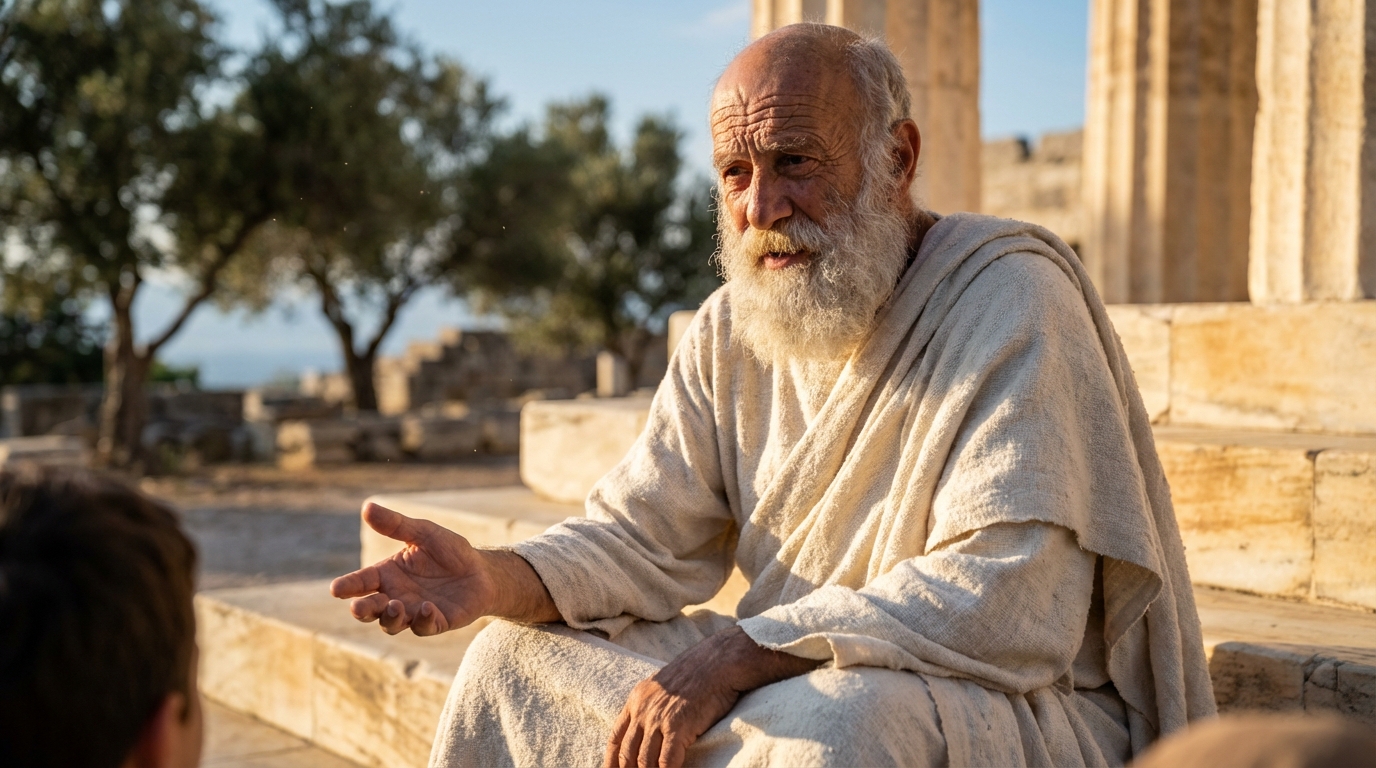
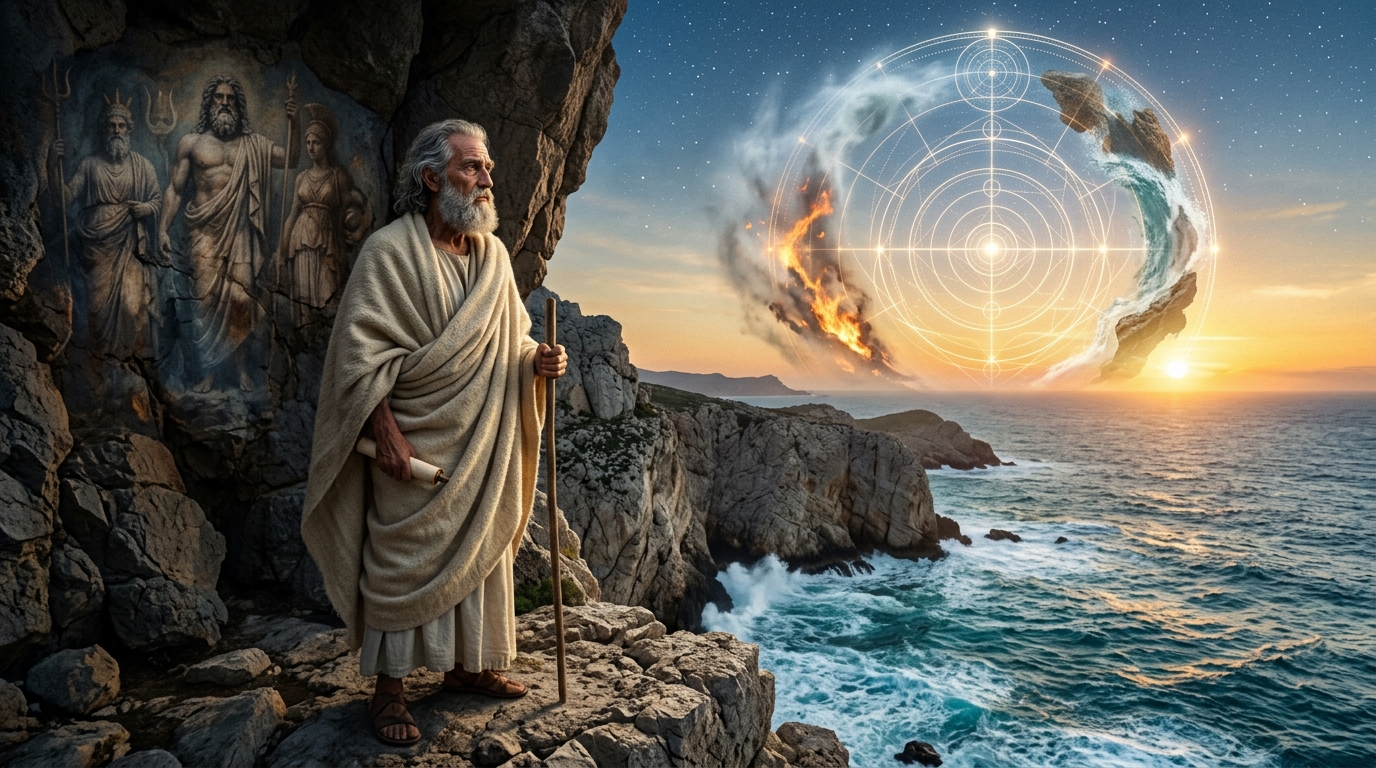
Imagine standing on the shores of ancient Greece, looking up at the stars and daring to ask “why” without reaching for a myth or a god. This monumental shift from storytelling to rational inquiry is the heart of pre-socratic cosmogony, a period that fundamentally rewrote the human script for understanding the universe. You are stepping into a world where the first natural philosophers traded divine whims for logical principles, seeking a single arche, a primary substance, that could explain the origin of everything we see.
As you explore these early theories, you will discover a fascinating tug-of-war between stability and change that still resonates in modern science. Whether you are drawn to the idea of a world made of water, the infinite boundless, or the invisible dance of atoms, these thinkers provide the foundational tools for your own intellectual journey. By moving from mythos to logos, you are not just studying ancient history; you are witnessing the birth of the scientific mind and the first rigorous attempts to map the cosmos through reason alone.
Key Takeaways
- The transition from mythos to logos replaced supernatural storytelling with rational inquiry, establishing the universe as an intelligible system governed by physical laws rather than divine whims.
- The search for the arche introduced the fundamental concept that a primary substance or principle—whether water, air, or the infinite—serves as the logical origin of all existence.
- The intellectual conflict between Heraclitean flux and Eleatic permanence forced a shift toward abstract reasoning, challenging humanity to distinguish between sensory perception and the underlying structure of reality.
- Early pluralist and atomic theories laid the groundwork for modern science by proposing that the cosmos is composed of eternal, indivisible building blocks governed by mechanical processes.
The Milesian Quest For The Arche
The Milesian quest for the arche represents your first step away from the world of gods and monsters toward the dawn of scientific reasoning. When you look at the work of Thales, you see a thinker daring to suggest that a single material substance, water, could be the source of all life and change. He noticed that moisture is essential for nourishment and growth, leading him to conclude that the entire cosmos is built upon this fluid foundation. By setting aside mythological explanations, Thales invited you to view the universe as a rational system that can be understood through observation and logic.
Anaximander took this investigation a step further by arguing that the primary substance must be something more abstract than a common element. You can imagine his reasoning that if the arche were water, it would eventually overwhelm its opposite, fire, and destroy the balance of nature. To solve this, he proposed the Apeiron, an infinite and boundless source that remains hidden while giving birth to everything you see. This move toward the indefinite shows a sophisticated leap in human thought, as it suggests that the ultimate truth of reality might exist beyond your immediate physical senses.
Anaximenes eventually refined these ideas by identifying air as the fundamental substance, providing a clear mechanical explanation for how variety arises from unity. You can understand his theory through the concepts of rarefaction and condensation, where air becomes fire when thinned or solid earth when thickened. This approach offered a specific process to explain how one substance transforms into many different things. By focusing on these natural mechanisms, the Milesians transformed your relationship with the world from one of superstition to one of intellectual discovery.
Heraclitean Flux Versus Eleatic Permanence
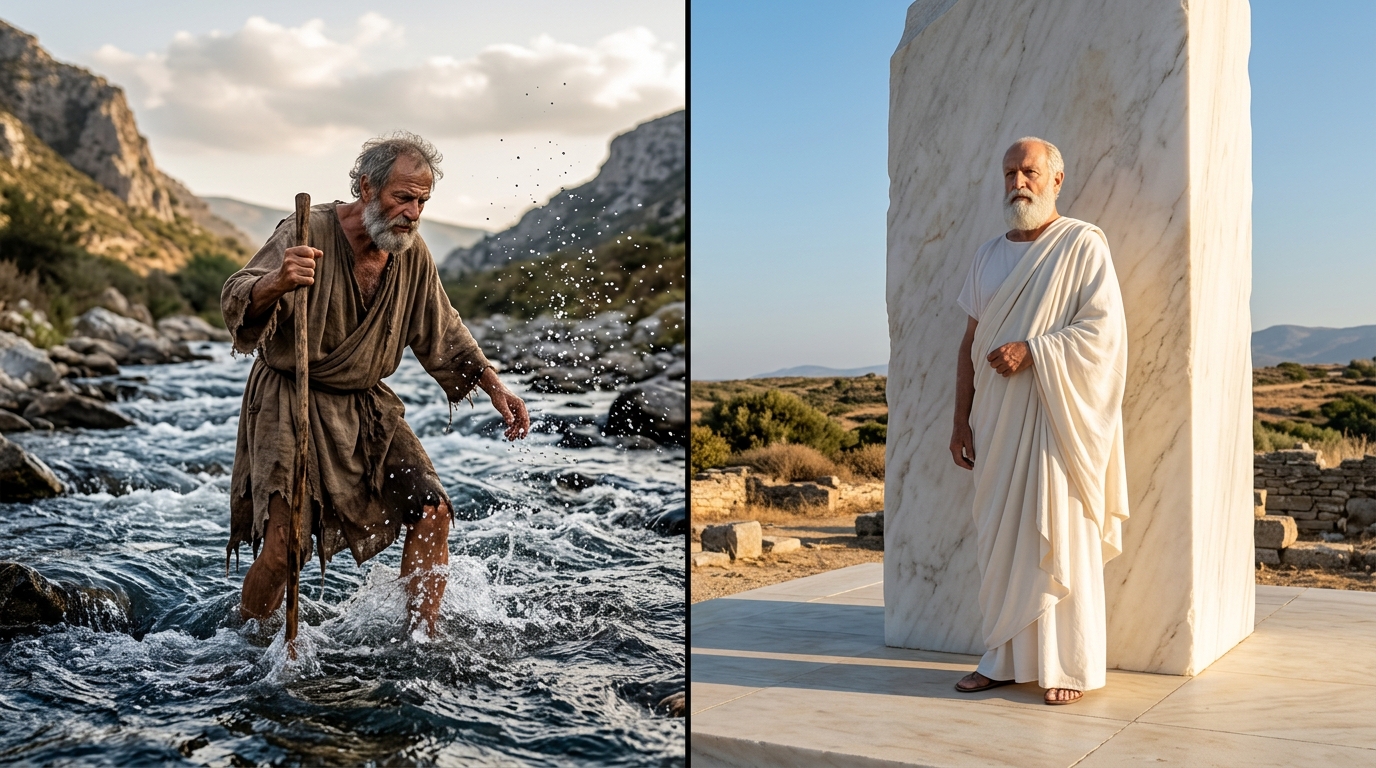
As you move deeper into the origins of the universe, you will encounter the clash between Heraclitus and Parmenides, two thinkers who fundamentally redefined how we perceive reality. Heraclitus of Ephesus proposed that the world is in a state of perpetual flux, captured by his observation that you cannot step into the same river twice. To him, the arche was fire, a volatile element that represents the constant transformation and tension inherent in nature. You can think of his philosophy as a celebration of change, where the only permanent thing in existence is the law of change itself. This perspective challenges you to see the cosmos not as a collection of static objects, but as a world in motion and a dynamic process of becoming.
In sharp contrast to this world of motion, you must grapple with the logic of Parmenides and the Eleatic school. Parmenides argued that our senses are deceptive and that true reality, which he called Being, is actually eternal, indivisible, and completely unchanging. From his perspective, the very idea of things coming into existence or passing away is a logical impossibility because something cannot come from nothing. You are invited to view the universe as a singular, solid sphere of existence where motion is merely an illusion of the human mind. This shift toward rational deduction over sensory experience laid the groundwork for centuries of metaphysical debate regarding the nature of truth.
Navigating this intellectual divide helps you understand the critical transition from mythological storytelling to the rigorous use of logos. While the Milesians looked for a physical substance like water or air, Heraclitus and Parmenides pushed you to consider the underlying logical structure of the universe. Their debate forced subsequent philosophers to find a middle ground, leading to the complex systems of the pluralists and atomists. By engaging with these opposing views, you gain a clearer picture of how early humans began to use abstract reasoning to solve the mysteries of existence. This pivotal moment in history marks the birth of serious inquiry into the fundamental laws that govern our world.
Pluralist Building Blocks And Atomic Theory
As you move beyond the idea of a single originating substance, you encounter the Pluralists, who revolutionized cosmogony by suggesting that the universe is built from several fundamental ingredients. Empedocles proposed that everything in existence is composed of four roots consisting of earth, air, fire, and water. He argued that these elements do not change into one another but instead mix and separate under the influence of two cosmic forces called Love and Strife. This shift was monumental because it allowed for a world of constant change and variety while maintaining that the underlying building blocks remain eternal and constant. You can see this as a sophisticated attempt to bridge the gap between permanent reality and the shifting world you experience every day.
The evolution of rational inquiry reached a peak with the introduction of atomic theory by Leucippus and Democritus. These thinkers moved away from macroscopic elements to propose that the entire cosmos is made of atomon, which are indivisible and microscopic particles moving through an infinite void. In this view, the vast diversity of the physical world is simply the result of these tiny units differing in shape, size, and arrangement as they collide with one another. By removing the need for divine intervention or purposeful forces, the Atomists provided you with a purely mechanical explanation for how the universe began and continues to function. This transition from mythological storytelling to logical particle physics represents one of the most significant milestones in the history of human thought.
From Myth to Logic: Your Intellectual Origins
The shift from mythos to logos represents one of the most profound turning points in human history. When you look back at the Pre-Socratics, you are witnessing the moment humanity stopped asking which god caused a storm and started asking what physical laws govern the natural world. These early thinkers replaced divine whims with the search for the arche, establishing the idea that the universe is an intelligible system. By seeking a single material origin or a mathematical order, they provided the first blueprints for what we now recognize as the scientific method. You can see their influence every time a modern physicist searches for a fundamental particle or a universal law of motion.
These ancient theories forever changed how you perceive your place among the stars by removing the veil of supernatural mystery. Instead of being a mere plaything of the gods, you became an observer of a rational cosmos that functions through cause and effect. The transition from Thales’ water to the invisible atoms of Democritus shows a growing confidence in the power of human reason to decode the invisible structures of reality. This intellectual courage allowed future generations to look at the night sky not as a realm of myth, but as a frontier waiting to be understood. You are a participant in a legacy of inquiry that began over two thousand years ago in the streets of Miletus.
Ultimately, the Pre-Socratic legacy is a reminder that the most important questions often start with a simple desire to understand the essence of things. Their debates over flux and permanence or unity and plurality shaped the very language you use to discuss science and philosophy today. Even though their specific conclusions have been updated by modern technology, their foundational spirit of rational curiosity remains the heartbeat of all human progress. You carry their flame every time you prioritize evidence and logic over superstition. By honoring these early pioneers, you acknowledge that the journey toward truth is a continuous path that links the ancient past to our future discoveries.
Frequently Asked Questions
1. What exactly is the ‘arche’ in Pre-Socratic philosophy?
The arche is the primary substance or fundamental principle that you can point to as the origin of everything in the universe. It represents your first attempt to find a single, logical source for the diversity of the natural world without relying on gods or myths.
2. How did the shift from ‘mythos’ to ‘logos’ change how you see the world?
This transition moved you away from explaining natural events through divine stories and toward using rational logic and observation. It represents the moment you began to treat the cosmos as a predictable system that your mind can actually decode and understand.
3. Why did Thales believe that water was the source of everything?
You can see his logic in the way moisture is necessary for all living things to grow and stay nourished. By observing that even heat and life seem to come from water, he concluded that this versatile element must be the fundamental building block of the entire cosmos.
4. What makes Anaximander’s ‘boundless’ different from other elements?
Anaximander realized that if the primary substance was a specific element like water, it would eventually overwhelm its opposites like fire. To solve this, he proposed the Apeiron, an infinite and indefinite substance that allows all opposites to exist in a state of balance.
5. Is Pre-Socratic cosmogony considered the beginning of modern science?
Yes, you are looking at the birth of the scientific mind because these thinkers were the first to prioritize natural explanations over supernatural ones. Their commitment to using reason and evidence to map the universe laid the essential groundwork for all future scientific inquiry.
6. How can these ancient theories still be relevant to you today?
These theories invite you to join a long intellectual tradition of questioning the surface of reality to find deeper truths. By studying these early philosophers, you sharpen your own ability to think critically and appreciate the logical foundations of the modern world.