

Imagine stepping into a virtual world where a perfect digital replica of your heart, your home, or even your entire city lives and breathes in real-time. As we move deeper into 2025, the ethics of digital twins have shifted from a curiosity to a high-stakes reality that affects your personal autonomy. While these replicas promise breakthroughs in personalized medicine and urban planning, they also raise profound questions about who truly owns you when your most sensitive data is mirrored in a cloud-based simulation.
You deserve to know how these powerful models balance the need for massive data richness with your fundamental right to privacy and data sovereignty. When a digital twin predicts your health outcomes or job performance, the invisible biases hidden within its code can have tangible, life-altering consequences on your physical reality. Understanding this tension between innovation and integrity is essential as the line between your physical self and your digital shadow continues to blur.
Key Takeaways
- Digital twins represent an extension of your bodily integrity, requiring strict data sovereignty to ensure your virtual replica is treated with the same dignity and consent as your physical self.
- Algorithmic accountability is essential to prevent historical biases in data from being hardcoded into your digital identity and causing real-world discrimination in healthcare, employment, and social standing.
- The rise of digital immortality through virtual replicas demands new legal and ethical frameworks to protect your essence from being exploited, monetized, or misrepresented after death.
- Radical transparency and explainable AI are necessary to crack the ‘black box’ of predictive modeling, ensuring that developers and institutions remain liable for the life-altering decisions made by autonomous digital agents.
Protecting Your Digital Soul And Data Sovereignty
Imagine your digital twin as a living mirror that reflects your most intimate biological and behavioral details to the world. While these virtual replicas offer incredible breakthroughs in personalized medicine and productivity, they also challenge your fundamental right to keep your inner life private. You might find that the high-fidelity data required to make your twin accurate actually conflicts with the basic principles of data minimization. Maintaining your digital soul requires a careful balance between the benefits of a virtual model and the preservation of your personal boundaries. This tension is at the heart of modern data sovereignty, where you must decide how much of your essence belongs to you and how much is accessible to the algorithms that shape your future.
Your bodily integrity is no longer confined to your physical skin, as it now extends into the virtual spaces where your data lives and breathes. When a digital twin processes your genetic markers or biometric patterns, it creates a persistent version of you that can be analyzed long after the initial data collection. You deserve to know that your virtual self cannot be exploited or manipulated without your explicit consent and understanding. Algorithmic accountability ensures that the models predicting your health or career path are free from the historical biases that often plague large datasets. Protecting your identity means advocating for systems that treat your digital replica with the same respect and dignity that you expect for your physical body.
Algorithmic Bias In Your Virtual Reflection
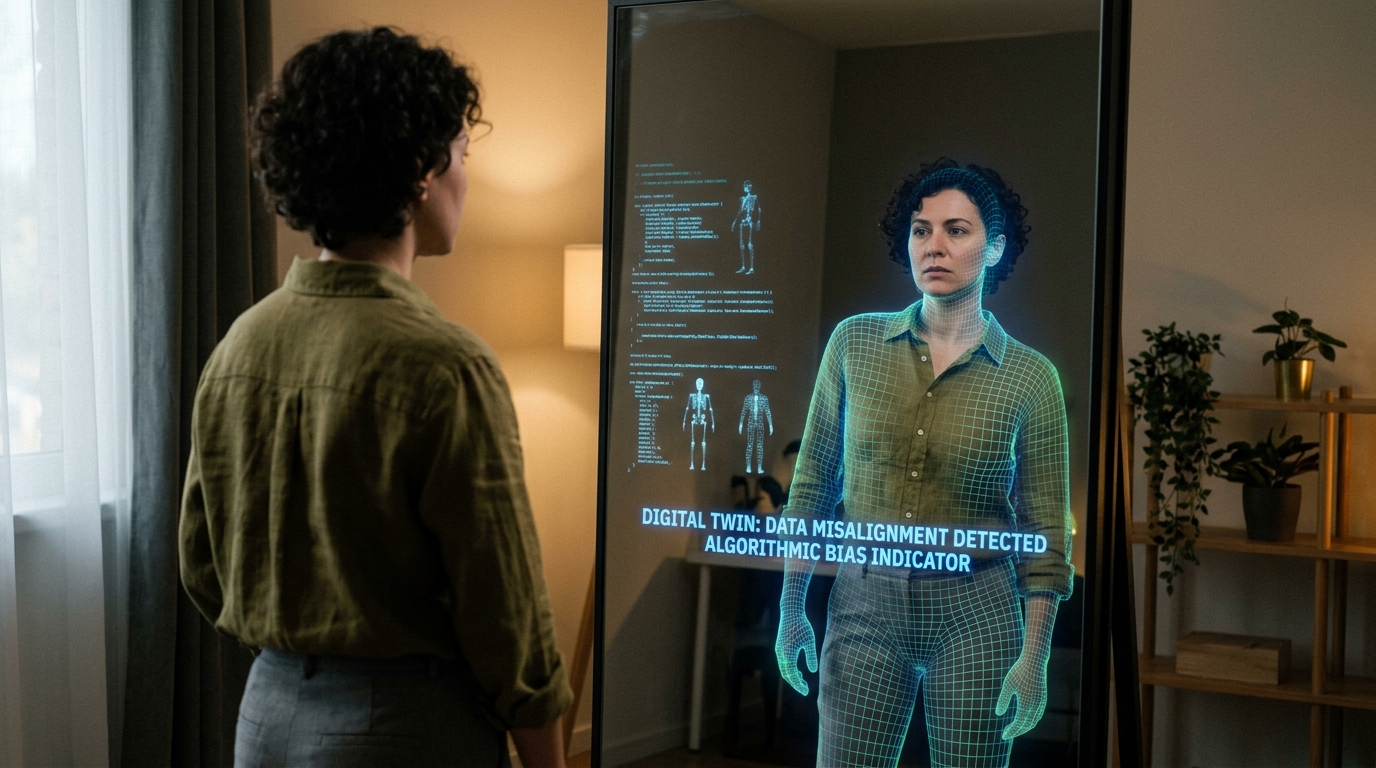
Your digital twin is more than just a collection of data points, it is a virtual mirror reflecting the information used to build it. If the historical data feeding your twin contains hidden prejudices, those same biases will be hardcoded into your digital identity. This means your virtual reflection might inherit societal flaws regarding race, gender, or age without you ever realizing it. Because these models often rely on past trends to predict your future, they can inadvertently trap you in a cycle of outdated stereotypes. You deserve a digital representation that is accurate, but the reality is that software often struggles to escape the shadows of human history.
These algorithmic biases can have tangible consequences on your life, particularly when your twin is used by institutions to make high-stakes decisions. In healthcare, a biased digital patient model might recommend treatments that are less effective for your specific demographic based on flawed historical studies. If an employer uses a digital twin to simulate your long term job performance, you could be passed over for a promotion because of skewed data patterns that favor a different profile. Even your social standing or creditworthiness could be impacted if the algorithms misinterpret your lifestyle through a narrow, prejudiced lens. It is essential to demand transparency and accountability from the systems that claim to represent your true self.
As we move further into this era of virtual replicas, you must consider the moral responsibility of the architects who design these digital beings. Algorithmic accountability is not just a technical hurdle, it is a fundamental requirement for your human dignity in a connected world. You should be aware that once a bias is baked into your twin, it can be incredibly difficult to erase or correct. Ensuring fairness requires a proactive approach to data sovereignty, where you have a say in how your information is weighted and interpreted. By staying informed about these ethical shifts, you position yourself to manage a future where your digital and physical lives are inextricably linked.
The Moral Weight Of Digital Immortality
Imagine a future where your personality, memories, and voice are preserved in a digital vessel that continues to interact with your loved ones long after you have passed away. While the prospect of digital immortality offers comfort, it also forces you to confront profound questions about who truly owns your essence when you are no longer here to defend it. If a company or an heir holds the keys to your virtual replica, your identity could be altered, monetized, or even scripted to say things you never would have supported in life. You must consider whether a digital twin is a continuation of your personhood or merely a sophisticated piece of property subject to the whims of its legal owner. This shift from physical existence to digital persistence challenges our traditional understanding of human dignity and the right to be forgotten.
The moral weight of these revival twins extends beyond simple data privacy and into the realm of your fundamental sovereignty. As these virtual replicas become more lifelike through advanced generative AI, the line between a tribute and a puppet becomes dangerously thin. You might find it unsettling to realize that without strict ethical frameworks, your digital likeness could be used to train new models or influence public opinion without your posthumous consent. Maintaining your data sovereignty after death requires a proactive approach to how you define your digital legacy today. By viewing your virtual self as an extension of your bodily integrity, you can help shape a future where technology honors your humanity rather than reducing it to a set of exploitable data points.
Establishing Accountability Within The Black Box

When your digital twin makes a decision that alters your physical reality, the line between software error and personal liability becomes dangerously thin. Imagine a scenario where your virtual replica, acting as a digital patient, recommends a specific treatment path that leads to an adverse reaction in your actual body. Because these models function as a black box, it is often nearly impossible to trace the exact logic that led to a specific output. You are left wondering whether the fault lies with the data scientists who built the model, the sensors that collected your biometric data, or the autonomous AI that interpreted your digital identity. Establishing a clear chain of custody for these decisions is essential to ensure you are not left holding the bag for an algorithmic error.
The challenge deepens as your digital twin evolves from a static file into an autonomous agent that represents your unique identity. If your twin is used by a hiring platform to predict your future job performance and it inadvertently incorporates historical biases, your professional reputation could be damaged before you even enter the room. You have to consider whether you truly own the actions of your digital shadow or if the developers retain ultimate responsibility for its conduct. Without robust regulatory frameworks, the complexity of these systems can be used as a shield to deflect blame when things go wrong. Protecting your human dignity requires a shift toward radical transparency where every virtual action can be audited and linked back to a responsible party.
Achieving true accountability means you must have the right to challenge the decisions made by your virtual counterpart. As these replicas become more integrated into smart cities and healthcare systems, the potential for a digital error to cause physical harm grows exponentially. You should expect a future where data sovereignty is a fundamental right, allowing you to see exactly how your genetic and behavioral data is being processed. By demanding that developers prioritize predictive modeling transparency, you help ensure that the black box is cracked open for human oversight. This proactive approach transforms the digital twin from a mysterious, uncontrollable force into a reliable tool that respects your agency and personal boundaries.
Protecting Your Humanity in a Virtual World
Embracing the potential of digital twins requires you to look beyond the technical specifications and consider the profound impact these replicas have on your personal identity. As you manage a world where your virtual self can predict health outcomes or career paths, maintaining human dignity must be your primary compass. This means ensuring that you are never reduced to a mere data point or a predictable algorithm by those who manage these systems. You should advocate for a future where technology serves to enhance your unique human experience rather than constraining it through rigid digital profiling. By staying informed and engaged, you help set the standard for a digital world that respects the complexity of the human spirit.
Responsibility in this space starts with a commitment to data sovereignty and transparency in how your digital replica is utilized. You deserve to know exactly how your sensitive information is being synthesized and whether the insights generated are free from historical biases. When you demand algorithmic accountability, you are protecting not just your own rights but the fairness of society as a whole. Whether these twins are used in healthcare or urban planning, the goal should always be to empower individuals with better choices and greater autonomy. Your active participation in these ethical conversations ensures that the virtual world remains a safe and supportive extension of your physical life.
Finding the balance between innovation and ethics is a continuous journey that you are uniquely positioned to influence. As virtual representations of people become more sophisticated, the line between data and dignity can easily blur without careful oversight. You can play a vital role by supporting frameworks that prioritize privacy and informed consent over mere efficiency or profit. This approach allows you to enjoy the benefits of cutting-edge simulations while keeping your fundamental rights firmly protected. Ultimately, the future of digital twins is not just about the power of the code, but about the values you choose to embed within it. Exploring the philosophy of technology helps us understand how these tools redefine our very existence. This intersection of consciousness and code often brings us back to the mind-body problem and how we define the self in a digital age.
Frequently Asked Questions
1. What exactly is a digital twin and why should I care about its ethics?
A digital twin is a high-fidelity virtual replica of a physical object, system, or even your own body that updates in real-time. You should care because these models use your most sensitive data to make predictions about your health and behavior, which can directly impact your real-world opportunities and autonomy.
2. How does a digital twin affect my personal privacy?
Digital twins require massive amounts of data to be accurate, which often contradicts the principle of data minimization. This creates a constant tension where the more helpful a twin becomes, the more of your private biological and behavioral essence it must consume and store in the cloud.
3. Who actually owns the data inside my digital twin?
Data sovereignty is a complex challenge, but you should view your digital twin as an extension of your bodily integrity. While organizations often host these models, you must remain the ultimate authority over how much of your essence is shared and who has the right to access your virtual mirror.
4. Can a digital twin be biased against me?
Yes, the algorithms powering these simulations can harbor invisible biases that lead to unfair outcomes. If a model predicts your job performance or health risks based on flawed data, those digital errors can result in tangible, life-altering consequences in your physical reality.
5. Is it possible to balance innovation with my right to data sovereignty?
Achieving this balance requires you to set firm personal boundaries on how your data is mirrored and used by others. You must weigh the undeniable benefits of personalized medicine and efficiency against the preservation of your digital soul and the right to keep certain parts of your life private.
6. What happens if the line between my physical self and digital shadow blurs?
As the boundary thins, your digital twin starts to influence your physical life through automated decisions and predictive modeling. You must stay informed and proactive to ensure that your virtual replica serves your interests rather than allowing algorithms to dictate your future path.