

Teen AI Schoolwork Statistics: Key Findings for Teachers and Parents
Teen AI schoolwork statistics start with a clear headline: 70% of U.S. teens ages 13 to 17 say they use AI for schoolwork, according to a nationally representative Common Sense Media survey from August 2026. That same survey found that only 27% of teens said a teacher had talked with them about using AI safely.
If you are comparing classroom materials and policies, that gap matters. Use is widespread, but guidance appears to lag behind it. In the same survey, 44% of AI-using teens reported that an AI tool had been blocked on a school network or device.
70%
of U.S. teens ages 13 to 17 say they use AI for schoolwork
27%
of teens say a teacher has talked with them about using AI safely
44%
of AI-using teens say an AI tool was blocked on their school network or device
59%
of teens who hit a school AI block switched to a personal device
Quick Facts
- Teen AI use for schoolwork: 70% of U.S. teens ages 13 to 17 say they use AI for schoolwork, according to a nationally representative Common Sense Media survey from August 2026.
- Teacher conversations about safe AI use: Only 27% of teens said a teacher had talked with them about using AI safely, in the same 2026 Common Sense Media survey.
- School AI blocks: 44% of AI-using teens said an AI tool had been blocked on a school network or device, and 59% of those teens said they switched to a personal device.
- Teens’ concern about learning: 39% of AI-using teens said they feel they miss out on learning when they use AI to complete assignments.
- Pew chatbot figure for schoolwork: Pew Research Center’s 2025 survey of 1,458 teens (fielded September 25 to October 9, 2025) found that 54% had used chatbots for schoolwork. This measures chatbot use only, so it is not directly comparable to the 70% figure.
Key Takeaways
- Seventy percent of U.S. teens ages 13 to 17 say they use AI for schoolwork, according to a nationally representative Common Sense Media survey from August 2026, yet only 27% of those teens said a teacher had talked with them about using AI safely, so you should look closely at whether your classroom guidance keeps pace with that use.
- When you review a classroom AI policy, check whether it sets clear safe-use expectations and addresses the learning concerns teens raise themselves, since 39% of AI-using teens said they feel they miss out on learning when they use AI to complete assignments.
- Before you approve a classroom AI tool, ask the vendor in writing to confirm the FERPA school-official conditions: the provider performs an outsourced institutional function, stays under the school’s direct control, uses student-record information only for authorized purposes, and does not improperly redisclose that information.
- Filtering alone will not close the gap, because 59% of AI-using teens who hit a school block said they switched to a personal device, so schools should pair network controls with a clear classroom AI policy and direct instruction on safe, honest use.
- Before your next class or household session with an AI tool, you should confirm three things: a teacher-led discussion of honest use, activities that teach students to check AI answers, and a plan that addresses students’ concern about missing out on learning.
How Many Teens Use AI for Schoolwork?
Seventy percent of U.S. teens ages 13 to 17 use AI for schoolwork, according to a nationally representative survey, so the figure applies to teens across the country in that age range. The number is self-reported: teens told researchers in their own words whether they use AI for schoolwork. It measures AI use for school specifically, not AI use in general, such as chatting for fun or looking up recommendations. Pew Research Center’s separate 2025 survey of 1,458 teens, fielded September 25 to October 9, 2025, asked about chatbots and found that 54% had used them for schoolwork. That is a different question, so you should compare the two figures carefully rather than treat them as interchangeable.
What Do Teens Actually Use AI For?

Most teens who use AI for schoolwork use it to get answers, though many also do more with those answers. In a follow-up Common Sense Media article on AI in education published in September 2026, 63% of teens who use AI for schoolwork said they use it to get an answer. Respondents could select more than one response, so the categories below overlap.
Among that same group, 25% said they take the answer as-is, 31% said they rewrite it to sound like them, and 35% said they improve it using what they already know. A student who pastes in a response unchanged and a student who revises a draft with their own knowledge both count as getting an answer, so the 63% figure on its own hides how the answer is used. For a teacher reviewing an assignment policy, the difference between copying, rewording and building on a response is the detail worth looking at.
Teen AI Schoolwork Figures Side by Side
Placing the two surveys side by side shows what each one counts. The table lists the source, year, population, measure and figure for each number.
| Source | Year | Population | Measure | Figure |
|---|---|---|---|---|
| Common Sense Media | 2026 | U.S. teens ages 13–17 | Use AI for schoolwork | 70% |
| Pew Research Center | 2025 (fielded September 25–October 9, 2025; 1,458 teens) | U.S. teens ages 13–17 | Used AI chatbots for schoolwork | 54% |
| Pew Research Center | 2025 (same Pew survey as the row above) | U.S. teens ages 13–17 | How much chatbots helped with schoolwork: all or most / some / a little / not at all | 10% / 21% / 23% / 45% |
Common Sense Media’s 70% covers any AI use for schoolwork, while Pew’s 54% covers only chatbot use. Pew’s breakdown describes degree of help among all teens surveyed, so its four categories add up to the full group. Because the two surveys measure different things, compare their figures with care.
Do Teachers Talk With Students About Safe AI Use?
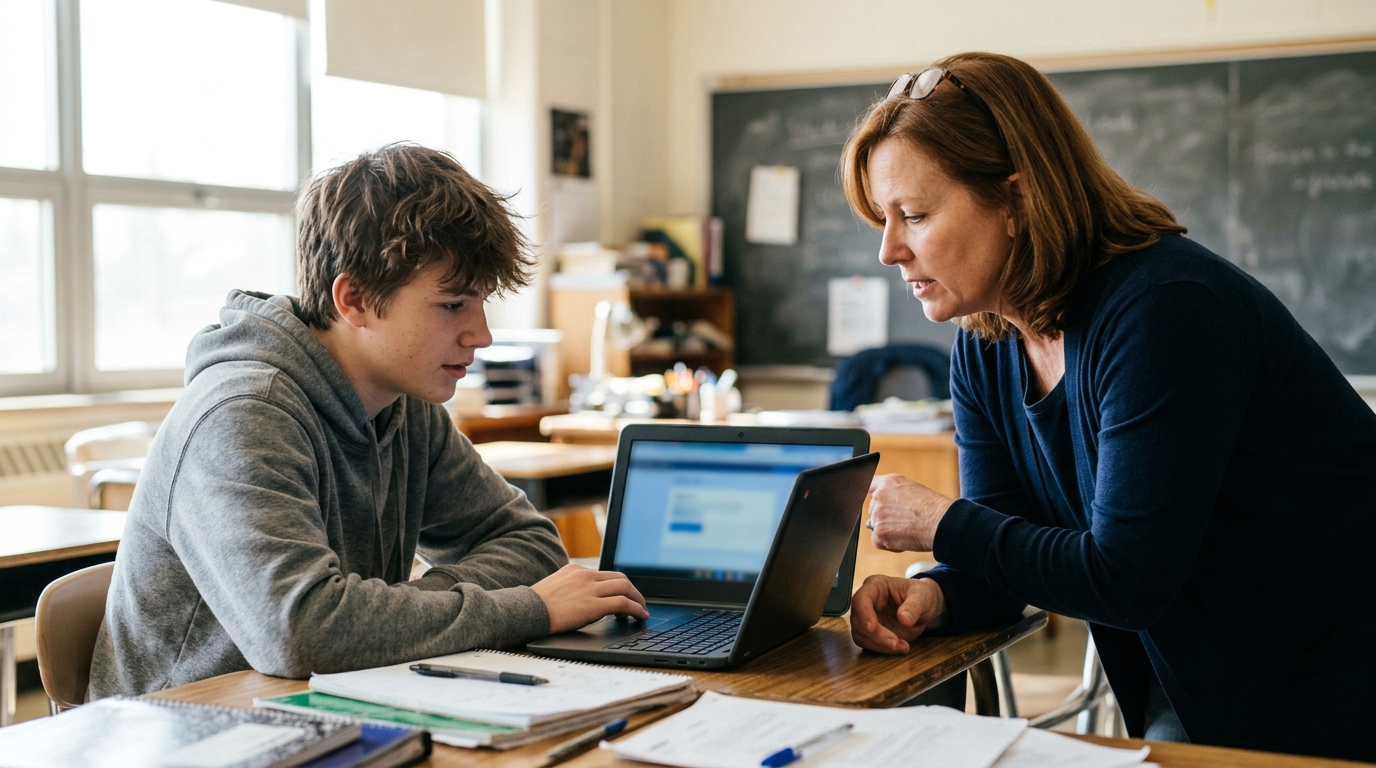
Only 27% of teens in the 2026 Common Sense Media survey said a teacher had talked with them about how to use AI safely, which means most students in that survey had not had that conversation.
38% of AI-using teens said AI availability leads them to generate fewer of their own ideas.
39% said they feel they miss out on learning when they use AI to complete assignments.
Student attitudes about cheating are also worth tracking. In Pew Research Center’s 2025 survey, 59% of teens thought AI cheating occurred at least somewhat often at their school. That figure reflects teens’ perceptions rather than a measured cheating rate. When you review a classroom AI policy, check whether it sets clear safe-use expectations and addresses the learning concerns teens raise themselves.
Why Do Students Get Around School AI Blocks?
Many students who hit a school AI block get around it by switching devices. In the 2026 survey, 44% of AI-using teens said an AI tool had been blocked on a school network or device, and 59% of those teens said they switched to a personal device to reach it.
Filtering controls the network, but it does not change why students want the tool or how they should use it. Most teens in the same survey had not discussed safe AI use with a teacher, so the guidance gap remains even where a block is in place.
For policy design, treat filtering as one layer. Schools that pair network controls with a clear classroom AI policy and direct instruction on safe, honest use address both access and understanding.
What Privacy Rules Apply to Classroom AI Tools?
The main federal privacy rules for classroom AI tools are COPPA and FERPA, so check how a vendor addresses both before a tool reaches students. Under the Federal Trade Commission’s COPPA guidance, covered operators generally must obtain verifiable parental consent before collecting personal information online from children under 13. Schools may authorize that collection for a school-authorized educational purpose, but not for any other commercial purpose, so read the vendor’s terms for any commercial use.
FERPA’s school-official exception applies only when a third-party provider performs an outsourced institutional function, remains under the school’s direct control, uses student-record information only for authorized purposes, and does not improperly redisclose it. Ask for these four conditions in writing, as set out in the Student Privacy Policy Office’s vendor FAQ.
The Department of Education’s Supplemental Priority on Advancing Artificial Intelligence in Education was published in the Federal Register on April 13, 2026. It applies to discretionary grant competitions, as described on the Department of Education’s grant priorities page. It is not a universal mandate for classroom AI use, so it does not replace COPPA or FERPA obligations.
Next Steps for Evaluating Classroom AI Materials
Start with the gap the surveys reveal: only 27% of teens said a teacher had talked with them about safe AI use. Check whether each classroom AI material includes a teacher-led discussion of safe, honest use, or whether it leaves that conversation out. The free K–12 Digital Literacy & Well-Being Curriculum from Common Sense Education lists more than 170 lessons, about 20 minutes each for K–8 and about 40 minutes for grades 9–12. The ISTE Standards for Students, in its 1.5 Computational Thinker standard, name AI-powered tools among technologies students can use to analyze data, identify patterns and draw conclusions. For every vendor, ask in writing how student data is handled under COPPA and FERPA, including whether any commercial use is permitted.
Putting the Findings Into Practice
Your next step is small and specific: choose one AI tool or lesson your class or household will use next term, and review its materials before anyone logs in. Look for three things. First, a teacher-led discussion of honest use. Second, activities that teach students to check an AI answer, since 57% of teens in Pew Research Center’s 2025 survey had used chatbots to search for information. Third, a plan that addresses students’ concern about missing out on learning.
Then send the vendor written questions about data handling, and compare the answers against the FERPA conditions. Keep a one-page record so your next review starts from notes, not memory.
Frequently Asked Questions
1. Does COPPA protect students aged 13 to 17 when they use AI tools?
COPPA’s parental consent requirement applies to children under 13, so it does not set that consent rule for students aged 13 to 17. Under the Federal Trade Commission’s guidance, covered operators generally must obtain verifiable parental consent before collecting personal information online from children under that age. You should still ask any vendor how it handles data for teen users, because the age cutoff changes which rules apply rather than removing the need for careful review.
2. Is using AI to write homework considered cheating under typical school policies?
Whether AI use counts as cheating depends on the rules set by your school, teacher or assignment, since there is no single national standard that settles the question. Many classes treat handing in unchanged AI-generated text as cheating, while allowing AI for brainstorming or feedback when the teacher says that is acceptable. If a rule is unclear, asking the teacher before submitting work is the simplest way to avoid a dispute.
3. How should a school decide whether an AI tool is appropriate for a particular grade level?
A school should start by checking the tool’s data handling against COPPA and FERPA, since those rules shape what a vendor may collect from students of different ages. Next, compare the tool’s content and tasks with the grade band, and confirm that a teacher will lead a discussion of safe, honest use before students log in. Keeping a written record of the vendor’s answers lets the school revisit the decision when the tool or the students’ needs change.
4. Do younger children need parental consent before using an AI homework tool?
Children under 13 generally require verifiable parental consent before an online service collects their personal information, under the FTC’s COPPA rule. Schools may authorize that collection for a school-authorized educational purpose, but not for any other commercial purpose. Before a younger child uses a tool, check whether the vendor’s terms allow commercial use of student information.