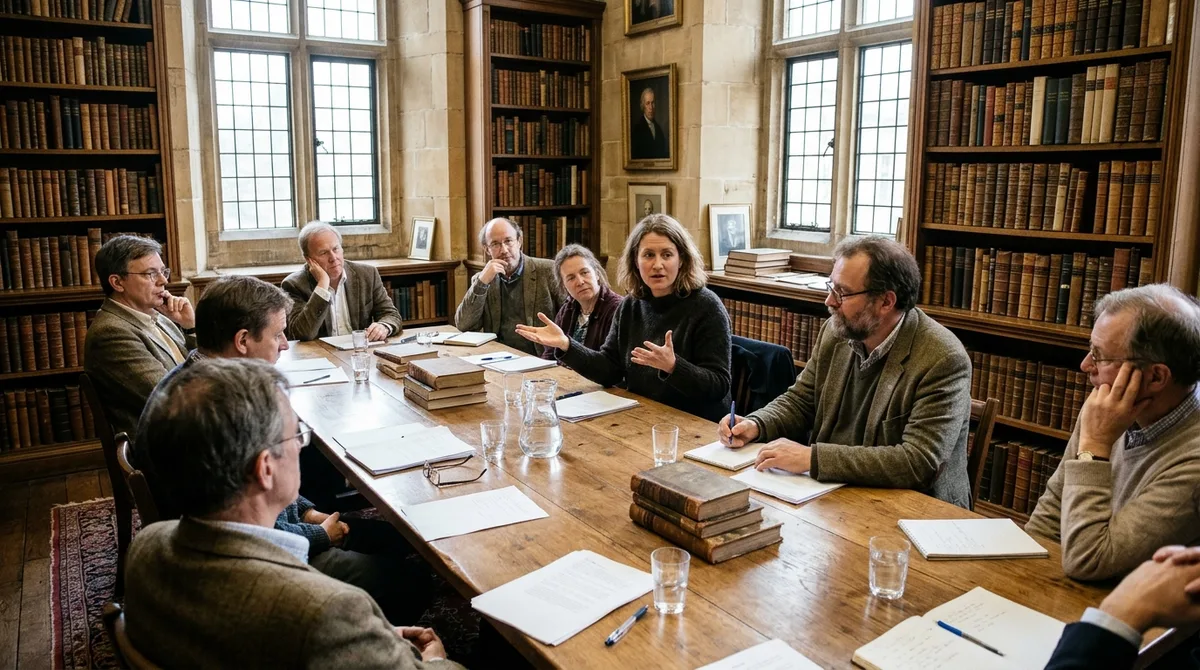
The 14th annual Oxford political philosophy workshop was scheduled for October 22–24, 2026, at Westward Look in Tucson, Arizona, according to the workshop’s conference page. As of November 5, 2026, those dates have passed, so the meeting is now a recent event rather than an upcoming one.
The “Oxford” in the name refers to the Oxford Studies in Political Philosophy series, not the University of Oxford campus. The workshop brings together new work in political philosophy and related areas.
Key Takeaways
- If you plan to submit to the Oxford Studies workshop, make sure your full paper runs 7,000 to 12,000 words including footnotes, opens with an abstract, and is fully anonymized, because papers and abstracts must be anonymous to be considered.
- Your presentation at the 2026 workshop in Tucson does not by itself secure a place in volume 14 of Oxford Studies in Political Philosophy, since selected papers must still pass referee review before Oxford University Press publishes them.
- If you are a junior scholar who submitted to the 2026 meeting, you may be considered for the 2027 Marc Sanders Prize in Political Philosophy, a consideration open to junior scholars.
- Before you rely on venue details for the meeting held October 22 to 24, 2026, check the official workshop page first, because a University of Arizona listing places it in Social Sciences, Room 224 while the official site names Westward Look.
- Your best next step is to watch for the table of contents of volume 14 so you can see which 2026 talks were refereed into published chapters.
Tucson Hosted the 14th Oxford Studies Workshop in October
The workshop’s submission instructions call for full papers of 7,000 to 12,000 words, footnotes included, each opening with an abstract. Papers and abstracts must be fully anonymized for consideration. Selected papers from the 2026 meeting are slated for volume 14 of Oxford Studies in Political Philosophy, a series published by Oxford University Press. If you are a junior scholar who submitted, you may also be considered for the 2027 Marc Sanders Prize in Political Philosophy.
The previous meeting, the 13th, took place at the University of Arizona in Tucson on October 23–25, 2025, with all of its speakers invited. Its accepted-paper titles included “Democracy Beyond Self” and “Two Puzzles of Distributive Justice,” which offer context for the series rather than a preview of the 2026 program.
Conflicting Venue Details for the 2026 Meeting

The workshop’s official site names Westward Look as the venue, while a University of Arizona Department of Philosophy event listing places the meeting in Social Sciences, Room 224. Both sources put the workshop in Tucson, so the disagreement concerns the specific building rather than the city.
If you need exact venue details, check the official workshop page first. You can send factual corrections through the site’s contact form, which is separate from questions about how the workshop’s research should be interpreted.
How Papers Are Submitted and Selected
The format alternates from year to year. In most years, speakers are chosen by blind review, meaning reviewers judge papers without knowing who wrote them. In other years, every speaker is invited instead, as the workshop’s general information describes for the 2025 meeting. A typical program has eight papers, which keeps each year’s schedule fairly compact.
Anonymity affects how you write, not just how you submit. A paper and its abstract must contain nothing that identifies the author, so a self-citation such as “as I argued in my earlier book” would need to be rewritten in neutral terms or removed. Check file names and document properties too, since reviewers see only the text they are asked to assess.
From Workshop Discussion to Published Volume

The workshop’s papers that are selected for publication are planned for a printed place in volume 14 of Oxford Studies in Political Philosophy, a series published by Oxford University Press. A talk at the workshop can therefore lead to a printed chapter. The route is well established: Oxford University Press states that the chapters in volume 11 were first presented at an Oxford Studies workshop in Tucson in October 2023, and referees reviewed them before publication.
Refereeing is the step that separates a presentation from a publication. Being presented at the workshop does not by itself secure a place in the volume, because chapters must still pass that review.
If you submitted to the 2026 workshop as a junior scholar, you may also be considered for the 2027 Marc Sanders Prize in Political Philosophy. This consideration is limited to junior scholars, so senior researchers should not expect the same route.
Research Themes Behind the Series’ Recent Papers
No 2026 paper list is included here, so the titles below come from the 2025 meeting and should be read as context only. That year’s accepted papers included “Democracy Beyond Self,” “Egalitarianism without the Moral Arbitrariness Talent,” and “Two Puzzles of Distributive Justice.” Taken together, they point to questions about democratic authority, equality, and how a society should divide its benefits and burdens.
Two more 2025 titles, “Migration and Social Population” and “Voluntary Statelessness,” turn to a different question: who belongs to a political community, and what happens when that membership is weak or absent. Political membership, in this sense, asks whether citizenship is a right, a privilege, or something a person can give up. Treat these five titles as a picture of last year’s interests, not as a guide to what the 2026 papers argue.
Where to Watch for the Next Steps

Three developments are worth tracking. Selected papers from the 2026 meeting are slated for volume 14 of Oxford Studies in Political Philosophy, so watch for the volume’s table of contents to see which talks became chapters. Junior scholars who submitted may be considered for the 2027 Marc Sanders Prize, and the series’ future workshop announcements will show when the next call opens.
If you spot an error, you can send a correction through the site’s contact form, which also accepts suggested topics. Factual corrections are handled separately from differences in philosophical interpretation, so a disagreement about how an argument should be read is best raised as a question.
Following the Series After Tucson 2026
If you want a concrete next step, pick one 2025 title, such as “Two Puzzles of Distributive Justice,” and write a short note on what you think each puzzle asks. Then compare your note with the workshop’s general information page to see how the series frames its questions.
If you are a junior scholar considering the 2027 Marc Sanders Prize, begin with the abstract, since the submission rules require one. Before you upload, search your draft for self-citations and remove your name from the file’s header and properties.
Finally, bookmark the table of contents for Oxford Studies in Political Philosophy, volume 14. Once it appears, compare its chapters with the talks you read about and note which ones were refereed into print.