
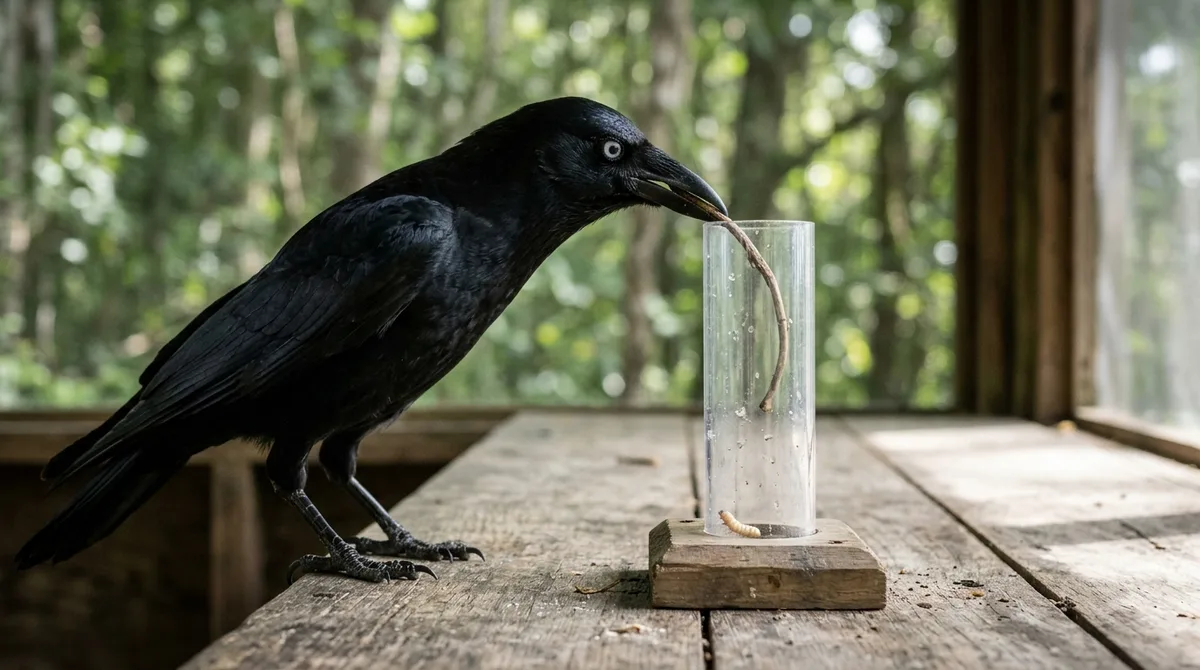
Comparative psychology philosophy asks how to characterize and compare human and nonhuman minds, and how to interpret evidence about animal cognition. Richard Moore, Susana Monsó, and Kristin Andrews published their overview, “The Philosophy of Comparative Psychology,” in Philosophy Compass on September 9, 2026, as volume 21, issue 5.
The authors argue that philosophical concepts should be refined in light of empirical findings, rather than assuming human-centered definitions apply unchanged to other species. That shift changes how you can read claims about animal minds.
Key Takeaways
- Before accepting an animal behavior claim, check whether its evidence comes from field recordings or controlled lab experiments.
- Your reading of a chimpanzee’s choices depends on whether you accept a mentalistic or behavioristic interpretation.
- Animal memory claims should be judged by whether episodic memory differs from human memory in kind or only in degree.
A New Overview Maps the Philosophical Questions
Philosophers have long asked what separates human minds from other minds, but comparative psychology asks that question with real animals in view. The field draws on ecology, ethology, cognitive science, developmental psychology, evolutionary biology, and neuroscience. Because of that mix, a single observation of a bird or primate can raise claims about memory, planning, or belief, and you need careful tools to judge whether those claims hold up.
The overview also stresses that the stakes reach beyond animals. Research on nonhuman minds bears on how human cognition evolved, so comparative psychology speaks to questions about your own thinking as well.
First-Order and Second-Order Questions in Animal Cognition
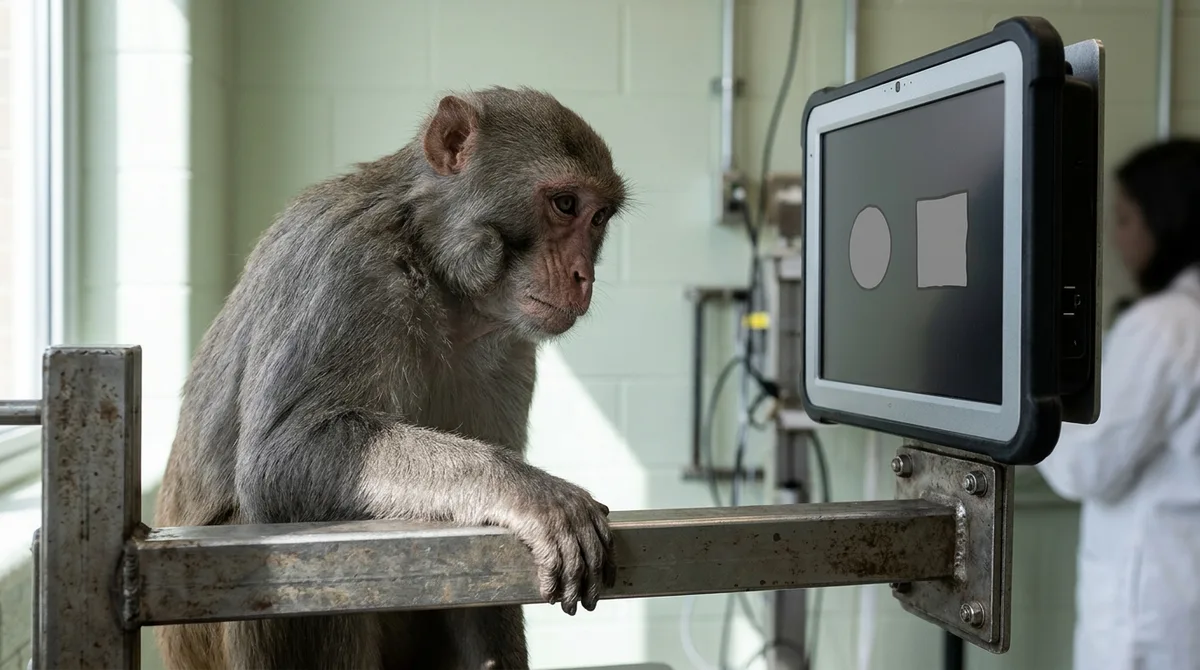
The overview divides the field’s questions into two kinds. First-order questions ask which cognitive traits animals have, which abilities those traits involve, and how they are distributed among species. Episodic memory, the recall of specific past events, offers a test case in chimpanzees and dogs. Do their memories differ in kind from human episodic memory, or only in degree? Second-order questions turn to methods, to how evidence from different studies is combined, and to the empirical limits on philosophical theories. Comparative cognition, in this view, treats humans as animals while recognizing species-specific capacities and individual differences. Here, the approach is to define each term and to treat the chimpanzee and dog case as an illustration of a question, not as an argument for a particular answer.
Field Notes, Recordings, and Lab Experiments as Evidence
The overview lists a wide range of methods for studying animal minds. Field workers use ethograms, which are catalogues of defined behaviors, and ethnographic descriptions of animals in their own surroundings. Camera traps, drone video, and audio recordings capture behavior without constant human presence, and machine-learning analyses can sort the large volumes of data they produce. Field observation can show how chimpanzees use stripped twigs to fish for termites, or how vervet monkeys respond to different alarm calls in their own habitat. Controlled experiments can isolate one variable, such as whether a scrub jay remembers where it hid food, but they may remove the context that made the behavior meaningful. Morgan’s Canon, which holds that a behavior should not be explained by a higher psychological process when a lower one can fairly account for it, adds a further constraint. Some philosophers object that simplicity cannot serve as a universal guide to interpreting animal behavior, so the choice of method is itself a philosophical decision.
The Theory-of-Mind Debate and Morgan’s Canon
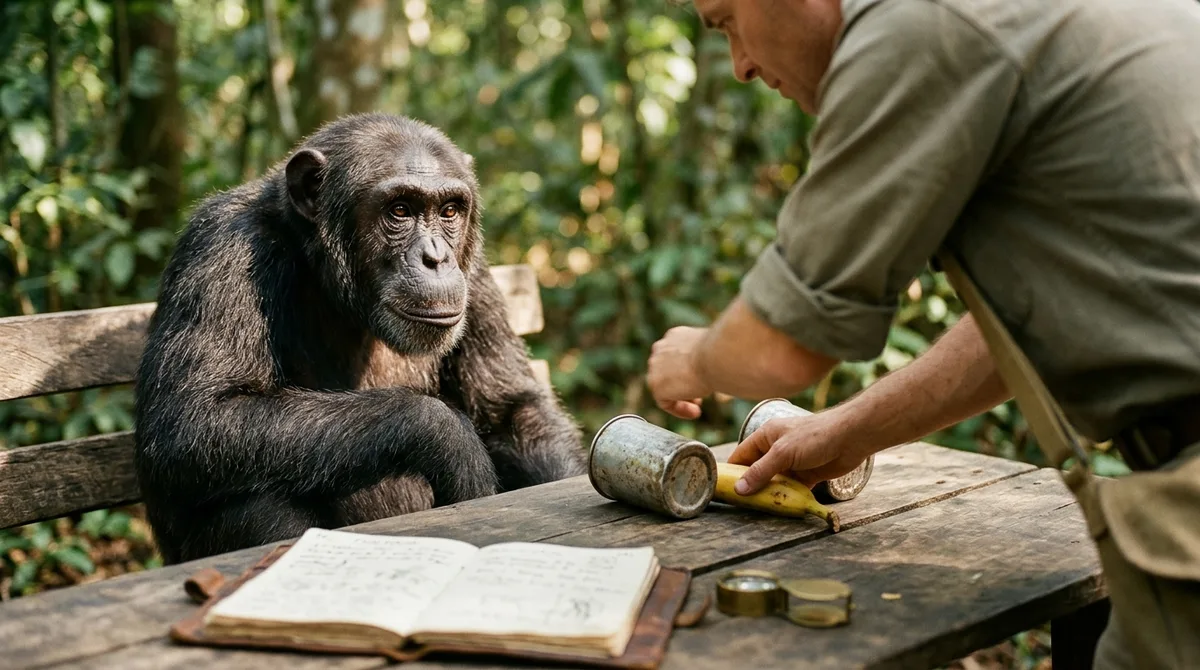
In 1978, David Premack and Guy Woodruff defined theory of mind as the capacity to impute mental states to oneself and others. In their Behavioral and Brain Sciences article, they presented an adult chimpanzee with videotaped problem scenarios and photographs of possible solutions. The debate turns on how to read such a result. A mentalistic reading treats the chimpanzee’s choices as evidence of an inner state, such as a goal or a belief. A behavioristic reading treats them as patterns of response that need no such state. Morgan’s Canon pushes interpreters toward the second reading, because it favors the lower-level explanation when one can fairly account for the behavior. Whether you conclude that the chimpanzee has a mind, or anything like conscious experience, depends on which reading you accept.
From Washburn’s Textbook to Today’s Field
Darwin’s argument that differences between human and animal minds are differences of degree encouraged scientists to take animal mental life seriously. George Romanes applied this idea to animal intelligence, and C. Lloyd Morgan responded with his canon urging restraint in explaining behavior. The overview traces the discipline’s academic beginnings to Margaret Floy Washburn’s textbook The Animal Mind, published in 1908.
Today the field sits between ethology, the study of animal behavior in natural settings, and behavioral ecology, which asks how behavior helps animals survive and reproduce. Researchers increasingly work alongside ecologists, neuroscientists, and developmental psychologists rather than in isolation. That collaboration matters for human cognitive evolution, because comparing chimpanzee or dog abilities with our own helps show which capacities are shared and which may be distinctively human.
Why Practitioners Still Disagree About Parsimony

Practitioners do not even agree on how to apply Morgan’s Canon. According to a practitioner survey published in the Journal of Comparative Psychology in November 2025, respondents generally treated Morgan’s Canon as a parsimony principle, a preference for the simpler explanation of behavior. Yet they did not regard the associative-cognitive distinction as a version of that canon. When a question has several serious answers, this site explains the disagreement rather than offering a single conclusion. For you, the practical step is to check which principle a study invokes before you accept its claim about animal minds. Disagreement of this kind signals an active debate, not a failed field.
What the Overview Means for Thinking About Minds
The overview’s central claim has a practical consequence: concepts such as memory or belief should be defined by what the evidence shows, not by a human template. If that standard holds, the same refinement can sharpen how researchers describe human cognition and how it evolved. Three questions remain open. Do chimpanzee and dog episodic memories differ in kind from human memory? Which version of parsimony should guide interpretation, given that practitioners disagree about Morgan’s Canon? And how should field recordings and controlled experiments be combined into one account? To follow the debate, start with the overview itself, then read recent studies and note which principle each one invokes.
Where the Debate on Animal Minds Goes Next
Pick one recent study on chimpanzee or dog memory and test it against the questions above. Note whether its method is a field recording, a camera trap, or a controlled experiment, and write down which principle its authors invoke. Then check whether they explain why a lower-level explanation fails. If you have questions, feedback, or suggested topics, you can send them through the site’s contact form.