
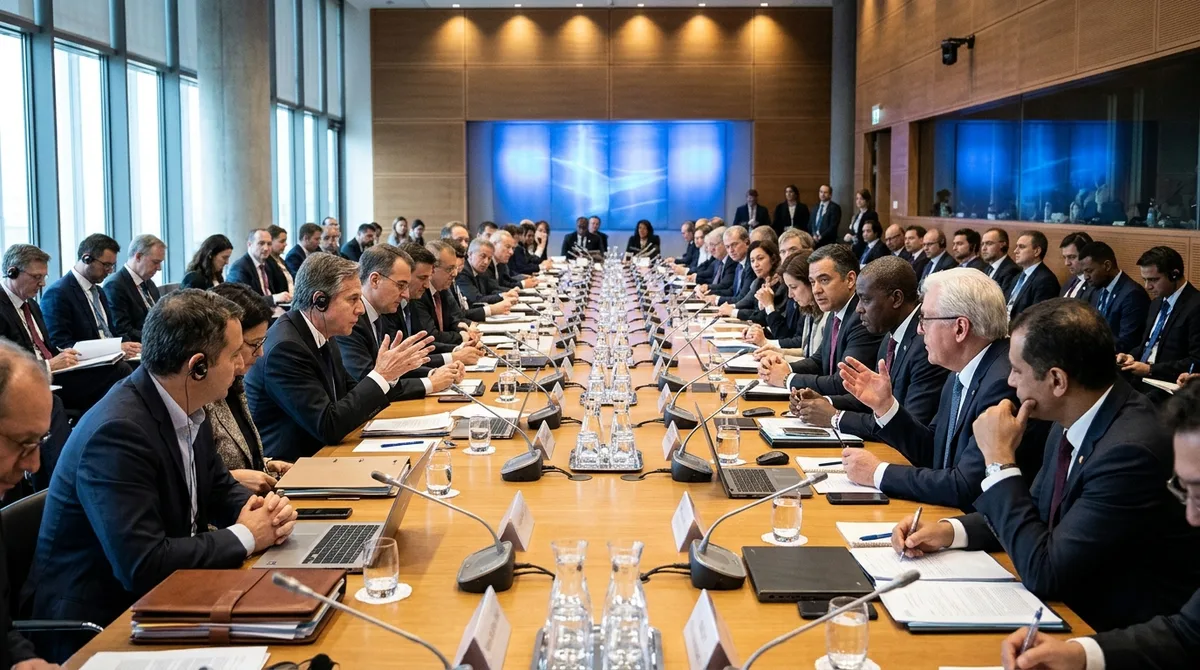
The phrase “AI safety summit 2026” blends several separate events, so you won’t find a single agreement to check. The main 2026 outcomes were a UN forum in Geneva on 6–7 July, a cooperation body founded in Shanghai by 29 countries, and voluntary pledges endorsed by 92 countries and organizations at India’s AI Impact Summit.
If you’re assessing compliance, the firm dates come from law, not summit headlines. The EU’s Regulation (EU) 2026/1744 moved the AI Act’s high-risk rules to 2 December 2027 and 2 August 2028, so knowing which outcomes are binding matters more than the event names.
Key Takeaways
- The UN Global Dialogue’s Co-Chairs’ Summary reflects the chairs’ own observations, not a text that governments negotiated.
- WAICO sets no corporate compliance rules, so your binding duties will come from the national or regional laws where you operate.
- Signing a voluntary pledge like the New Delhi commitments does not create legal obligations, so check what a firm must actually do.
- The AI Act’s prohibitions on generating or manipulating non-consensual intimate material apply from 2 December 2026, so check your tools now.
Which Events Are Behind the AI Safety Summit 2026
The phrase “AI safety summit 2026” usually points to several separate events. The series began with the UK’s gathering at Bletchley Park and continued with a follow-up in Seoul. In 2026, you’ll want to tell apart India’s AI Impact Summit in February, the UN Global Dialogue in Geneva in July, and the Shanghai meetings held that same month.
The distinction matters because each carries different weight. A leader’s speech signals intent, a voluntary declaration records what its signers chose to promise, and a treaty-like agreement sets commitments that parties are expected to honor.
How Many Countries Attended the Geneva Dialogue?

Delegations from 163 countries attended the first UN Global Dialogue on AI Governance, held in Geneva on 6–7 July 2026. More than 3,000 participants took part, including more than 60 ministers.
The event followed an eight-month preparatory process that produced 1,532 unique written submissions. A large turnout suggests that governments and stakeholders care about AI governance, but attendance is not the same as agreement. The Co-Chairs’ Summary records their own observations rather than a negotiated outcome, so sending a delegation did not mean signing on to any specific position.
Is the UN Dialogue a Binding Treaty?
No, the UN Global Dialogue on AI Governance is a recurring forum for discussion, not a treaty negotiation, so it does not create binding obligations for governments. Its Co-Chairs’ Summary records the Co-Chairs’ own observations rather than a negotiated outcome document.
The next session is scheduled for 3–4 May 2027 in New York. Before you treat any summit document as a commitment, check whether governments negotiated its text or whether it is simply a chair’s account of the discussion.
What Did the Shanghai Agreement Create?

The Shanghai agreement created the World Artificial Intelligence Cooperation Organization, or WAICO. On 16 July 2026, representatives of 29 countries signed the agreement in Shanghai, and those countries became its founding members. The Chinese Ministry of Foreign Affairs describes WAICO as an independent intergovernmental organization headquartered in Shanghai. Its stated aims are cooperation, global governance, and AI development that is beneficial, safe, and fair.
Because WAICO is a body that governments join, it sets no corporate compliance rules for businesses. An AI company does not gain a certification or checklist from it, so any binding duties you face will come from the national or regional laws where you operate.
What Voluntary Commitments Came Out of New Delhi?
The New Delhi Declaration on AI Impact, adopted at India’s AI Impact Summit in February 2026, was endorsed by 92 countries and international organizations. It promotes voluntary, non-binding frameworks, so signing it does not create legal obligations. Alongside it, 13 leading model providers signed the New Delhi Frontier AI Impact Commitments. A company pledge tells you what a firm says it will do, while a regulator’s rule tells you what the firm must do. That gap is what you should check before relying on any pledge.
Why Do Experts Split on Existential Risk?

Serious researchers disagree about whether advanced AI could cause catastrophic or even existential harm, and about how soon such harm might arrive. Some argue that systems far more capable than today’s could become hard to control, so the stakes justify early action even under uncertainty. Others warn that fixation on distant scenarios can crowd out present harms, such as fraud, discrimination, and job loss, that already affect people.
Frontier AI risk thresholds are where this debate becomes practical. Developers must decide which capabilities trigger extra testing or restrictions, and that choice is where voluntary pledges meet everyday practice. When you read a company’s threshold, ask what test it uses and who verifies the result.
Which Near-Term Harms Are Getting Attention Now?
Four near-term harms draw the most attention today: misinformation, job change, uneven effects on marginalized communities, and the energy use of AI.
Manipulated images, audio, and video can be produced cheaply, so people may begin doubting authentic evidence as well as fakes. That erosion of public trust is often the harm that matters most.
Job concerns focus less on whole professions than on which tasks AI will reshape, such as drafting, coding, and customer support. Hiring and lending tools trained on past decisions can repeat old discrimination against groups that already face disadvantage.
Energy demand depends on three factors: how much capacity data centers need, how large training runs become, and whether the electricity comes from low-carbon or fossil sources.
Which AI Rules Have Real Compliance Dates?

The only firm compliance dates from 2026 come from law, and the clearest ones are in the EU’s AI Act. Under the amended timetable, the high-risk rules for Annex III systems apply from 2 December 2027, and the rules for Annex I high-risk AI products apply from 2 August 2028. If you run a product in those categories, those are the deadlines to plan around.
Some obligations arrive sooner. The European Commission says the AI Act’s prohibitions on generating or manipulating non-consensual intimate material and child sexual abuse material apply from 2 December 2026, so check whether your tools could fall under them well before the later dates.
The NIST AI Risk Management Framework, published on 26 January 2023, works differently. It is a voluntary US resource for managing AI risks across design, development, use, and evaluation. It carries no legal deadline, but you can use it to structure internal risk controls and documentation.
Reading the Next Round of AI Governance Debates
Start with a simple inventory. List every AI feature your organization builds or uses, and note where each one is deployed. If any of them reaches EU users, mark 2 December 2026 on your calendar and test whether it could generate non-consensual intimate or child sexual abuse material.
Next, compare your hiring and lending tools with the Annex III categories, which face the 2 December 2027 deadline. Then watch the UN’s next session in New York, scheduled for 3–4 May 2027. Read its agenda for proposals, but do not treat anything said there as an obligation.
Frequently Asked Questions
1. Does the EU AI Act apply to companies based outside Europe?
It can, depending on your situation. Whether the Act applies to you depends on where your system is offered and where its outputs are used, not only on where your company is based, so mapping where your users are is a sensible first step.
2. How can a small company begin using the NIST AI Risk Management Framework?
Start with the framework’s four core functions: Govern, Map, Measure, and Manage. Govern covers policies, roles, and accountability, Map records what each AI system does and who it affects, Measure assesses the risks you find, and Manage decides what to fix and what to monitor. A small team can begin with one short page per AI tool that answers these four questions, then add detail as the number of tools grows.
3. Who enforces the EU AI Act if a company breaks its rules?
Enforcement is shared between national authorities and the European Commission. Each EU member state designates its own authorities to supervise AI systems on its market, while the Commission’s AI Office oversees general-purpose AI models directly. Member states also set their own penalty rules under the Act, so the consequences of a breach can differ depending on where you operate.