
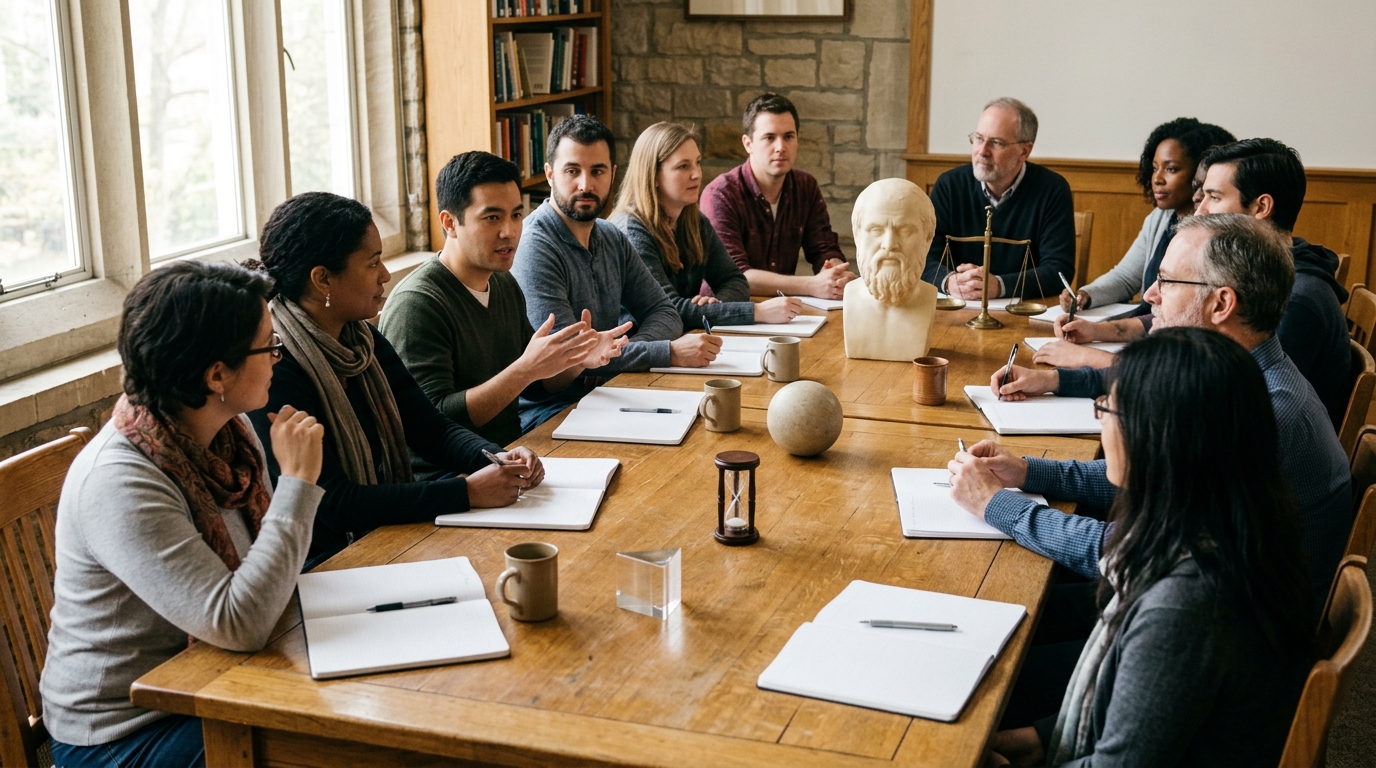
When you search for the philosophy curriculum benchmark 2026, you may expect a single official checklist, but no globally adopted standard currently governs the subject. Instead, frameworks across jurisdictions emphasize overlapping skills: asking precise questions, analyzing arguments, using evidence and logic, and communicating conclusions clearly.
That distinction matters when you are choosing, reviewing, or updating a course. Current guidance emphasizes inquiry, dialogue, cultural breadth, interdisciplinary connections, and applying philosophical reasoning to ethical, political, scientific, technological, and everyday questions. Students should learn not only what thinkers argued, but also how to examine assumptions and revise their own views.
2026
Planning horizon for the cross-jurisdiction philosophy benchmark
7
Shared competencies emphasized across current frameworks
6
Assessment formats that prioritize demonstrated reasoning
0
Single globally mandated philosophy curriculum benchmarks
Quick Facts
- Global standard: No single globally mandated philosophy curriculum benchmark exists for 2026.
- Shared competencies: Current frameworks converge around 7 competencies: philosophical questioning, argument evaluation, logical reasoning, cultural comparison, applied ethics, communication, and reflective revision.
- Assessment formats: The benchmark identifies 6 assessment formats that prioritize demonstrated reasoning over memorization, including essays, dialogue, argument maps, case analyses, portfolios, and revised position statements.
- Planning horizon: The article presents 2026 as a planning horizon for a cross-jurisdiction philosophy benchmark rather than as the start of a universal syllabus.
Key Takeaways
- There is no single globally mandated Philosophy Curriculum Benchmark for 2026; use a cross-jurisdiction framework to compare local curricula and requirements rather than treating it as a universal syllabus.
- Strong philosophy programs develop seven competencies: asking and refining questions, evaluating arguments, using logic and evidence, comparing cultural traditions, applying philosophy to real-world issues, communicating clearly, and revising positions reflectively.
- Assessment should prioritize demonstrated reasoning over memorization through essays, dialogue, argument maps, case analyses, portfolios, and revised position statements that show evidence use, respectful disagreement, and intellectual self-correction.
- A modern curriculum should connect philosophy with ethics, politics, science, technology, civics, and everyday decisions while representing diverse traditions and making expectations visible in both instruction and assessment.
Philosophy Curriculum Benchmark 2026
No single globally adopted Philosophy Curriculum Benchmark exists, but current frameworks converge around seven competencies: philosophical questioning, argument evaluation, logical reasoning, cultural comparison, applied ethics, communication, and reflective revision. This emerging standard places less emphasis on memorizing a chronological sequence of Western philosophers and more on inquiry, dialogue, cultural breadth, and real-world application. As an educator or program planner, your key question is not simply whether philosophy appears in a curriculum, but what students are expected to think, discuss, write, and revise.
A useful comparison examines required subjects, reasoning skills, ethical decision-making, and interdisciplinary coverage alongside named content. A strong framework should show how students develop questions, construct and test arguments, use evidence, compare traditions fairly, and apply philosophical ideas to political, scientific, technological, and everyday problems. It should also make communication and self-correction visible in classroom tasks and examinations, rather than treating them as assumed outcomes. This approach helps you distinguish a curriculum built around active philosophical practice from one focused primarily on recall.
This comparison examines official curricula and examination frameworks to clarify how these competencies are defined, taught, and assessed in different settings. You can review learning outcomes, required areas of study, assessment formats, cultural representation, and links with subjects such as science, citizenship, literature, and technology. Use the comparison as a practical planning tool to identify alignments, gaps, and opportunities for curriculum development. Because frameworks vary by jurisdiction and institution, the benchmark should serve as a common reference point rather than replace local requirements.
Seven Shared Philosophy Competencies

For 2026 planning, treat these seven competencies as a practical cross-jurisdiction benchmark rather than a single mandated syllabus. You can use them to compare whether a course develops inquiry, reasoning, applied ethics, intercultural understanding, communication, and intellectual self-correction. The indicators below translate broad curriculum aims into observable evidence from student questions, arguments, discussions, essays, source use, and position revisions. They draw on philosophy and critical-thinking expectations published by examination boards, regional authorities, and national curriculum bodies.
| Competency | Concise performance indicator and assessment evidence | Relevant source |
|---|---|---|
| Ask and refine philosophical questions | Frames a clear, open-ended question, explains its assumptions, and improves it after discussion or feedback. | Official philosophy curriculum guidance, 2024 |
| Construct, analyze, and evaluate arguments | Identifies premises and conclusions, tests validity and strength, and presents a defensible argument in speech or writing. | Examination specification for philosophy, 2025 |
| Use logic, evidence, and reasoning | Distinguishes reasons from assertions, selects relevant philosophical or empirical evidence, and explains how the evidence supports a claim. | National critical and creative thinking guidance, 2022 |
| Compare perspectives across cultures and traditions | Accurately represents contrasting viewpoints, avoids caricature, and uses comparison to deepen rather than simply rank positions. | Official philosophy curriculum guidance, 2024 |
| Apply philosophy to real-world issues | Uses philosophical concepts to analyze an ethical, political, scientific, technological, or everyday case and considers consequences. | Regional social sciences and humanities curriculum, 2013 |
| Communicate through dialogue and writing | Contributes constructively to discussion and produces an organized essay that defines terms, develops reasons, addresses objections, and reaches a justified conclusion. | Examination specification for philosophy, 2025 |
| Reflect and revise a position | States an initial view, responds to counterarguments or new evidence, and explains precisely what changed, stayed constant, and why. | National critical and creative thinking guidance, 2022 |
You can assess the benchmark with a portfolio that combines a question log, an argument map, seminar observations, an evidence-based essay, and a revised position statement. This approach rewards the quality of a student’s reasoning process, not only the fluency of a final answer. When comparing programs, check whether assessment measures all seven competencies across ethical, political, scientific, technological, and everyday contexts, rather than concentrating on content recall. A strong 2026 curriculum should also make its criteria visible, so students can see how questioning, evidence use, respectful disagreement, and revision contribute to achievement.
Curriculum Framework Comparison
For 2026 planning, you can treat a philosophy curriculum benchmark as a comparison tool rather than a single global standard. Dedicated courses usually make argument analysis, philosophical writing, logic, and conceptual inquiry explicit, while embedded models place those skills inside humanities, citizenship, ethics, or religious studies. The key question is not only whether philosophy appears in the timetable, but whether students are required to formulate questions, evaluate evidence, compare perspectives, and apply reasoning to real issues. The source-linked comparison below distinguishes compulsory provision from optional courses and separates formal examination from teacher-designed assessment.
| Framework or course | Required subject, level, and status | Assessment and reasoning skills | Canonical content and tradition balance |
|---|---|---|---|
| International upper-secondary philosophy course (2024) | Dedicated philosophy course for upper-secondary students, normally ages 16 to 19; elective within the program. | External examinations and an internally assessed component; emphasizes questions, arguments, analysis, evaluation, and clear written communication. | Organized around philosophical themes, problems, and selected thinkers. Teachers can broaden coverage beyond the Western tradition, but Indigenous representation is not a uniform course requirement. |
| National citizenship programs of study (2014) | Statutory citizenship subject across several school stages, with implementation determined by schools. Philosophy is embedded rather than offered as a dedicated course. | Class discussion, research, debate, and written work are common school-level methods. The national framework does not prescribe one philosophy examination. | Focuses on democracy, rights, law, government, and participation. Ethical and political reasoning is present, while non-Western and Indigenous philosophical traditions are not systematically prescribed. |
| National civics and citizenship curriculum (2022) | Embedded humanities and social sciences curriculum for school years 7 to 10; not a standalone philosophy subject. | School-based assessment uses inquiry, source analysis, discussion, and communication tasks. Reasoning is applied to civic institutions, values, and public issues. | Includes democratic concepts and an Indigenous cross-curriculum priority, but does not require a balanced survey of Western, non-Western, and Indigenous philosophical systems. |
| Regional religious education guidance (2010) | Religious education is required through locally determined syllabuses, including at secondary level. Philosophy and ethics are embedded unevenly. | Assessment methods and depth vary by syllabus and school, with opportunities for interpretation, ethical reasoning, dialogue, and reflection rather than one national model. | Requires attention to Christianity and other religions and worldviews, while the treatment of non-religious, non-Western, and Indigenous traditions depends on the locally agreed syllabus. |
When you use this benchmark, look for the difference between nominal coverage and assessed performance. A humanities or religious studies framework may introduce ethical questions without requiring students to build valid arguments or engage directly with philosophical texts. Conversely, a dedicated course may provide stronger progression in reasoning but still rely heavily on a Western canon unless its syllabus deliberately includes non-Western and Indigenous perspectives. For a balanced 2026 evaluation, compare required subjects, grade-level access, course status, assessment evidence, applied ethics, interdisciplinary links, and opportunities for students to revise their views through dialogue. The strongest framework is the one that makes those expectations visible in both curriculum documents and student work.
Applied Ethics And Interdisciplinary Coverage

An applied ethics benchmark should show how philosophy helps you examine technology, artificial intelligence, science, climate change, medicine, politics, media literacy, justice, and everyday choices. Rather than rewarding memorization, assess whether students can identify the values, assumptions, stakeholders, and likely consequences within a real problem. A strong case analysis might ask whether an automated system is fair, how medical consent should work, or what obligations people have during a climate crisis. You can compare programs by checking whether these cases invite culturally diverse perspectives and require students to connect abstract principles with evidence and lived experience.
Ethical deliberation provides a practical measure of reasoning in action. Give students a contested scenario, ask them to clarify the central question, present competing arguments, test objections, and revise their conclusions when the evidence or principles change. Your benchmark can examine whether students distinguish facts from value judgments, recognize uncertainty, and justify decisions without treating personal opinion as sufficient support. This approach also makes everyday decision-making part of philosophical learning, from responsible media use to choices about privacy, consumption, health, and civic participation.
Interdisciplinary projects can reveal whether students transfer philosophical reasoning beyond the classroom. You might pair philosophy with computer science to evaluate algorithmic bias, with environmental science to debate responsibility for emissions, or with civics and history to investigate justice and political power. Assess both the quality of the inquiry and the clarity of the final written or spoken argument, including the use of evidence, accurate interpretation of opposing views, logical structure, and thoughtful reflection. When you compare curricula, look for repeated opportunities to deliberate, collaborate, communicate, and apply philosophical ideas to problems that matter in public life.
Benchmark Scoring And Source Methodology
The 2026 benchmark uses a consistent rubric to compare curriculum frameworks without treating any one national model as the global standard. You can assess philosophical knowledge, reasoning skills, dialogue, cultural diversity, applied ethics, interdisciplinary learning, and assessment quality against shared performance descriptions, ranging from no clear evidence to explicit, embedded provision. Each rating is based on what a framework requires learners to know, do, discuss, and demonstrate, rather than on its title or reputation. This approach helps you distinguish a curriculum that mentions philosophy from one that builds sustained inquiry, argument analysis, ethical judgment, and reflective communication into learning.
The evidence base is compiled from dated primary sources, including official curriculum documents, examination specifications, and education authority webpages. For every recorded claim or statistic, the benchmark identifies the source type, publication date, and direct reference, while noting the relevant section, page, or webpage heading so you can verify the interpretation. Where documents differ by jurisdiction, age group, qualification, or implementation status, those distinctions remain visible instead of being merged into a misleading average. Undated summaries, promotional descriptions, and unsupported commentary are excluded from the core scoring evidence.
You can therefore read each result as an evidence-led comparison, not as a claim that one framework is universally best. Scores are assigned only when the source shows a clear expectation, learning outcome, examination requirement, or assessment method, and missing evidence is reported as unverified rather than assumed absent. The method also separates curriculum intention from assessment coverage, allowing you to see whether reasoning, dialogue, diverse traditions, applied ethics, and interdisciplinary work are actually evaluated. This makes the benchmark useful when you are reviewing required subjects, planning a program, or deciding which framework best supports inquiry-based and culturally inclusive philosophy education.
Philosophy Curriculum Benchmark 2026 Outlook

The philosophy curriculum benchmark 2026 should be understood as a shift from memorizing philosopher timelines to demonstrating transferable inquiry skills. You should expect a stronger program to help students formulate and refine questions, construct and evaluate arguments, use evidence and logic, and communicate positions clearly in speech and writing. It should also invite comparison across cultural and intellectual traditions, rather than presenting philosophy as a single Western succession of thinkers. This emphasis on dialogue, critical reflection, and plural perspectives supports education that develops cooperation, peace, and respect for diversity.
A useful benchmark also connects philosophical reasoning to questions students recognize from public life, science, technology, politics, and everyday decisions. You can assess a curriculum by looking beyond its reading list and asking whether learners regularly investigate problems, test assumptions, respond to opposing views, and revise their conclusions. The comparison below turns those expectations into observable evidence, making it easier to distinguish content coverage from genuine philosophical learning. It also reflects the broader priority of developing knowledge, skills, values, and attitudes together.
| Benchmark area | Evidence in a strong program | Review question |
|---|---|---|
| Inquiry and reasoning | Student-generated questions, argument analysis, evidence-based conclusions | Do students explain how they reached a position? |
| Dialogue and communication | Structured discussion, listening, respectful disagreement, clear writing | Can students respond to and improve an opposing argument? |
| Cultural and intellectual breadth | Multiple traditions, perspectives, contexts, and voices | Whose assumptions and experiences are represented? |
| Application and reflection | Ethical, political, scientific, technological, and everyday case studies | Do students apply ideas and reconsider their own views? |
Use the table as an audit tool rather than a checklist that rewards superficial inclusion. Map each row against your required subjects, units, assignments, discussion routines, and assessment criteria, then mark where evidence is strong, occasional, or missing. Gaps may reveal an overreliance on historical recall, limited cultural coverage, weak attention to applied ethics, or too few opportunities for students to revise their thinking. From there, plan a stronger curriculum by pairing essential philosophical knowledge with recurring inquiry, dialogue, argument practice, and real-world application. A program that makes those competencies visible will be better prepared for the philosophy curriculum benchmark 2026 and more useful to both students and educators.
Build a Practical Philosophy Curriculum Benchmark
The philosophy curriculum benchmark 2026 is best understood as a practical comparison framework, not a single globally mandated syllabus. Since philosophy education is shaped by national, regional, examination, and school-level standards, you should compare what each program expects students to know and do rather than search for one universal course outline. A strong benchmark gives clear weight to philosophical questioning, argument analysis, logic, evidence, and reflective discussion. It also considers whether students encounter diverse philosophical traditions and apply ideas to ethical, political, scientific, technological, and everyday problems. This broader focus reflects the shift toward inquiry-based and real-world learning rather than memorizing a fixed history of thinkers.
When you evaluate a curriculum, look for balanced evidence in course requirements, classroom activities, writing tasks, dialogue, and assessment criteria. You should be able to see how students build and revise positions, respond to objections, distinguish reasons from opinions, and communicate with clarity and intellectual humility. The most useful benchmark also reveals whether philosophy connects meaningfully with subjects such as science, civics, literature, technology, and environmental studies. Used this way, the philosophy curriculum benchmark 2026 helps you identify programs that develop transferable reasoning skills while preserving philosophy’s depth, cultural range, and ethical purpose.
Frequently Asked Questions
1. What is the philosophy curriculum benchmark 2026?
The philosophy curriculum benchmark 2026 is not a single globally mandated checklist. It is an emerging reference point based on shared priorities across current frameworks, including philosophical questioning, argument evaluation, logical reasoning, cultural comparison, applied ethics, communication, and reflective revision.
2. Is there an official global standard for philosophy curricula in 2026?
No globally adopted standard currently governs philosophy education. You should compare recognized frameworks and adapt their common principles to your learners, educational context, and institutional goals.
3. What skills should students develop in a 2026 philosophy curriculum?
Students should learn to ask precise questions, identify assumptions, analyze arguments, evaluate evidence, and use logic carefully. They should also communicate conclusions clearly, engage respectfully in dialogue, compare perspectives across cultures, and revise their views when stronger reasons or evidence emerge.
4. How should philosophy curricula address cultural diversity?
A strong curriculum should move beyond a predominantly chronological study of Western philosophers and include diverse philosophical traditions and voices. You can help students compare ideas across cultures while examining how historical, social, and linguistic contexts shape philosophical questions and answers.
5. Which real-world topics belong in a modern philosophy curriculum?
Students should apply philosophical reasoning to ethical, political, scientific, technological, and everyday questions. Topics might include artificial intelligence, climate responsibility, justice, personal freedom, medical decisions, knowledge, and the responsible use of evidence.
6. How can you assess student learning in philosophy?
Assess students on the quality of their questions, reasoning, evidence, argument structure, listening, and ability to respond to alternative views. Useful tasks include philosophical essays, structured discussions, argument maps, case analyses, presentations, and reflective writing that shows how a student’s position developed.
7. Does a philosophy curriculum need to follow a fixed list of thinkers?
No, a fixed sequence of thinkers is not essential for meeting the strongest 2026 priorities. You can use major philosophers as resources for inquiry, but the central goal should be helping students examine assumptions, compare arguments, apply ideas, and form justified conclusions.
8. How can you update an existing philosophy course for 2026?
Begin by mapping your current learning outcomes against the seven core competencies: questioning, argument evaluation, logical reasoning, cultural comparison, applied ethics, communication, and reflective revision. Then add more dialogue-based inquiry, culturally diverse materials, interdisciplinary topics, and assessments that measure reasoning rather than memorization alone.