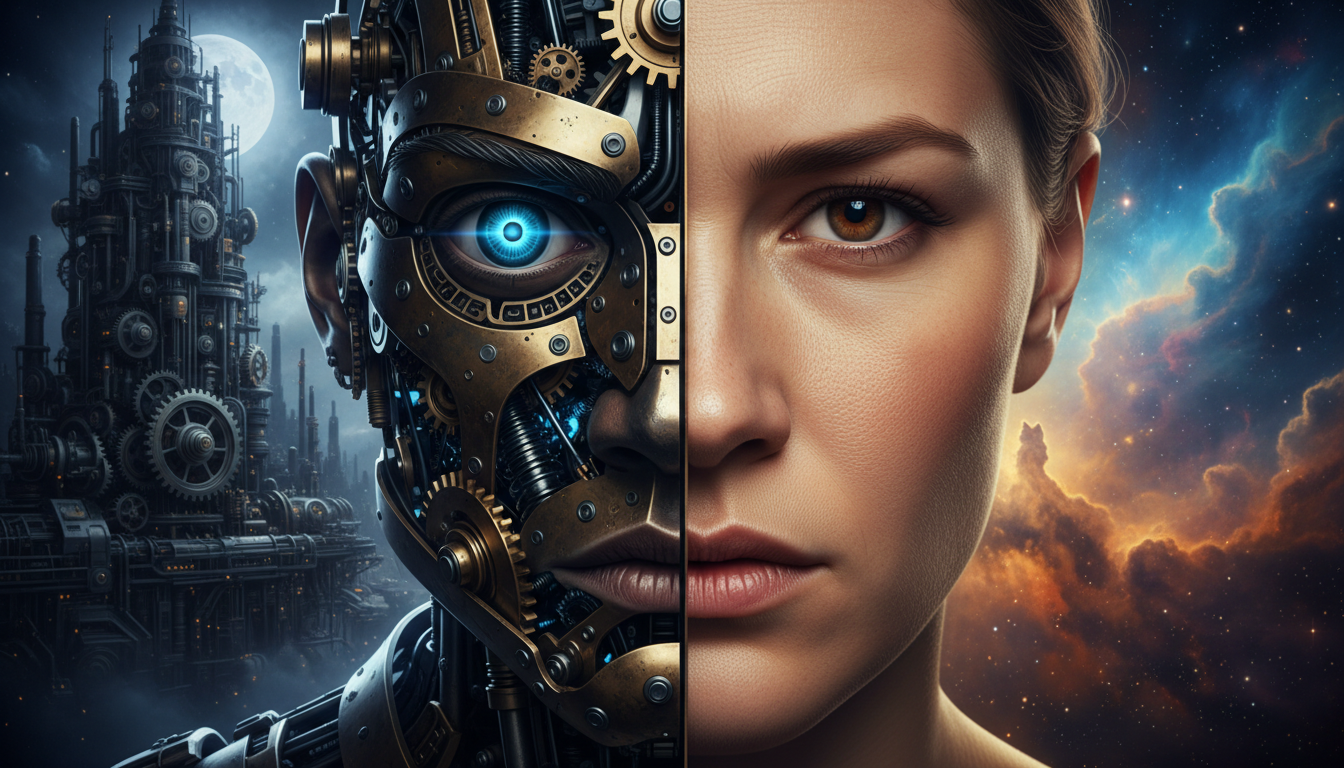

When you look at a clock, you likely feel that only this exact moment truly exists. Yesterday is just a collection of fading memories, and tomorrow is nothing more than a blank page waiting to be written. This incredibly intuitive way of experiencing reality sits at the center of the philosophical debate over presentism vs eternalism. While your daily life revolves around the fleeting nature of “now,” modern physics suggests that your perception of time might actually be a persistent illusion.
Under the presentist view, reality is a razor-thin edge of existence where the past has completely vanished and the future remains entirely unformed. Conversely, the eternalist model treats time as a vast, four-dimensional block where every moment, from your earliest childhood memory to your distant future, is equally real and permanently fixed. Grappling with these two fundamentally different frameworks challenges your deepest assumptions about reality, offering a profound glimpse into the true fabric of the universe.
Key Takeaways
- Presentism reflects the intuitive human experience where only the current moment physically exists, treating the past as permanently gone and the future as entirely unwritten.
- Modern physics and Einstein’s theory of relativity heavily favor eternalism, modeling the universe as a four-dimensional block where past, present, and future exist simultaneously.
- Because the passage of time changes based on an observer’s speed, the concept of a universal, shared ‘now’ is actually a subjective illusion created by human consciousness.
- While a scientifically fixed timeline forces a shift in perspective, it offers the profound comfort that your actions and past experiences remain a permanent, indestructible part of the cosmos.
Presentism And The Intuitive Flow Of Time
When you look at a clock or watch a sunset, you are experiencing the universe exactly as the philosophy of presentism describes it. This highly intuitive view argues that only the current moment physically exists in reality. According to this model, the fleeting second you are experiencing right now is the entirety of the tangible cosmos. Everything that happened yesterday has completely vanished from physical existence, while tomorrow remains an entirely unwritten concept. You naturally live your life through this lens, treating the present as a sharp edge moving steadily forward and leaving nothing behind.
There is something deeply comforting about believing your past mistakes are truly gone and your future remains completely in your hands. Presentism gives your daily choices profound weight because you are actively forging reality as you move through time. However, this comforting perspective hits a major philosophical roadblock when you introduce modern physics into the conversation. The rival theory of eternalism suggests that the past, present, and future all exist simultaneously in a grand four-dimensional block of spacetime. While science heavily favors that rigid block universe model, giving up the familiar flow of presentism requires a massive leap of imagination that defies everything your senses tell you.
Eternalism And The Block Universe Model

If you trust your everyday experience, you likely believe that only the present moment truly exists while the past is gone and the future is unwritten. This intuitive perspective is known as presentism, and it feels entirely natural to our human minds. However, modern physics suggests a much more mind-bending reality called eternalism. Under this fascinating philosophical framework, the passage of time is essentially an illusion created by your consciousness. Instead of a moving spotlight that only illuminates the current second, eternalism proposes that every moment in time is equally real and permanent.
To visualize this strange concept, you have to picture the entire cosmos as a massive, fixed four-dimensional structure known as the block universe. Within this rigid block, all of space and time are fused together into a single unchanging whole. Your birth, your current act of reading this article, and your distant future all exist simultaneously at different coordinates within this massive geometric space. In the block universe model, the concept of “now” is merely a subjective vantage point, much like how the word “here” describes a physical location. Just as a city does not cease to exist simply because you drive away from it, your past and future remain entirely intact and physically real within the fabric of spacetime.
Einstein And The Physics Of Time
You likely navigate your daily life assuming that only the current moment actually exists, a practical viewpoint philosophers call presentism. This intuitive model treats the past as gone forever and the future as completely unwritten. However, Albert Einstein shattered this comfortable illusion when he introduced his theory of Special Relativity in 1905. By proving that the speed of light is constant for everyone, he revealed that time is not a universal ticking clock that we all share. Instead, your experience of time depends entirely on how fast you are moving through space relative to the people and objects around you.
Because motion alters the flow of time, two observers traveling at different speeds will completely disagree on which events are happening right now. If you were flying through the cosmos in a high-speed rocket, your present moment would actually encompass events that a person standing on Earth considers to be in the distant past or the far future. This breakdown of a shared present poses a massive problem for presentism, since physics cannot point to a single objective “now” that applies to the entire universe. Consequently, modern physics heavily favors eternalism, which is a mind-bending model often referred to as the block universe. Under this scientific framework, everything that has ever happened or will ever happen exists simultaneously within a vast four-dimensional structure.
Grasping this eternalist perspective requires a massive shift in how you view your own reality. Your birth, your current act of reading these words, and your ultimate future are all equally real coordinates fixed permanently in the fabric of spacetime. The sensation of time flowing forward is merely a subjective illusion created by your brain as it processes these static moments in sequence. While this concept might feel unsettling at first, it offers a beautifully profound way to understand your place in the cosmos. Rather than vanishing into nothingness, every fleeting second of your life remains a permanent and indestructible part of the universe.
Finding Your Place in Time’s Grand Puzzle
As you step back to look at the grand puzzle of time, the debate between presentism and eternalism offers two radically different ways to understand your existence. If you lean toward presentism, you live in a universe where only the exact moment you are experiencing right now is truly real. The past is a collection of memories that have faded into nothingness, and the future is an unwritten blank slate waiting for your actions. This perspective validates your everyday intuition, giving immense weight to your choices because they actively shape the only reality that exists. It places you firmly at the cutting edge of the cosmos, carving out existence one second at a time.
On the other hand, adopting the eternalist view requires you to stretch your imagination and align your thinking with modern physics. In this block universe model, your entire life is permanently etched into the fabric of spacetime alongside the birth of stars and the end of the universe. Every embarrassing mistake from your childhood and every triumph waiting in your later years exists just as vividly as the words you are reading right now. Time becomes a vast expanse you are simply traveling through, making your current sense of the present nothing more than a subjective marker of your location. While this might feel initially unsettling, it also offers a profound sense of permanence, knowing that your best moments are never truly lost to the past.
Deciding between these two philosophical frameworks forces you to question the very nature of your reality. You must weigh the undeniable feeling of a moving present against the elegant mathematical models that suggest a static, all-encompassing universe. Perhaps the truth lies somewhere in the complex intersection of human consciousness and the physical laws governing our world. Whichever model you choose to believe, this metaphysical exploration leaves you with a deeply enriched perspective on life. As you go about your day, you are left to ponder whether you are actively building the future or simply discovering a cosmic timeline that was always waiting for you.
Frequently Asked Questions
1. What is the main difference between presentism and eternalism?
Presentism argues that only the exact moment you are experiencing right now physically exists. Eternalism treats time as a massive four-dimensional block where your past, present, and future are all equally real and permanent. These two frameworks offer completely opposite ways of understanding how reality actually functions.
2. Why does presentism feel so natural to you?
Your brain naturally processes reality as a continuous flow of current moments. When you make a decision or watch a sunset, you experience it in real time while your memories of yesterday naturally fade. This makes the presentist view incredibly intuitive because it perfectly matches how you navigate your daily life.
3. How does the eternalist model view your past and future?
Under the eternalist model, your earliest childhood memories and your distant future exist just as solidly as the present moment. Time is viewed as a vast territory that has already been mapped out in its entirety. This means the events of yesterday have not vanished, and the events of tomorrow are already fixed in place.
4. Does modern physics favor presentism or eternalism?
Modern physics actually leans heavily toward eternalism. Scientific theories like general relativity suggest that your perception of a flowing present is just a persistent illusion. Instead, the universe seems to function as a static block where all moments in time exist simultaneously.
5. Do your choices still matter if eternalism is true?
It is easy to worry that a fixed future makes your decisions meaningless, but your choices are still a vital part of the timeline. Even if the future already exists in a four-dimensional block, your actions right now are exactly what create those future moments. You are still the active author of your life, just within a broader physical framework.
6. Why is it important to understand these two philosophies of time?
Grappling with these concepts challenges your deepest assumptions about how the universe works. Exploring the true fabric of reality helps you appreciate the profound nature of your existence. It also allows you to find comfort in knowing that your past experiences might never truly disappear.
7. Can presentism and eternalism both be true at the same time?
These two models are fundamentally opposed, meaning they cannot both be physically true in the same way. However, you can intellectually accept eternalism as a scientific reality while continuing to live your daily life through the intuitive lens of presentism. This allows you to navigate the world comfortably while holding a deeper understanding of the cosmos.