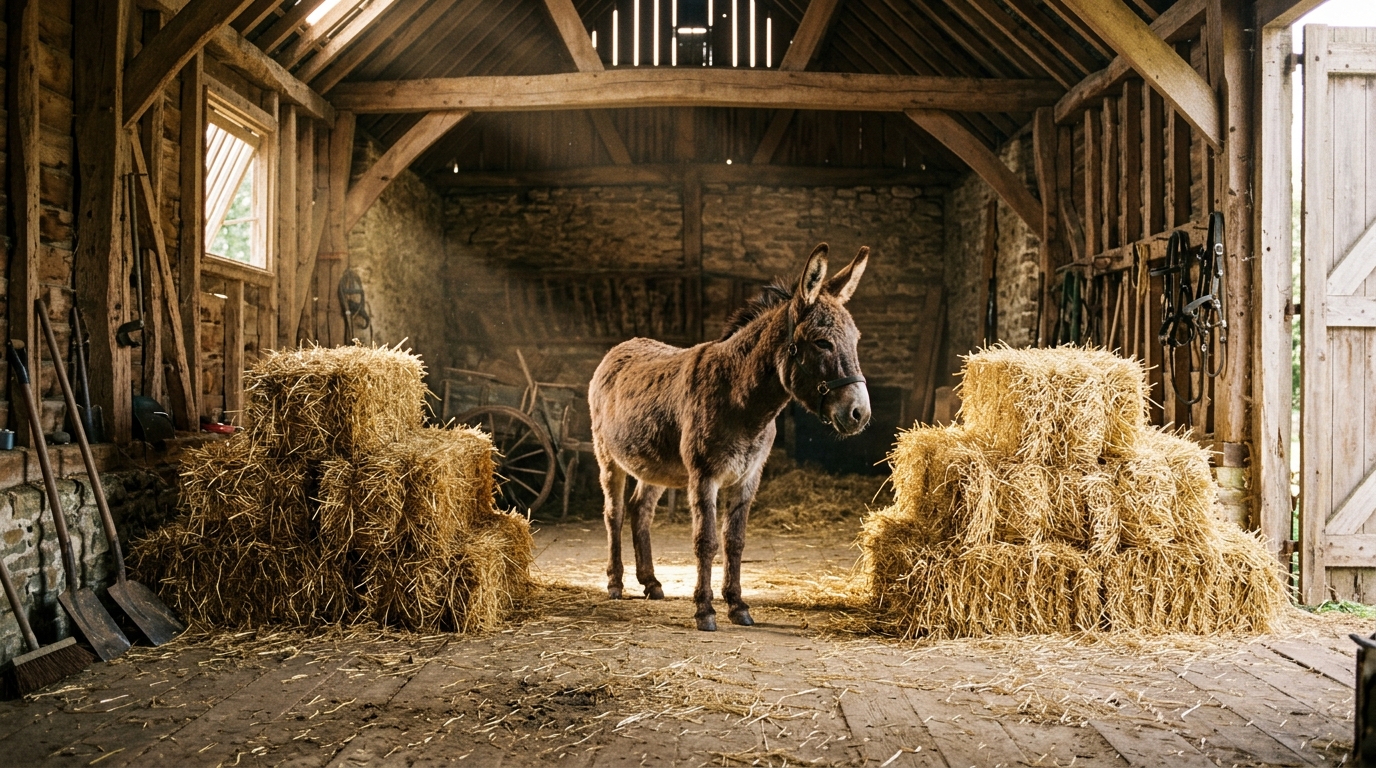
Imagine you are standing in a grocery aisle, staring at two identical jars of pasta sauce, unable to move because you cannot find a single logical reason to pick one over the other. This mental gridlock is the core of the buridans ass paradox, a classic philosophical thought experiment that illustrates the hidden dangers of perfect rationality. While it sounds like a simple quirk of indecision, the paradox suggests that without a clear preference, a purely rational being might remain frozen forever, unable to act.
You might think you are immune to such dramatic stagnation, but this dilemma touches on how you navigate every choice in your life. The story describes a donkey placed exactly between a stack of hay and a pail of water, eventually perishing from both hunger and thirst because it cannot choose a starting point. By exploring this scenario, you gain a deeper understanding of the tension between logic and the spontaneous will required to simply move forward.
Key Takeaways
- Pure rationality can lead to terminal indecision if you wait for a logical tie-breaker between two equally attractive options.
- Human agency is defined by the ‘will,’ an autonomous power that allows you to break a deadlock through spontaneous or arbitrary choice when logic reaches its limit.
- The ability to make a random decision is often more vital than finding a perfect one, as the act of moving forward prevents the stagnation of analysis paralysis.
- Relying strictly on moral determinism—the idea that one must always choose the ‘greater good’—results in a total failure of action when faced with balanced alternatives.
The Fatal Dilemma Of Jean Buridan’s Donkey
Imagine you are standing perfectly centered between two identical, mouth-watering meals after a long day of fasting. To your left is a gourmet feast, and to your right is an equally enticing spread, both placed at the exact same distance from where you stand. According to the logic of moral determinism, you would be forced to choose the “greater good,” but since these options are perfectly equal, your rational mind finds no reason to move toward one over the other. This is the essence of the paradox named after Jean Buridan, where a hypothetical donkey finds itself equidistant from a stack of hay and a bucket of water. Because the poor animal is driven by two equal and opposite desires, it remains frozen in a state of terminal indecision, eventually perishing from both hunger and thirst.
While the story is famously attached to Jean Buridan, you might be surprised to learn that this specific donkey never actually appeared in his surviving manuscripts. The scenario was likely invented by his intellectual rivals as a clever way to satirize his views on human choice and the limitations of reason. These critics wanted to show that if we always wait for a rational reason to act, we might become as paralyzed as a mindless beast when faced with balanced alternatives. By placing you in the shoes of the donkey, the paradox forces you to confront whether your own free will is truly independent or if you are simply a machine waiting for a logical nudge to move.
This thought experiment serves as a powerful reminder that the ability to make an arbitrary choice is often more vital than the ability to make a perfect one. If you lived strictly by the rules of Buridan’s critics, any moment of equal preference would lead to a total breakdown of your agency. Instead, this dilemma highlights the importance of the “will” as something that can transcend pure logic to break a stalemate. By exploring this fatal dilemma, you can see how 14th century philosophy still speaks to your modern struggles with overthinking and the fear of making the wrong move. Understanding this paradox helps you appreciate that sometimes the most rational thing you can do is simply pick a side and start walking.
Aristotle And Al-Ghazali On Rational Indifference
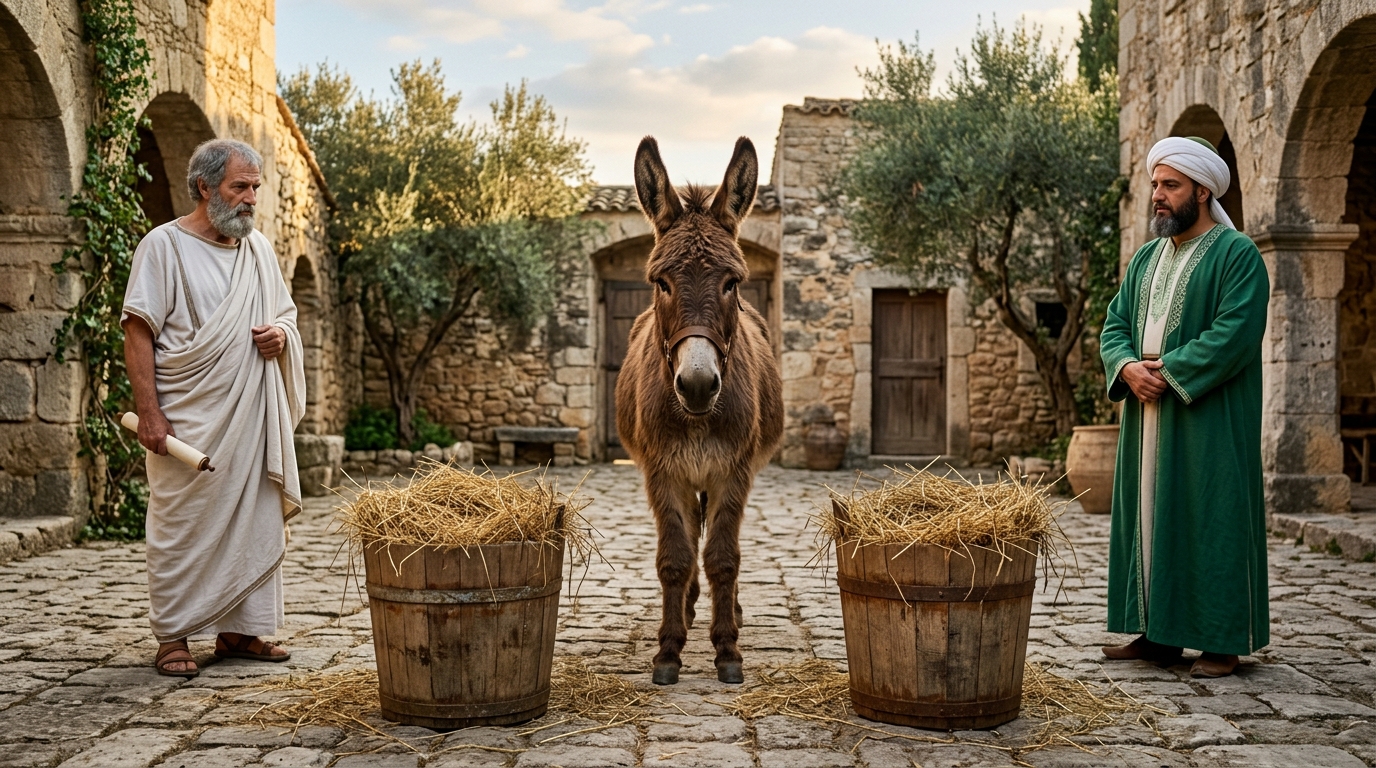
Imagine you are standing perfectly equidistant between two identical slices of your favorite pizza, feeling an equal amount of hunger for both. According to the logic of Buridan’s Ass, if you were a purely rational being with no reason to prefer one over the other, you might actually starve to death while waiting for a logical tie-breaker. This paradox serves as a fascinating gateway into the free will vs determinism debate, challenging the idea that we always act based on the strongest motive. Long before Jean Buridan’s critics used a donkey to satirize his views, Aristotle explored this concept by describing a man who is both hungry and thirsty but remains paralyzed between food and drink. Aristotle argued that such a person would remain stationary because there is no rational grounds to break the symmetry of the situation.
The Persian philosopher Al-Ghazali took this mental exercise a step further by using it to defend the existence of a divine, autonomous will. He argued that if you were faced with two identical dates and could only pick one, you would eventually just choose one without a specific reason, proving that the will can function independently of external logic. For Al-Ghazali, this ability to break a deadlock between two equal options is exactly what defines a “will” as something more than just a mechanical response to stimuli. By placing yourself in the hooves of the metaphorical donkey, you can see how these ancient thinkers used simple scenarios to tackle the profound mystery of human agency. Their insights suggest that if we were governed strictly by logic, we might lose the very spontaneity that makes us human.
Breaking The Deadlock Of Determinism Versus Free Will
Imagine you are standing perfectly centered between two identical, delicious meals, feeling equally hungry for both. According to the logic of Buridan’s Ass, if you were a purely rational being driven only by the strongest motive, you might actually starve to death while trying to decide. This classic paradox describes a donkey placed exactly midway between a stack of hay and a pail of water, unable to choose because the pull of each is perfectly balanced. It serves as a playful yet profound critique of moral determinism, suggesting that if our actions are strictly dictated by external reasons, a tie in logic results in total paralysis. You are invited to consider whether your own mind functions like a calculated machine or if you possess a unique spark that can break such a stalemate.
Breaking this deadlock requires you to look closely at the thin line between mechanical reasoning and true free will. If you were nothing more than a biological computer, you would need a “sufficient reason” to move toward one choice over the other, yet life often presents us with options that are functionally identical. To escape the donkey’s fate, you must rely on spontaneity or an arbitrary leap of faith that defies simple cause and effect. This suggests that human agency might not be about finding the most logical path, but rather about the ability to choose even when logic offers no clear direction. By asserting your will in the absence of a deciding factor, you prove that you are more than just a bystander to your own deterministic programming.
This thought experiment challenges you to define what makes your decision making process truly yours. If you can reach for the hay simply because you choose to, you are demonstrating a form of freedom that pure rationalism cannot fully explain. Philosophers have long debated whether this “liberty of indifference” is a sign of human greatness or merely a random glitch in our mental wiring. When you find yourself at a crossroads with no clear map, remember that your ability to move at all is a powerful argument against a purely predictable universe. Embracing life’s contradictions allows you to navigate a world where logic sometimes fails, ensuring you never find yourself stuck in the middle like Buridan’s unfortunate donkey.
Escaping the Trap of Analytical Paralysis
The paradox of Buridan’s Ass serves as a powerful cautionary tale about the dangers of over-analysis in your daily life. While you might not find yourself literally starving between two identical bales of hay, you likely face the paralysis of analysis when confronted with two equally appealing career paths or even two similar items on a dinner menu. In these moments, the search for a purely rational tie-breaker becomes a trap that consumes your most valuable resource, which is time. By recognizing that some choices are mathematically or logically balanced, you can free yourself from the need for a perfect justification. Sometimes the most intellectual thing you can do is acknowledge that logic has reached its limit.
When you find yourself stuck in the donkey’s shoes, the most rational move you can make is to simply embrace randomness. Since both options provide equal utility, the act of choosing is far more important than the specific choice itself. You can flip a coin or pick the option on the left not because it is inherently better, but because moving forward is the only way to avoid the stagnation that leads to failure. This approach transforms a moment of potential crisis into a simple exercise in momentum and willpower. Much like how the prisoner’s dilemma explained how rational actors can reach suboptimal outcomes, your ability to break a deadlock through a random act of will is a profound expression of your agency and freedom.
Frequently Asked Questions
1. What exactly is Buridan’s Ass paradox?
This paradox is a thought experiment describing a scenario where a person or animal is faced with two equally attractive choices. Because there is no logical reason to prefer one over the other, a purely rational being remains frozen in indecision and fails to act at all.
2. Did Jean Buridan actually come up with the story of the donkey?
While the concept is named after the French philosopher Jean Buridan, the specific example of the donkey does not appear in his surviving works. The idea was likely attributed to him by critics who wanted to satirize his views on moral determinism and the mechanics of human choice.
3. Why does the donkey die if it has two great options?
The donkey perishes because it is trapped in a state of perfect rationality without a tie-breaking mechanism. Since it cannot find a logical justification to choose the hay over the water or vice versa, it remains stuck at the midpoint until it eventually dies of hunger and thirst.
4. How does this philosophical problem apply to your daily life?
You encounter this dilemma whenever you face analysis paralysis, such as choosing between two identical products at a store. It highlights the tension between using pure logic to find the best option and using your spontaneous will to simply make a move.
5. What is the main lesson you should take away from this paradox?
The primary takeaway is that perfect rationality can sometimes be a hindrance to survival and progress. To navigate life effectively, you must be able to break a deadlock through a random or spontaneous choice when logic fails to provide a clear winner.
6. Does this paradox suggest that being rational is a bad thing?
Not at all, but it does suggest that logic has its limits in practical decision-making. You need a balance of intellectual rigor and the ability to act on impulse to avoid becoming stuck in a cycle of endless deliberation.
7. What is the relationship between this paradox and moral determinism?
Moral determinism suggests you are obligated to always choose the greater good. Buridan’s Ass challenges this by showing that when two goods are perfectly equal, a strictly deterministic mind has no path forward, leading to a complete failure of action.