
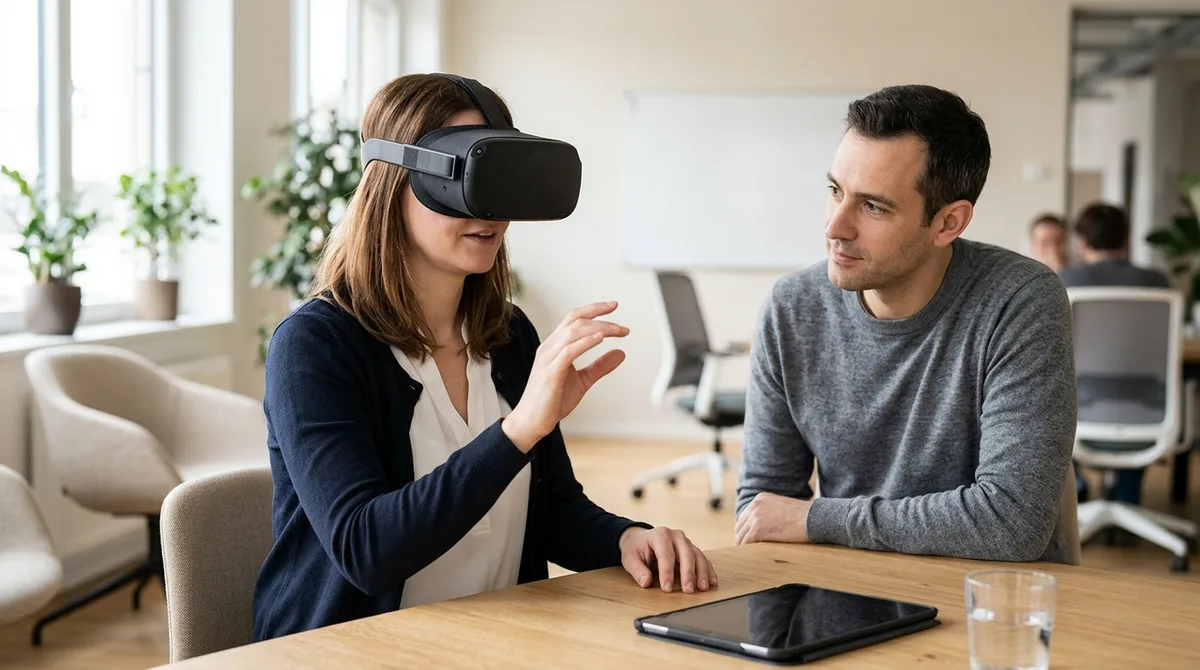
Virtual reality empathy training uses immersive, first-person stories or role-play to place you inside another person’s situation, usually followed by reflection or group discussion. The research offers a modest promise: it points mainly to better perspective-taking, not reliably deeper feelings of empathy. If you’re buying for a California workplace, note that employers with five or more staff must provide harassment-prevention training every two years, with the next deadline on January 1, 2027. The state guidance does not specifically certify VR as a compliant format.
Key Takeaways
- Virtual reality empathy training mainly improves perspective-taking, while a 2024 systematic review of 111 head-mounted-display studies found that emotional empathy gains were temporary, so you should not expect reliable improvements in feelings of empathy.
- You should schedule a follow-up test about one month after any virtual reality empathy session, because a 2026 randomized trial of 160 dementia caregivers found that immediate empathy gains were not sustained at one month.
- If your California workplace has five or more employees, you must provide harassment-prevention training every two years, with the next deadline on January 1, 2027, and the state guidance does not specifically certify VR as a compliant format.
- You can reduce risk by starting with a fixed-price pilot that records a baseline score, measures perspective-taking and emotional empathy separately, and runs a follow-up about one month after training, since licensed modules can reach a field pilot in one to two months while custom builds take three to four months.
What Does Virtual Reality Empathy Training Actually Teach?
VR empathy training puts you in a headset, lets you step into a first-person story or role-play, and then asks you to talk through what happened with a facilitator or group. The main skill these modules target is perspective-taking. The American Psychological Association defines it as looking at a situation from a viewpoint different from your usual one, including adopting another person’s perspective. In plain terms, you practice seeing a workplace conflict or a customer complaint through the eyes of someone whose position differs from yours.
Perspective-taking is not the same as feeling with someone. It asks what the other person sees and faces, while emotional empathy concerns how you respond to their feelings. A module can strengthen one without the other, so buyers should measure them separately.
The headset rarely does the reflective work alone. Self-reflection and bias awareness are usually built into the debrief, where participants examine their own assumptions about the character they just played. When you evaluate a module, ask how much time the debrief receives and who leads it.
Does VR Empathy Training Actually Work?
Partly. The research supports better perspective-taking, while gains in emotional empathy are less consistent and often short-lived. A 2024 systematic review of 111 head-mounted-display studies found that emotional empathy increases from VR were temporary, while cognitive empathy stayed enhanced. VR did not outperform 2D video for emotional empathy.
A 2020 meta-analysis found a significant positive effect on perspective-taking after VR (d+ = 0.51, 95% CI 0.15–0.88), but its empathy estimate was not statistically significant (d+ = 0.21, 95% CI −0.37–0.79).
Healthcare trials show a similar split. In one 2024 study of 59 medical students, a single depression-focused VR experience significantly raised perspective-taking and compassionate-care scores, yet the authors said overall empathy and attitude did not improve much. A 2024 study of 44 and 69 university students found no significant change in empathy or compassion, though moral reasoning shifted.
The durability problem is the most important caveat. In a 2026 randomized trial with 160 dementia caregivers, a three-hour VR session with guided reflection produced immediate gains in empathy, but those gains were not sustained at one month.
Structured designs are showing more promise. A 2026 trial of 80 nursing students found that AI-guided VR communication practice outperformed a 360-degree video control at two post-training measurements. Ask any vendor when and how it will re-test your learners.
Where Organizations Use Perspective-Taking Modules
Most organizations use these modules for three kinds of work. Diversity, equity and inclusion workshops often place staff in a colleague’s situation, such as a parent returning from leave or an employee who is repeatedly interrupted in meetings. Customer service teams use scenarios in which an agent hears a frustrated caller and must work out what the caller actually needs. Managers practice difficult conversations, such as giving feedback to a team member who keeps missing deadlines for reasons they have not shared.
Healthcare and student studies are encouraging, but they were run with medical students, nursing students and dementia caregivers, not with your employees. A bedside conversation or a classroom exchange differs from a sales rep resolving a dispute with a regional partner. Remote and global teams can take the same module without travel, which is a practical reason buyers consider VR. The scenarios still have to match your workforce’s real situations to be useful, so test a sample scene with a few of your own employees before you commit.
How Will You Measure Empathy Gains?
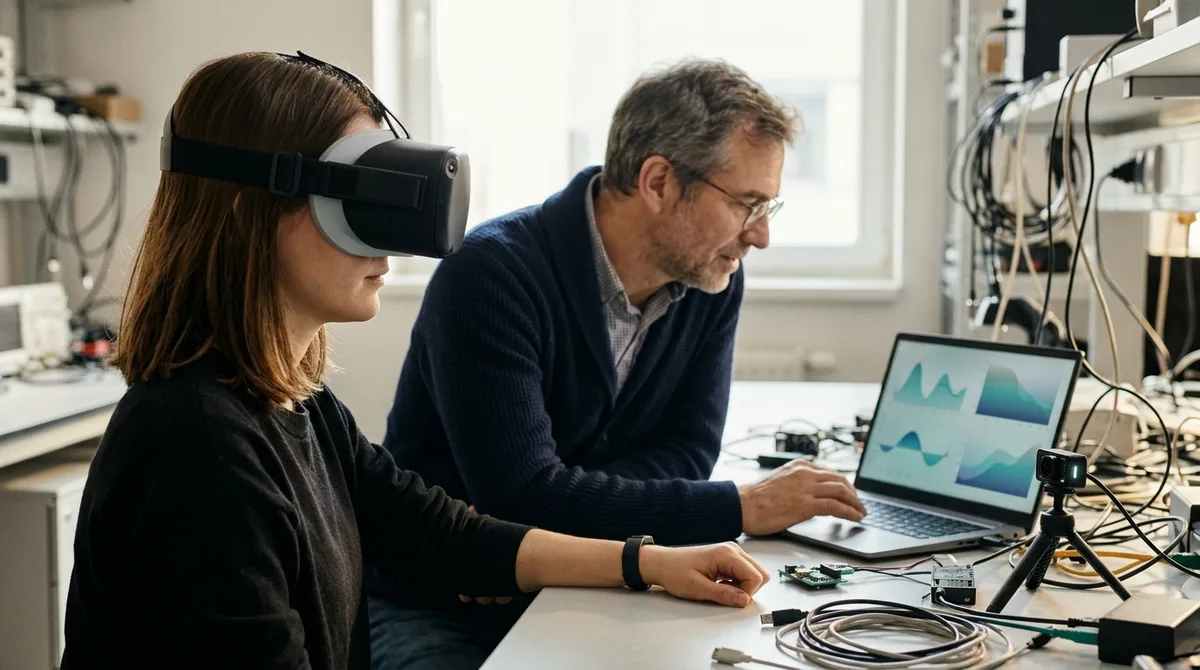
Measure empathy gains by testing the same learners before the module, right after it, and again after a delay, using separate measures for perspective-taking and emotional empathy. Start by asking each vendor how learner completion, scores and error data will be tracked and reported, and who receives those reports. Some vendors offer LMS integration with SCORM 1.2, SCORM 2004 or xAPI, so confirm which standard your learning system supports before you sign. Choose instruments that separate the two skills. The Jefferson Scale of Empathy, for example, has a perspective-taking domain and a compassionate-care domain, so you can see which one moves. Schedule the follow-up test about one month after training, because immediate gains can fade quickly. Pair those survey scores with observed behavior, such as how a manager handles the next difficult feedback conversation with a team member.
What Does a VR Empathy Module Cost?
Custom VR empathy projects have been listed in the market at roughly $60,000 to $120,000, and interactive 360-degree video modules at $30,000 to $60,000 per module. The currency is not always stated, so confirm it in writing. Pre-built licensed modules have been described as reaching a field pilot in about one to two months, while custom builds take three to four months, depending on scope and how much subject-matter-expert review the scenarios need. Day rentals are a different model. One-day editions have been advertised at around €2,500 per day, including hardware and on-site support, while lifetime licenses are quote-based. Many buyers start with a fixed-price pilot before committing to a wider rollout, which lets them test whether the scenarios fit their own staff.
Does California Law Shape Your Choice?

California does shape your choice, but it does not pick the format for you. Employers with five or more employees must provide sexual-harassment and abusive-conduct prevention training every two years: one hour for nonsupervisory staff and two hours for supervisors. The state’s employer guidance says this training must be effective and interactive. Its examples include individualized e-learning built by a qualified trainer and a trainer available to answer questions.
That guidance does not specifically certify VR as a compliant format, so a headset module is not automatically sufficient. Before you buy, ask your legal team whether a particular VR product would meet those conditions and whether live trainer access can be built in. If your staff work in another state, check that jurisdiction’s rules too.
Planning a Low-Risk Pilot for Your Team
Start by choosing one goal: perspective-taking, emotional empathy, or behavior change, since each needs a different measure. Then pick a small group of employees from a single team who face the situation the scenario depicts. Record a baseline score before the first session, and set a fixed follow-up date about one month after training. Compare pre-built and custom options against that timeline. A licensed module can reach a field pilot in one to two months, while a custom build takes three to four. If the follow-up shows gains that hold, scale the program. If they fade, revise the scenarios before you buy more licenses.
Writing Your Pilot Brief
Your next step is to write a one-page pilot brief before you contact any vendor. Name the single goal, the team that will take part, the date of the baseline survey, and the follow-up date about one month after the session. Then ask each vendor to price a fixed-price pilot that covers discovery, scenario design, and a report on learner completion, scores and error data. Compare those quotes against your timeline, because licensed modules and custom builds reach the field on very different schedules.
Send the brief to your legal team as well. Ask them to confirm whether the proposed format would satisfy your state’s training rules, and whether a live trainer can answer questions during the program. Only after that review should you schedule the first headset session.
Frequently Asked Questions
1. Is virtual reality empathy training free to try?
Most of these modules are priced rather than offered free. The usual low-risk entry point is a fixed-price pilot that covers discovery, scenario design and a learner report. One-day rental editions have been advertised at around €2,500 per day, including hardware and on-site support. Ask each vendor for a written pilot quote before you schedule any sessions.
2. Can you teach yourself empathy with VR or video games?
A headset alone can build perspective-taking, but much of the reflective work happens in a facilitated debrief where participants examine their own assumptions. Working through a VR story on your own skips that step, so self-study covers less ground than a guided session. If you go this route, plan your own structured reflection after each scenario.
3. Do all employees need their own headset?
Your delivery model largely decides this. Day-rental editions include hardware, while lifetime licenses are quote-based, which means equipment costs and sharing arrangements vary by vendor. Ask how many headsets a session requires and whether learners can rotate through shared devices.
4. Will a VR empathy module work for people who get motion sickness?
You cannot assume a module will suit every learner. Immersive headsets can cause discomfort for some people, so plan an alternative such as a seated session or a 2D video version. Ask vendors what comfort options and non-headset formats they provide before you schedule anyone.
5. How long does a typical VR empathy session last?
Session length varies by module. One randomized trial with dementia caregivers used a single three-hour VR session divided into three segments, with guided group reflection. Shorter modules exist, so the right length depends on how much debrief time you want alongside the headset work. Ask vendors how many minutes go to the immersive scenario and how many to discussion.