
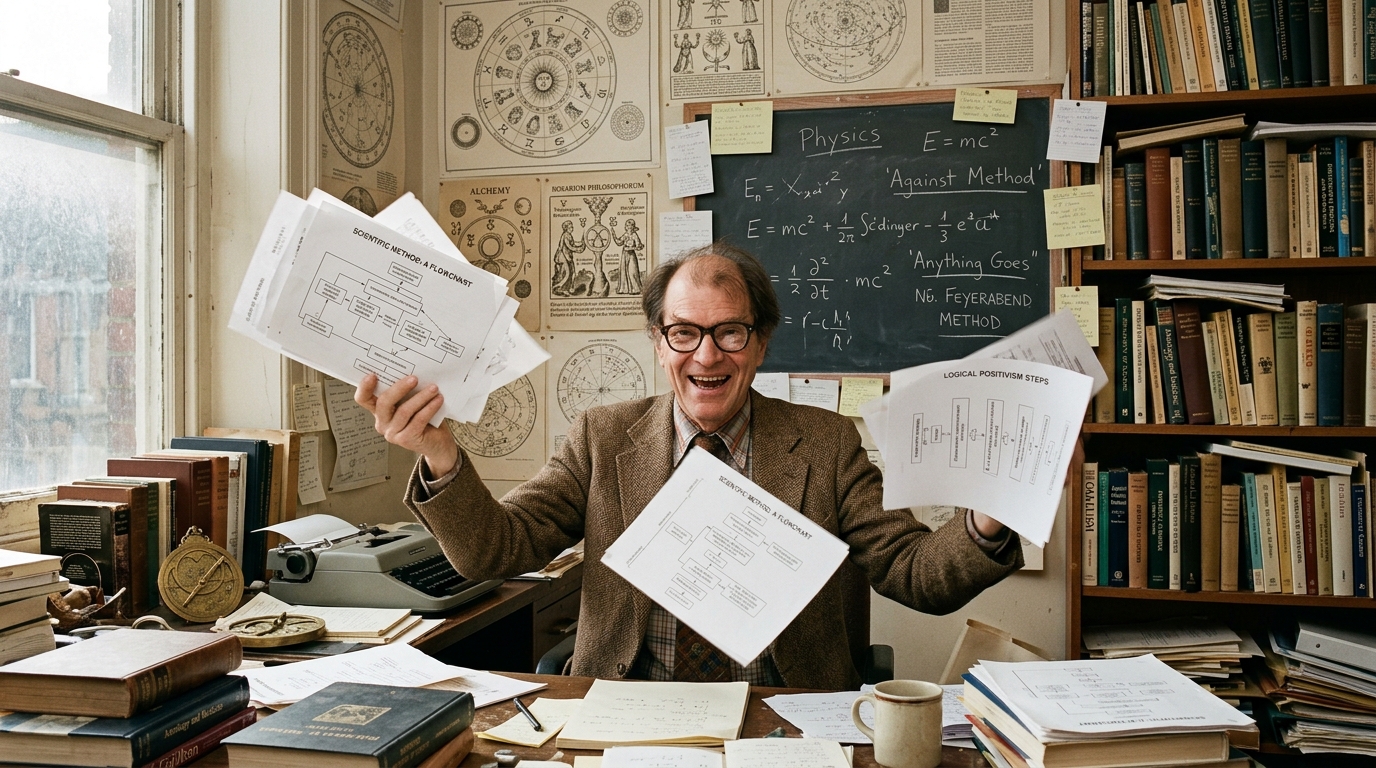
Imagine you are told that the secret to scientific genius isn’t a strict set of rules, but the courage to break them. In his provocative masterpiece, feyerabend against method, Paul Feyerabend challenges the idea that a single, universal logic governs how we discover truth. You might think of science as a rigid ladder of logic, but Feyerabend invites you to see it as a wild, creative frontier where progress often requires a complete departure from tradition.
By embracing what he calls epistemological anarchism, you begin to see that the most famous breakthroughs in history happened because someone dared to ignore the handbook. His famous slogan, “anything goes,” isn’t a call for chaos, but a reminder that no single rule can ever account for the complexity of human discovery. You are about to explore why flexibility is more than just a convenience, it is the very engine of intellectual growth.
Key Takeaways
- Scientific progress is driven by epistemological anarchism, where breakthroughs occur because researchers have the courage to ignore established rules and rigid methodologies.
- The famous slogan ‘anything goes’ serves as a necessary reminder that no single universal principle can account for the complexity of discovery or be defended in every historical circumstance.
- Major intellectual revolutions, such as Galileo’s defense of the Copernican model, often require counter-induction and the use of persuasion rather than a strict adherence to existing data or logic.
- A pluralistic approach to science prevents intellectual stagnation by ensuring that discovery remains a creative, diverse, and human endeavor rather than a dogmatic authority.
Breaking The Rules Of Epistemological Anarchism
You might think that science follows a strict, orderly recipe for success, but Paul Feyerabend invites you to look closer at the chaotic reality of discovery. In his provocative work, Against Method, he argues that the most significant breakthroughs in history occurred only because scientists chose to ignore the established rules of their time. If you examine the work of figures like Galileo, you will see that they often relied on persuasion, rhetoric, and even ad hoc hypotheses rather than a rigid formula. Feyerabend suggests that sticking to a single, uncompromising methodology acts as a straightjacket that prevents us from seeing the world in new ways. By embracing epistemological anarchism, you recognize that science is a far more creative and unpredictable human endeavor than most textbooks are willing to admit.
When you hear Feyerabend’s famous slogan that anything goes, it is easy to mistake it for a call for total intellectual chaos. However, he is actually making a sophisticated point about the limitations of universal rules in a complex, changing universe. He contends that there is no single principle that has not been violated at some point to advance our understanding of nature. If you demand that every new theory must be consistent with older, established facts, you risk trapping yourself in a cycle of stagnation where radical ideas are smothered before they can breathe. For Feyerabend, the only principle that does not inhibit progress is the one that refuses to set any permanent boundaries on how you should think or experiment.
Adopting this anarchistic view of science allows you to appreciate the diversity of thought required to solve our most difficult problems. Instead of viewing science as a cold, mechanical process, you can see it as a vibrant competition between different worldviews and traditions. Feyerabend believed that by protecting this plurality of ideas, we ensure that science remains a servant of humanity rather than a dogmatic authority. This perspective encourages you to stay curious and skeptical of anyone who claims to have the one true path to knowledge. Ultimately, breaking the rules is not just a historical curiosity but a necessary strategy for anyone looking to push the boundaries of what we currently believe to be possible.
Galileo And The Power Of Counter Induction

You might assume that Galileo Galilei won his battle for the Copernican model simply by pointing to the facts, but Paul Feyerabend argues that the reality was much more radical. When Galileo claimed the Earth moved around the sun, he was actually contradicting the senses and the established experimental evidence of his time. According to the physics of the day, if the Earth were moving, a stone dropped from a tower should land far away from the base. Since this did not happen, the evidence was technically against him. Feyerabend highlights this as a moment where Galileo had to ignore the facts to protect a theory he believed had potential.
To bridge the gap between his radical theory and the observations of his peers, Galileo employed what Feyerabend calls counter induction. Instead of following the rules of the scientific method, he used clever rhetoric and psychological persuasion to make his ideas more palatable. He introduced new ideas about motion that were not yet proven, essentially using one unconfirmed theory to support another. This process shows you that scientific progress often relies on daring to think against the evidence rather than just following it. By refusing to be silenced by the data of the moment, Galileo paved the way for a revolution that a more rigid scientist would have missed.
This historical example serves as the cornerstone for Feyerabend’s argument that there is no single, fixed path to discovery. You can see through Galileo’s lens that if we always insisted on total agreement with existing observations, we would still be stuck in ancient ways of thinking. Major breakthroughs often require a level of intellectual anarchy where the scientist must act as a salesman and a rebel as much as a researcher. By embracing this messy and unpredictable process, science gains the flexibility it needs to overturn old dogmas. Ultimately, Feyerabend invites you to view science not as a strict set of instructions, but as a creative and often chaotic human endeavor.
Science As An Essential Anarchic Enterprise
When you think of science, you likely imagine a rigid set of rules and a strict, linear process that leads directly to the truth. Paul Feyerabend challenges this comfortable image by arguing that science is actually an essentially anarchic enterprise where progress often depends on breaking the rules. He suggests that if you look closely at history, you will see that the most significant breakthroughs occurred only because scientists refused to be bound by standard methodological constraints. By rejecting a single universal method, you open the door to a pluralistic approach that protects intellectual freedom from the suffocating grip of stagnant ideology.
Feyerabend famously introduced the slogan anything goes, though he did not intend for it to be a call for chaos or a lack of rigor. Instead, he wanted you to understand that no single rule can be defended in every possible circumstance throughout the history of discovery. If you insist on a fixed set of procedures, you risk turning science into a dogmatic system that is no different from the religious or political structures it sought to replace. By embracing epistemological anarchism, you allow for a diversity of ideas and methods that keep the pursuit of knowledge vibrant, unpredictable, and truly revolutionary.
Embracing the Creative Chaos of Discovery
Feyerabend’s radical provocations remind you that the history of human discovery is far messier and more exciting than any textbook would lead you to believe. By challenging the idea of a single, rigid scientific method, he invites you to see science as a creative and deeply human endeavor rather than a mere mechanical process. You can appreciate how his concept of epistemological anarchism serves as a necessary safeguard against intellectual stagnation and dogmatism. Embracing this perspective allows you to value the breakthroughs that occurred only because someone had the courage to ignore the established rules of their time.
When you accept that anything goes, you are not abandoning logic, but rather opening yourself up to a more honest understanding of how progress actually happens. This shift in mindset encourages you to remain curious and skeptical of any authority that claims to have a monopoly on the truth. By integrating a bit of methodological chaos into your worldview, you recognize that innovation often requires a departure from the status quo. Ultimately, Feyerabend’s legacy teaches you that the pursuit of knowledge is most effective when it remains as diverse and unpredictable as the world it seeks to explain.
Frequently Asked Questions
1. What exactly is epistemological anarchism?
Epistemological anarchism is the idea that there is no single, permanent set of rules that governs scientific progress. You can think of it as a philosophy that prioritizes creative freedom over rigid methodology, ensuring that your pursuit of truth isn’t limited by outdated or restrictive boundaries.
2. Does the phrase anything goes mean that science has no standards?
Not at all, as this phrase is actually a warning against the limitations of a one size fits all approach. You should view it as an acknowledgment that for every rule a scientist creates, there will eventually be a situation where that rule must be broken to achieve a breakthrough.
3. Why does Feyerabend use Galileo as an example of breaking the rules?
You can see through Galileo’s work that he didn’t just rely on raw data, but used persuasion and clever arguments to win people over. He often had to work outside the accepted scientific standards of his time, proving that progress sometimes requires you to step beyond what is currently considered rational.
4. How does a rigid methodology act as a straightjacket for your intellect?
When you follow a scholar’s strict formula without question, you inadvertently close yourself off to perspectives that don’t fit that specific mold. By stepping away from a fixed method, you free your mind to explore unconventional ideas that could lead to the next major discovery.
5. Isn’t a structured method necessary for scientific reliability?
While structure has its place, you must realize that over-reliance on a single method can actually stifle innovation. Real world discovery is often messy and unpredictable, so maintaining a flexible mindset allows you to adapt to complex problems that a rigid handbook might miss.
6. What is the ultimate goal of adopting an anarchist approach to knowledge?
The goal is to foster intellectual growth and ensure that science remains a vibrant, human endeavor. By embracing this flexibility, you empower yourself to seek the truth in all its complexity without being held back by the traditions of the past.