

Autonomous weapon ethics in 2026 asks whether machines that can select and engage a target without human intervention can comply with international humanitarian law, and the UN is now turning that question into draft text. On September 4, 2026, the Group of Governmental Experts on lethal autonomous weapon systems adopted its final report by consensus, recommending that the Seventh CCW Review Conference consider endorsing its elements at its November 16 to 20, 2026 session. For you, that window matters most, because it is when governments decide whether those elements move toward something more formal.
You do not need to be a diplomat to feel the stakes. In December 2025, the UN General Assembly backed a resolution on lethal autonomous weapon systems with 164 votes in favor, and a separate resolution on military AI with 167. Keep in mind that the GGE report is not a binding treaty. It is a set of elements covering compliance with humanitarian law, human judgment and control, weapons reviews, testing, bias mitigation, and accountability. The International Committee of the Red Cross goes further, calling for a legally binding instrument that would prohibit unpredictable systems and systems designed to target people directly. Whether you write policy, build software, or approve procurement, understanding where that gap sits is the first step toward a defensible ethics framework.
Key Takeaways
- The Group of Governmental Experts on lethal autonomous weapon systems adopted its final report by consensus on September 4, 2026, and recommended that the Seventh CCW Review Conference consider endorsing its elements at its November 16 to 20, 2026 session.
- The GGE report is not a binding treaty, so the elements covering humanitarian law compliance, human judgment and control, weapons reviews, testing, bias mitigation, and accountability create expectations rather than legal obligations.
- International humanitarian law applies fully to autonomous weapons, and a lethal autonomous weapon system must not be used if it is inherently indiscriminate, incapable of complying with that law, or if its effects cannot be anticipated and limited as the law requires.
- The International Committee of the Red Cross calls for a legally binding instrument that would prohibit unpredictable autonomous weapon systems and systems designed to target people directly, which goes further than the consensus GGE text.
What Exactly Counts as a Lethal Autonomous Weapon System?
A lethal autonomous weapon system, or LAWS, is, in the words of the 2026 Group of Governmental Experts report, a set of weapons and technological components that together can identify, select, and engage a target with force without intervention by a human operating the system. Put simply, once the system is deployed, the machine finds a target, decides it is the one to strike, and fires, with no person stepping in during that sequence. The report’s text is the reference point negotiators are now working from.
Notice what the definition does not say. It does not name a particular technology, such as machine learning or a specific sensor. It focuses on the absence of human intervention in the targeting cycle, meaning the chain of steps from spotting a possible target to striking it. That shift in focus matters. A drone with a guided munition is not automatically a LAWS because of its chips. The question is who makes the targeting decisions, and whether a person can intervene before force is applied.
This is also why the definition is the starting point for every ethical and legal debate. If two parties describe different objects when they say “autonomous weapon,” they will talk past each other about legality, testing, and accountability. A shared definition tells you what is being regulated before anyone argues about whether the rules are adequate.
Semi-autonomous systems sit on the other side of the line. In these systems, software may handle tasks such as navigation, tracking, or flagging possible targets, but a human still selects the specific target and authorizes the engagement. The machine assists, and the person decides. The difference sounds technical, yet it determines who carries responsibility for a strike and what kind of human judgment the law expects to see.
U.S. policy takes a practical approach here. DoD Directive 3000.09, dated January 25, 2023, covers both autonomous and semi-autonomous weapon systems, so the two categories are regulated together. The directive requires appropriate human judgment over the use of force, rigorous verification and validation, realistic testing, and legal reviews. A system that is only partly autonomous is still inside the rulebook.
Precision in the definition decides which systems face controls and which fall outside them. If your product team calls a system “decision support” while the software in fact selects and engages targets without a person acting in time, the label will not change how it is classified. Ask yourself a few direct questions. At which step does a person choose a specific target? Can that person stop an engagement once it has begun? What happens to the system if communications are lost? Your answers will show which side of the line you are on.
How Does International Humanitarian Law Apply to Autonomous Weapons?

International humanitarian law applies fully to autonomous weapons, and the 2026 Group of Governmental Experts report says so directly. The rules of armed conflict, including the duty to distinguish between combatants and civilians and to avoid disproportionate harm, do not switch off because a weapon can select its own target. For you, that means no legal vacuum needs filling before the existing rules apply. The real questions are how those obligations can be met and who answers when they are not. Those obligations rest on people and states. The report makes clear that IHL obligations fall on states, on parties to an armed conflict, and on individuals, not on machines. A machine cannot be bound by the Geneva Conventions, cannot be prosecuted, and cannot be punished. When an autonomous system strikes the wrong building, responsibility runs back to the commanders who chose to deploy it, the officials who approved it, and the state that fielded it. No algorithm can take on legal responsibility for an attack, and the report stresses that accountability cannot be transferred to machines. Some systems are ruled out before compliance is even discussed. The report says a LAWS must not be used if it is inherently indiscriminate, if it is incapable of complying with IHL, or if its effects cannot be anticipated and limited as the law requires. Each condition works as a test you can apply to a design. Can the system tell a soldier from a civilian in the environment where it will operate? Can it be stopped or narrowed when the situation changes? Can the people responsible predict what it will do in the worst realistic case? The first condition asks whether a weapon can be aimed at a lawful military objective at all. A weapon that cannot be directed at a specific target fails before anyone examines its software. The second asks whether the system can follow the rules of distinction, proportionality, and precaution under the conditions it will actually face, not only in a laboratory. The third asks whether anyone can foresee the consequences of deployment well enough to limit them. If the answer to any of these is no, the system should not be used, however advanced its technology is. These conditions are where engineering and law meet. A team that can explain how its system would fail, and show evidence that it would fail safely, is in a far stronger position than one that simply claims the software is accurate. Your records should show what the system was tested against, what it was not tested against, and who decided that those gaps were acceptable. Those decisions, made by people, are exactly what international humanitarian law holds accountable.
What Does Meaningful Human Control Look Like in Practice?
Meaningful human control means a set of limits that a commander or designer can write down, test, and enforce before a system is used. Those limits cover how many targets a system may engage, how large an area it may cover, how long it may run, and how quickly a person can stop it. The GGE text treats these as the concrete levers that keep a human in charge of the targeting cycle.
Start with the boundaries of the mission. The report identifies limits on targets, operational scale, duration, and geographic scope as the basic controls. Imagine a loitering munition authorized to search one defined valley, for a fixed number of hours, against a named category of military vehicle. Each of those parameters is a control you can check against the system’s logs. If the system can roam beyond the valley or keep searching after the window closes, the control has failed, even if its targeting software works perfectly.
Mission parameters also change, and each change needs a decision. The GGE text calls for human authorization of material changes to mission parameters, so a new area, a new target class, or a longer deployment cannot be approved by the software alone. Your organization should define in advance what counts as material. If you cannot say which changes need a person’s sign-off, the system is not yet under meaningful control.
Stopping the system is the next test. The report says a system must allow timely deactivation or neutralization. Ask how long it takes from the moment a person decides to halt an engagement until the system is actually inert. Ask what it does when communications are cut, because a system that keeps executing its plan during a link failure is operating outside human reach.
The harder problem is automation bias, which the report asks states to mitigate. Operators may over-trust machine outputs, and a person who is nominally in the loop can become a rubber stamp. When a system presents a ranked list of possible targets faster than anyone can check the underlying evidence, approval may amount to little more than clicking accept. Nominal oversight is not the same as real judgment.
Mitigation has to be designed in. Operators should be trained on the system’s known failure modes, and exercises should sometimes include deliberately wrong recommendations so that reviewers learn to catch them. Override actions should be logged, and commanders should track how often recommendations are accepted without a recorded review. Staffing matters too, since a reviewer given seconds per decision cannot exercise judgment. The same attention applies to unintended bias: the data a system learned from should be checked against the environment where it will actually operate.
Finally, accountability stays with people. The report stresses that accountability cannot be transferred to machines, so every parameter, approval, and override needs a named person behind it. Records should show who set the mission envelope, who authorized each change, and who decided that a given test gap was acceptable. When something goes wrong, those records are how responsibility is traced back to the humans who made the decisions.
Which Legal Reviews and Testing Standards Should Apply?
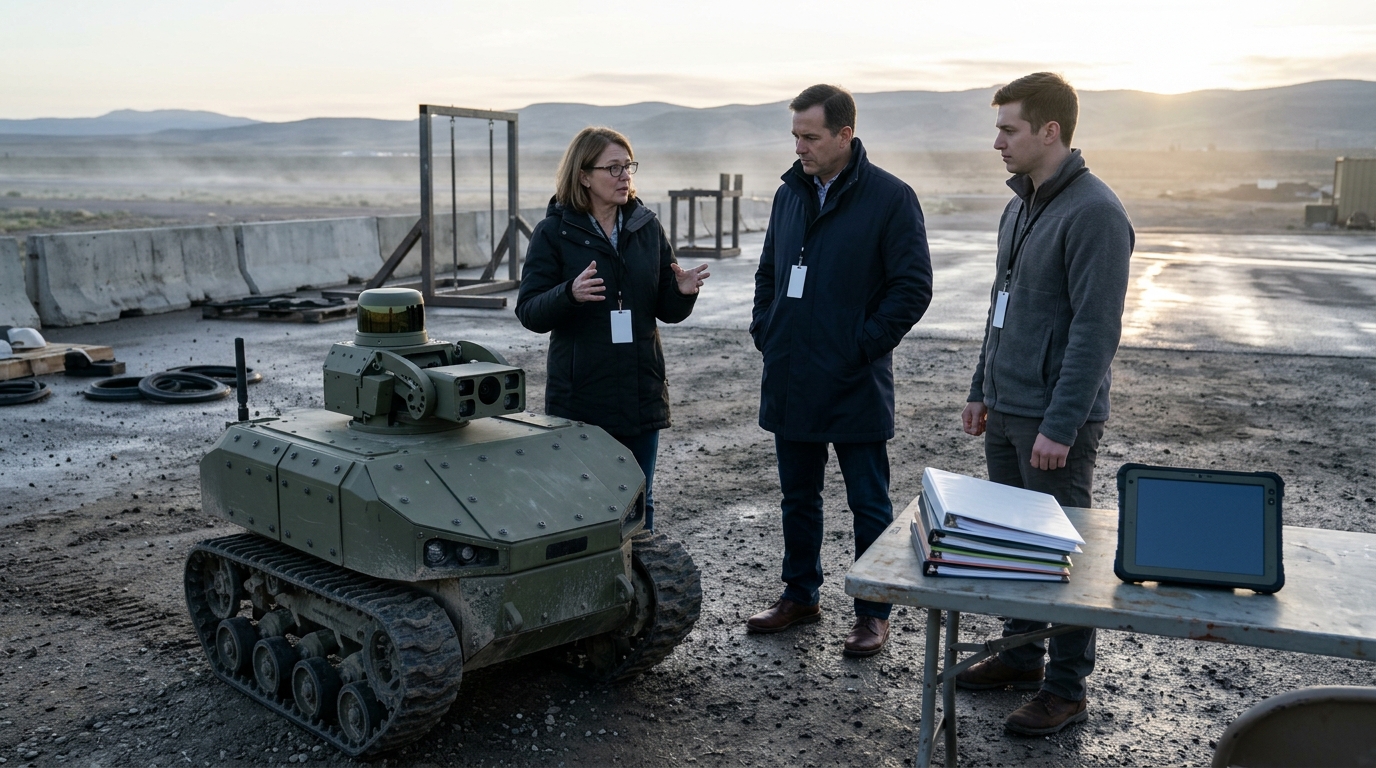
The review and testing standards that matter most are a legal review of the weapon against international humanitarian law and testing that shows how the system behaves under realistic conditions. The GGE text asks for both, and U.S. defense policy asks for the same things in its own terms.
Start with the legal review. The GGE elements call for legal reviews of new LAWS. They also call for a fresh review whenever a modification materially affects target identification, target selection, engagement, or the anticipated effects of the weapon. A software update that changes how the system classifies a vehicle, or a hardware change that extends its range, can trigger that review even when the platform looks the same from the outside. For your team, the practical step is a change log that records each modification alongside a short note on whether it touches one of those four functions. If it does, the legal reviewer should see the change before it reaches a live system.
Testing is the second check. The GGE text calls for testing and evaluation in representative operational environments, not only in controlled laboratories. Representative means the test conditions should resemble the terrain, weather, sensor clutter, civilian presence, and communications conditions the system will actually face. A classifier that performs well on clean images of tanks in an open desert may behave very differently near a crowded market or in smoke. A reviewer should ask which environments the testing covered, which were left out, and who accepted those gaps.
The U.S. approach uses similar language but adds more formal process. The Pentagon’s 2023 directive on autonomous and semi-autonomous weapons requires rigorous verification and validation. Verification asks whether the system was built as specified, and validation asks whether that specification matches what the system must actually do in the field. The directive also requires realistic developmental testing during the build phase and realistic operational testing under conditions close to real use. Legal reviews must address applicable domestic and international law. Because the directive covers design, development, acquisition, testing, fielding, and employment, the review does not end once a contract is signed.
When you are asked to approve a system, begin with the test plan. It should name the environments, the target types, the known failure modes, and the pass thresholds for each. Next, check whether the verification evidence links each requirement to a specific test result, rather than relying on a summary that says the system performed well. Then read the legal analysis. A useful one identifies which rules of distinction, proportionality, and precaution the system must satisfy and explains how the test results demonstrate compliance with each. A vague statement that the system is “consistent with the law” tells you very little.
Finally, confirm who is responsible for repeating the review. A review that was accurate for one version of the software may no longer describe the system after the next update. Name the person who decides whether a change is material, and make sure that person has the authority to pull the system back for a new review before it is used again.
Can a Voluntary Framework Like NIST’s Help Weapons Ethics?
Yes, but only as a supporting tool. The AI Risk Management Framework 1.0 from the National Institute of Standards and Technology, published January 26, 2023, gives organizations a shared vocabulary for describing AI risk. It is voluntary, it is designed to preserve rights, and it is non-sector-specific, so it was written for AI in general rather than for weapons. It is not a mandatory weapons-specific standard, and it cannot tell you whether a targeting system may lawfully be fielded.
The framework is organized around four functions: Govern, Map, Measure, and Manage. Govern covers the policies, roles, and accountability structures an organization sets up. Map asks you to describe the context a system operates in and the people it affects. Measure covers how you assess and track risks, and Manage covers how you respond when they change. For a team building a system that could be used in the field, these four functions give engineers, lawyers, and product managers a common language before they reach the harder questions.
Pairing that vocabulary with the Pentagon’s 2023 directive is a practical combination. The directive sets the binding requirements, such as appropriate human judgment and legal review, and the NIST functions help you organize your own evidence around them. You might list each mission parameter, such as the operating area or the target class, in a risk register. Next to it, attach a measure, such as the rate of misidentifications in trials that resemble the real environment. When a parameter drifts, the Manage function records who acted and what changed.
The gap appears where the general framework stops. NIST’s language about risk is broad enough to cover a recommendation engine, a chatbot, or a weapon, and that breadth is exactly what a weapons review cannot tolerate. A register can list automation bias as a risk and give it a rating, but it cannot decide whether a human reviewer has enough time and information to exercise judgment before force is applied. Nor does it replace the legal review that international humanitarian law requires for a new weapon, or for a modification that changes how the system identifies or engages targets.
Use the framework to keep your records organized, then test each entry against the questions the binding rules ask. Can a person intervene in time? Was the system tested in conditions like those where it will be used? Which named official signed off on the legal analysis? If a risk entry cannot answer those questions with names and evidence attached, it documents a concern without meeting the standard.
Where Are the UN Negotiations on Autonomous Weapons Heading in 2026?

In 2026 the UN process is moving from years of expert discussion toward a possible instrument, but it has not yet produced a treaty. The route runs through three steps: two General Assembly resolutions from December 2025, a consensus report from the Group of Governmental Experts, and the Seventh CCW Review Conference, scheduled for November 16 to 20, 2026. Each step answers a different question, so it helps to follow them in order.
On December 1, 2025, the General Assembly adopted resolution A/RES/80/57 on lethal autonomous weapon systems by 164 votes in favor, 6 against, and 7 abstentions. The same day, it adopted resolution A/RES/80/58 on artificial intelligence in the military domain, which passed with 167 in favor, 5 against, and 5 abstentions. Both votes show broad support, but the numbers also show where resistance sits. The states that voted no or abstained are the governments most likely to slow down a binding instrument later, so their positions are worth tracking.
The Group of Governmental Experts, which works under the Convention on Certain Conventional Weapons, adopted its final report by consensus on September 4, 2026. Consensus means no delegation objected to the text, so the elements it contains carry agreement that is hard to dismiss as one side’s view. The group recommended that the Seventh CCW Review Conference consider endorsing those elements.
A consensus report can establish shared language. The definition of a lethal autonomous weapon system, the statement that international humanitarian law applies fully, and the call for human control all become reference points that negotiators and national reviewers can cite. What it cannot do is bind anyone. The report is not itself a binding treaty, and nothing in it obliges a government to change a weapon or a procurement process. Its practical weight depends on what governments decide to do with it.
That decision belongs to the Review Conference. Governments there will decide whether to endorse the elements, and endorsement is a formal political act, not a treaty signature. Because CCW decisions are made by consensus, a single objecting state could block the recommendation. The outcome therefore depends on whether any delegation is willing to refuse, which is why the report’s wording has been negotiated so carefully.
Pressure is also building outside the conference room. The International Committee of the Red Cross reported on October 14, 2026, that 47 states and the African Group had expressed support for launching negotiations on autonomous weapons rules. By its count, more than 70 states had explicitly called for negotiations. The ICRC’s own position goes further than the GGE text, since it calls for a legally binding instrument. These figures suggest the November question is less whether states want rules and more whether they can agree on a mandate to write them.
For you, three developments deserve attention: whether the Review Conference endorses the elements, how the states that voted against the December resolutions position themselves, and whether the outcome contains any commitment to negotiate. Each one will shape how much weight your compliance planning should place on the GGE text.
Why Is the ICRC Calling for a Binding Ban on Some Systems?
The International Committee of the Red Cross wants a legally binding instrument that would ban two kinds of autonomous weapons outright: systems whose behavior cannot be predicted, and systems designed to target people directly. Every other autonomous system would stay legal but subject to firm limits on its targets, geography, duration, situations, and scale of use. That split is the heart of the ICRC’s position, and it goes further than the GGE text.
The reasoning behind the prohibitions is straightforward. A commander who cannot foresee what a weapon will do after launch cannot judge whether an attack will be proportionate or whether civilians will be spared. A system built to target people, rather than military objectives that happen to be people-free, removes the human choice about who may be harmed at the moment it matters most. For the ICRC, these two features cannot be fixed by better paperwork, so they call for a ban rather than a checklist.
The restrictions are the more practical part for developers. A system could be limited to a defined maritime zone, switched off after a fixed number of hours, kept out of populated areas, confined to specified situations such as attacks on military equipment in open terrain, and capped in how many engagements it can carry out. Each of those limits can be built into the software as hard constraints, such as geofences, automatic time-outs, and engagement counters, rather than left to an operator’s memory.
The gap between a consensus elements text and a binding prohibition matters most here. Elements describe what a responsible state should check, and a developer can satisfy them by documenting controls, running tests, and recording reviews, even if the underlying design is hard to predict. A binding prohibition works differently. It removes certain designs from the list of options altogether, so no amount of documentation makes an unpredictable or person-targeting system acceptable.
For a development team, the difference changes when the hard questions get asked. Under the consensus approach, the main work comes after design, through testing and legal review. Under a prohibition, the first question is whether the system can be shown to behave predictably and whether it is aimed at people at all. A team that discovers the answer late may face a costly redesign. The GGE report does not supply that prohibition, so the Review Conference in November will show how far the consensus language and the ICRC’s position can be reconciled.
Preparing Your Organization Before the November Review Conference
Start this week by naming one person who will own the question of whether your systems fall under the GGE elements. That person should not be the engineer who built the system, because the review needs someone willing to ask uncomfortable questions about it.
Next, write a one-page register of every system or component that selects or engages targets, and list its mission parameters: the target classes, the operating area, the maximum duration, and the point at which a human can stop it. Mark any parameter that a software update could change. Those are the items a legal reviewer must see before the next release.
Then compare the register against the four controls the GGE text describes. Where a gap appears, record who accepted it and when. A gap with no name attached is the first thing to fix.
Read the December 2025 military AI text, resolution A/RES/80/58 on artificial intelligence in the military domain, before the conference opens. Its vote count of 167 in favor, 5 against, and 5 abstentions shows which governments may resist stronger rules later, and that tells you where your compliance planning needs the most caution.
Finally, put a calendar entry for the day after the Review Conference is scheduled to close. By then you will know whether governments endorsed the elements, and you can decide whether your register should move from voluntary practice to a formal compliance requirement.