

Digital afterlife services reviews usually compare products that use recorded data or artificial intelligence to keep a deceased person’s voice and personality within reach of the living, and their prices vary enormously. HereAfter AI’s app lists in-app purchases from $3.99 to $199.99, while Eternos reportedly charged $15,000 for a voice-AI setup that involved recording 300 spoken phrases and a two-day computing process.
The differences matter as much as the prices. Some tools generate new sentences the person never said, while others, such as StoryFile Life, select answers from videos the person recorded while alive. StoryFile’s Life page currently directs new customers to a waitlist. Philosophers ask whether any of these simulations can be the person at all, or only a new presence you relate to, and that question should shape how you weigh each option.
Key Takeaways
- Before you choose a digital afterlife service, check whether it retrieves the person’s pre-recorded answers, as StoryFile Life does, or generates new sentences the person never said, because that difference determines the philosophical questions you will face.
- HereAfter AI’s recurring tiers of $3.99, $5.99 and $7.99 buy continued access rather than ownership of a person’s voice or memories, so you should total the yearly cost and compare it with its one-time $99.99 option before you subscribe.
- Before you rely on StoryFile Life, read its terms, which promise only reasonable efforts to let you download a video, may charge a fee for the download, and leave the video no longer interactive once your subscription ends.
- Talking to a grief simulation may comfort you, but researchers cannot yet say how often it helps or harms, and the main risk named in the literature is prolonged grief.
What Does a Digital Afterlife Service Actually Do?
A digital afterlife is the set of traces a person leaves online, along with the systems built to keep those traces responsive after death. People often call the material itself digital legacy: the accounts, messages, photos, and files someone leaves behind. Digital remains is the same material viewed as what survives of a person’s online life. Some of it simply stays where it is, such as old posts, saved voicemails, or recorded videos. This is what you could call passive presence. You read or watch it on your own terms, and nothing answers back.
Active presence works differently, because a system generates replies as if it were the person. Researchers writing in the Journal of the American Philosophical Association use the term thanabot for large-language-model chatbots designed to simulate a deceased person’s personality and speech. Others call them griefbots or deathbots. The label matters less than the mechanism. Because these systems compose new sentences, they can produce statements the person never actually made, which is the feature that makes them philosophically interesting.
The market is not one product type. At the low end, Project December charged $10 for a user to complete a questionnaire and simulate a text-based conversation with a chosen character. Recorded archives sit in the middle. For StoryFile Life, recording 10 to 20 video responses can take about 10 to 30 minutes, while the full library of roughly 500 questions may take several days. At the high end are custom voice replicas, which require far more recording and computing and cost considerably more.
So when you compare services, start by asking how each one produces its replies: by retrieving recordings, by generating new text, or by some mix of the two.
How Do Chatbots, Avatars and Recorded Archives Differ?
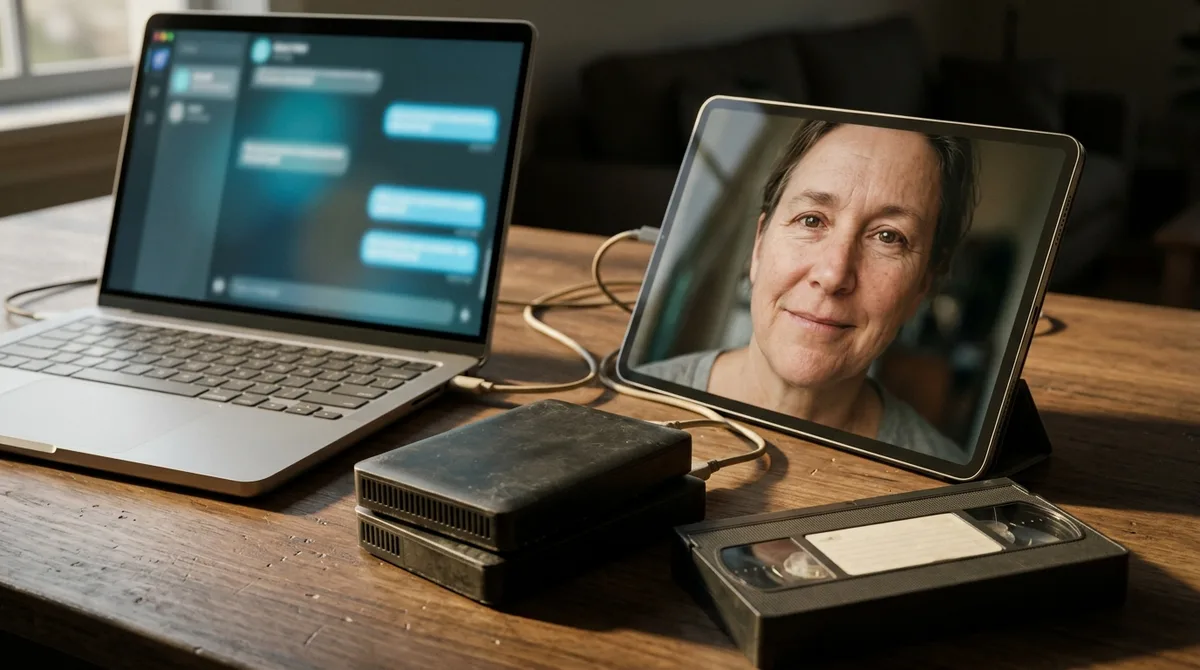
The main difference is where each reply comes from. Some services play back something the person already recorded, while others compose a new reply that the person never gave. Those two routes lead to very different philosophical situations, so they should be the first thing you check.
Text simulations and voice replicas both build their replies at the moment you ask. Project December, for example, has you complete a questionnaire and then simulates a text conversation with a chosen character, so the sentences you read are assembled in the course of the exchange. HereAfter AI takes a different commercial form. It is sold as an app with tiered in-app purchases, and its App Store listing also says it may collect contact information, user content, identifiers, usage data, purchases and diagnostics. Your privacy questions belong on the same checklist as the conversation quality.
Custom voice replicas sit at the expensive end. Eternos’s setup depended on 300 recorded spoken phrases followed by a two-day computing process, which means the voice is modelled from a sample of the person’s speech rather than played from a fixed archive.
StoryFile Life works differently. Its AI selects and plays the subject’s pre-recorded answers rather than making up new ones, so every sentence you hear was once spoken by the person being remembered. The labor of building that library happens in advance, when the person or family records answers to a long list of questions.
Why does this distinction matter? If a system only selects, you are still hearing the person’s own words, arranged by a machine that chooses which ones to play. If a system generates, it can say things the person never said, and the question shifts from “what did they say?” to “who is speaking now?” That shift is the heart of the identity debate, and it is why retrieval and generation should be your first review criterion. Before you compare prices or features, ask of each product whether it retrieves, generates, or mixes the two.
What Do the Subscription Fees Really Buy?
Subscription fees buy continued access to a service, not ownership of a person’s voice or memories. HereAfter AI, sold through its app, offers recurring in-app purchases at $3.99, $5.99 and $7.99, alongside one-time options of $99.99, $159.99 and $199.99. Recurring tiers continue only while payments continue, so you are paying for access over time rather than for a finished archive you keep.
Pricing also tells you who benefits. A commercial death tech company is a business, and its incentives include retaining subscribers, selling upgrades and collecting data. The privacy disclosure for HereAfter AI says the app may gather contact information, user content, identifiers, usage data, purchases and diagnostics. The material you upload about the person you lost can therefore generate information about you as well.
Availability can also change. StoryFile’s waitlist shows that a product you can join today may be closed to new sign-ups tomorrow, so your choice depends on the company’s capacity as much as on your preferences.
The harder question is what happens when payments stop or a company closes. StoryFile’s terms say that after termination the company will make reasonable efforts, where feasible, to let you download a video. That download may carry a fee, and the video will not remain interactive without StoryFile’s technology. The recording survives as a file, but the conversational presence that made it feel alive does not.
Some writers call this a second death. The first death ended the person’s life. A shutdown ends the relationship you had with the simulation, and you may be unable to reach it at all. Before you pay, read the terms for export rights, download fees and what remains once your subscription ends.
Can Talking to a Simulation Help You Grieve?
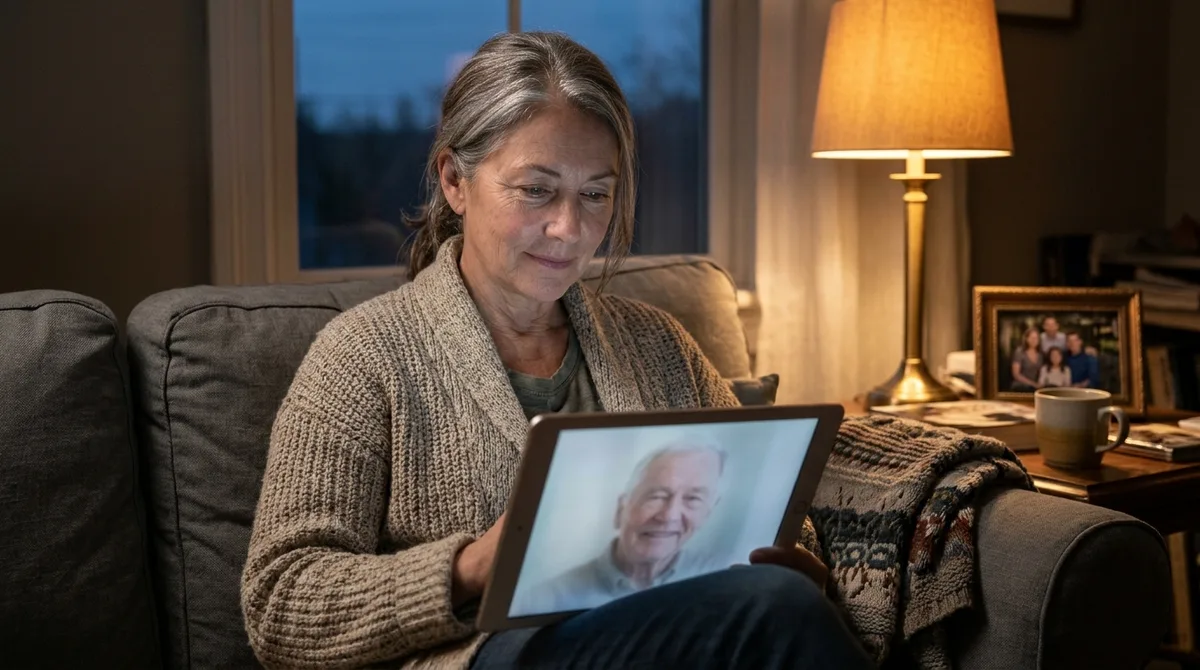
Talking to a simulation may comfort some people, but no one can yet say how often it helps and how often it harms. Grief is first a lived experience before it becomes a theory. You come home and reach for your phone to tell your mother something funny, then remember there is no one to answer. That pull to keep speaking to the dead is ordinary, and it is the impulse these services are built to meet.
Grief scholars have long described continuing bonds, the idea that many people keep a relationship with the deceased in changed form rather than cutting the tie. You might write letters, visit a grave, or imagine what someone would say about a decision. Seen this way, a chatbot that answers in a familiar voice looks like an extension of a practice many people already have.
A 2025 philosophical analysis argues that a thanabot cannot literally continue the identity or the relationship of the person who died, because the system composes words without being that person. The same analysis accepts that some users may still find support in it. You can know that a bot is not your father and still find it steadying to hear a version of his phrasing.
The main risk named in the literature is prolonged grief. Grief becomes prolonged when a bereaved person stays stuck in acute loss instead of gradually adjusting to a world without the person. If a simulation becomes the place you return to every evening, rather than a step toward acceptance, it may replace the work of mourning instead of supporting it. Because the system answers back, that replacement can feel like a real relationship, which makes it harder to notice.
The disagreement here is real. Some users may find comfort, others may find that contact keeps them from accepting the loss, and the effects still need empirical study. User outcomes cannot yet be generalized from a few personal stories, including the testimonials a company chooses to publish. When you read a review, ask who was studied, what was measured and how long people were followed.
Is a Simulation the Same Person, and What Is Essence?
No, a simulation is not literally the deceased person, though it can resemble them closely enough to feel like a continuation. Philosophers have long asked what makes someone the same person over time. John Locke tied personal identity to memory, so that you remain the same self as long as you can recall your past experiences. Others point to the body or to an unbroken chain of psychological connections. A chatbot passes none of these tests in full. It recombines patterns from the person’s words and never lived through a single day of their life.
Essence raises a further question. Aristotle distinguished the features a thing has by accident from those it cannot lose without ceasing to be what it is. For a person, the essential part might be character, conscience, or a particular way of loving, while habits of speech are accidental. A simulation can reproduce the accidental features well, which is why it sounds familiar, but that does not show it holds anything essential.
Nineteenth-century post-mortem photography was an earlier attempt to keep the dead visible. Families paid photographers to record their dead, sometimes posing the body upright or painting open eyes onto the print, so the person stayed present in the household. Portrait photography later claimed to capture the sitter’s true self, a claim that has never been fully settled. Roland Barthes, writing about a photograph of his mother, described its power as a certainty that she had once been there.
The same doubt applies to avatars and synthesized voices. A profile picture resembles a person without being that person, much as a portrait resembles its sitter. A useful way to see a simulation is as a likeness that can answer back. It keeps the surface of a life in view while leaving open who is speaking.
What Ethical Safeguards and Rules Apply to Death Tech?

Most death tech operates under few binding rules today, so ethical guidance and one narrow California law do most of the work. The first concern is dignity and autonomy. The central question is whether the person who died agreed to be simulated at all. Someone who answered questions for a family archive may have imagined something very different from a system that speaks in their voice to strangers, and no one can ask them now.
Consent has to cover two groups. The first is the people who supplied the data, such as the relatives who record, write and upload a life. The second is the people who talk to the bot, who may be grieving, young or vulnerable. A 2024 paper in Philosophy & Technology recommends mutual consent between data donors and interactants, meaningful transparency about what the system is, and adult-only access. It also calls for procedures for retiring deadbots, so a service plans for when a simulation should be shut down rather than left running indefinitely.
The law is far narrower. California’s AB 1836, signed on September 17, 2024, requires estate consent for covered commercial uses of deceased performers’ digital replicas in expressive audiovisual works and sound recordings, including films, television shows, video games and audiobooks.
That law does not reach an ordinary memorial chatbot. A family that builds a private bot for its own use, or a subscription service that recreates a grandparent for the grandchildren, falls outside it. Those services rely mostly on their own terms, privacy policies and voluntary design standards. When you read them, check whether they promise consent procedures, age limits and a retirement plan, and whether the company is bound to honor those promises.
Weighing Your Own Questions Before You Choose
Before you choose, bring a short set of questions to any review. Ask whether the service retrieves recordings or generates new replies, and whether it presents the result as a likeness or as the person. Ask who owns the photos and messages you upload, and whether you can delete them. Add up the cost over a year or two, not just the first month. Finally, ask what happens when you cancel and whether you can export what you made.
Reviews rarely settle these questions. Most report a disagreement among families, writers and philosophers, so read each one as an account of positions to weigh rather than a final verdict. If a question or a topic you would like Philosopedia to explore comes to mind, send it through our contact form. The questions you bring to the decision will shape it more than any star rating.
Practical Steps Before You Sign Up
Start by gathering the material before you sign up. Copy any videos, voice notes, letters and messages you want to keep into storage you control, so that nothing you care about depends on a company’s upload process or its continued operation.
Next, read the terms for the one service you are considering. Look for what happens to your uploads after you cancel, whether you can export them, and whether a download costs money. StoryFile’s terms, for example, promise only reasonable efforts to let you download a video, which may carry a fee, and the video will no longer be interactive.
Then do the arithmetic. Multiply the $5.99 HereAfter AI tier by the number of payment periods you expect to pay over a year, then compare that total with the one-time $99.99 option if you expect to keep using the service. Write the total on paper before you pay.
Finally, set a review date a few months ahead. Ask yourself whether the simulation helps you talk about the person you lost or whether it has quietly replaced the conversations you would have with family and friends. If the answer worries you, pause the subscription, and talk to someone you trust or to a grief counselor. The choice is yours, and it should remain yours.
Frequently Asked Questions
1. Can I delete a simulated version of a loved one, and who controls that decision?
Whether you can delete a simulated version depends mostly on the company’s terms, so the decision often rests largely with the service rather than with you alone. Before you upload anything, check whether you can remove uploaded photos, messages and recordings, and whether deleting your account also removes the bot’s responses. If the service offers no clear deletion route, ask for one in writing before you commit.
2. What happens to a bot’s data and responses if the company shuts down?
What happens depends on the company’s termination terms, which differ from one service to another. StoryFile’s terms, for example, promise only reasonable efforts to let you download a video, the download may carry a fee, and the video stops being interactive. Save copies of your own recordings, letters and messages before you rely on any service, so that nothing you value depends on the company staying in business.
3. Is it appropriate for children or teenagers to use a service that simulates a dead parent?
Most of these services are not designed for children or teenagers, and a 2024 paper in Philosophy & Technology recommends adult-only access to re-creation services. A simulation can speak in a parent’s voice and phrasing, so a young person may find it hard to tell a likeness from the parent. If you are considering this for a child, talk with them and with a counselor who knows their situation before you decide.
4. How can I tell whether a review of a digital afterlife product is reliable?
Start by checking whether the reviewer discloses any commercial relationship with the company, and whether prices and features are current, since listings and waitlists change. Look for who was studied, what was measured and how long users were followed, because a few personal stories or testimonials a company chooses to publish cannot show typical outcomes. Reviews that explain how each product produces its replies, by retrieving recordings or generating new text, are usually more useful than those that rank products by stars alone.