
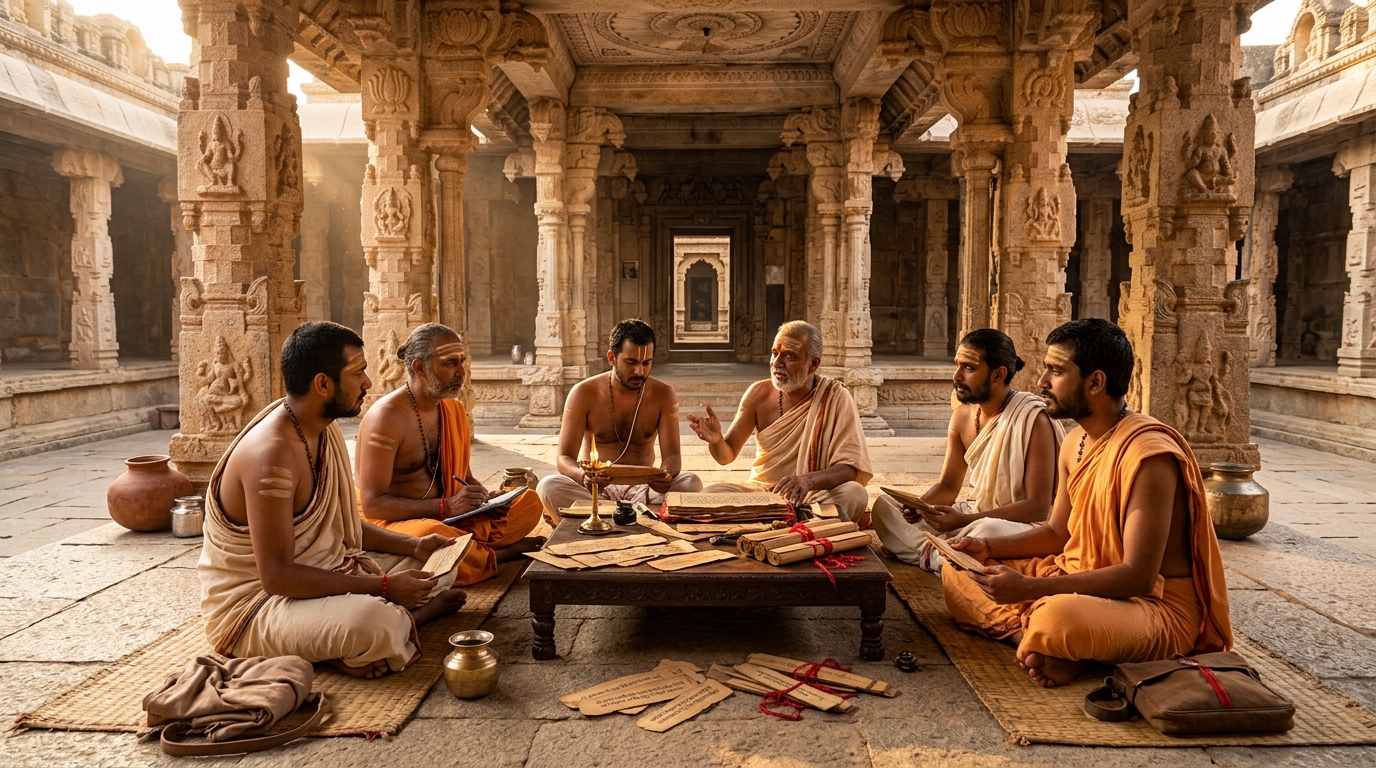
Have you ever wondered how ancient thinkers navigated the profound mysteries of existence, consciousness, and the nature of reality? This hindu darsanas overview invites you to explore the Shad Darshanas, six classical schools of Indian philosophy that offer a structured map for your spiritual and intellectual journey. By accepting the wisdom of the Vedas, these traditions provide you with diverse lenses, ranging from rigorous logic to deep meditation, to help you understand your place in the cosmos.
Whether you are seeking a rational foundation for knowledge or a metaphysical path to liberation, these systems transform abstract concepts into practical tools for living. You will discover how the interplay between pure consciousness and material nature shapes your daily experience and guides you toward moksha, or ultimate freedom. Each school serves as a specialized guide, empowering you to refine your perception and align your life with a deeper sense of truth and purpose.
Key Takeaways
- The Shad Darshanas provide a comprehensive framework for spiritual liberation by combining rigorous logical inquiry with practical metaphysical tools.
- Nyaya and Vaisheshika establish a rational foundation for reality by pairing the art of clear reasoning with a systematic classification of the physical and atomic world.
- The dualistic relationship between Samkhya and Yoga bridges the gap between theory and practice, using intellectual maps and disciplined meditation to achieve self-realization.
- Vedanta and Mimamsa guide the transition from external ethical duty and ritual to the ultimate internal realization of the unity between the individual soul and universal reality.
Logic And Atomism In Nyaya And Vaisheshika
When you begin your journey into the Nyaya school, you are essentially learning the art of thinking clearly through the lens of rigorous logic. Founded by the sage Gautama, this system teaches you that liberation is achieved by gaining right knowledge and eliminating the misconceptions that lead to suffering. You can use the four sources of knowledge, which are perception, inference, analogy, and testimony, to test the validity of your experiences and beliefs. By applying these logical tools, you develop a sharp mind capable of distinguishing truth from illusion in your daily life. This structured approach ensures that your spiritual growth is grounded in rational evidence rather than blind faith alone.
Complementing this logical framework is the Vaisheshika school, which invites you to explore the physical composition of the universe through a systematic classification of reality. Its founder, Kanada, proposed that everything in the material world is made up of indivisible atoms called paramanu, which combine to form the diverse objects you see around you. You can understand the world better by studying the distinct categories of existence, such as substance, quality, and action, which define how matter behaves. This ancient perspective remarkably mirrors modern physics, offering you a bridge between scientific inquiry and spiritual contemplation. By mastering these categories, you gain a profound appreciation for the sum of its parts that sustain our physical existence.
Together, Nyaya and Vaisheshika provide you with a powerful toolkit for navigating both the mental and material realms. While Nyaya gives you the rules of reasoning to avoid intellectual errors, Vaisheshika offers a detailed map of the natural world to ground your understanding. You will find that these two schools work in harmony, using logic to prove the existence of the very atoms that constitute our reality. This partnership empowers you to approach the mysteries of life with a balanced perspective that honors both the intellect and the physical environment. Engaging with these ancient systems helps you build a solid foundation for deeper metaphysical study as you progress through the other darshanas.
Dualism And Discipline In Samkhya And Yoga

When you explore Samkhya, you encounter one of the oldest and most influential metaphysical frameworks in Indian thought. This school introduces a rigorous dualism between Purusha, which is your eternal and unchanging pure consciousness, and Prakriti, the primordial matter that makes up the entire physical and mental universe. You can think of Purusha as the silent observer and Prakriti as the dynamic stage where the drama of life unfolds. By understanding that your true self is separate from the shifting emotions and physical sensations of the body, you begin to dismantle the ego that keeps you bound to suffering. This intellectual foundation is essential because it provides the map you need to navigate the complexities of your own existence.
While Samkhya provides the theoretical map, the Yoga school offers the practical compass to help you reach your destination. Founded by the sage Patanjali, this system accepts the dualistic metaphysics of Samkhya but adds a disciplined methodology to achieve direct experience of the self. You are guided through an eightfold path that includes ethical precepts, physical postures, and breath control to steady the fluctuations of your mind. As you move deeper into meditation, the distractions of the external world fade away, allowing you to perceive the distinction between your consciousness and the material world. This disciplined approach transforms abstract philosophy into a lived reality, leading you toward a state of profound self-realization and inner peace.
Ritual Wisdom And The Insights Of Vedanta
The journey through the Shad Darshanas eventually leads you to Purva Mimamsa, a school that emphasizes the profound power of Vedic ritual and ethical duty. You will find that this system focuses on the correct performance of action as a means to maintain cosmic order and achieve spiritual merit. It teaches you that every ritual act is a seed planted in the universe, governed by the laws of dharma that dictate your moral responsibilities. By mastering these external practices, you develop the discipline and focus necessary to move beyond the physical world into deeper metaphysical inquiries. This school serves as a foundational bridge, preparing your mind for the transition from outward action to inward reflection.
As you progress further, you encounter Vedanta, which shifts your focus from the mechanics of ritual to the ultimate inquiry into the nature of existence. This school invites you to explore the profound relationship between Atman, your individual soul, and Brahman, the universal reality. You are encouraged to realize that the perceived separation between yourself and the divine is often a result of ignorance that can be dissolved through higher knowledge. By studying the Upanishads and reflecting on these truths, you begin to see the underlying unity that connects all of life. This transition represents the pinnacle of Hindu thought, guiding you toward liberation by recognizing your true identity as one with the infinite.
Synthesizing Your Journey Through the Six Schools
Reflecting on these six orthodox schools allows you to see that Hindu philosophy is not a single, rigid doctrine but a vibrant tapestry of analytical and metaphysical perspectives. By engaging with the logical rigor of Nyaya or the atomic theories of Vaisheshika, you gain the intellectual clarity needed to navigate complex existential questions. These systems provide you with a structured vocabulary to describe the world around you, ensuring your spiritual curiosity is grounded in ancient yet sophisticated reasoning. As you integrate these viewpoints, you begin to see how different paths of inquiry can lead to a singular, cohesive understanding of reality.
Embracing the Shad Darshanas offers you a personalized roadmap toward liberation by honoring your unique temperament and intellectual needs. Whether you find resonance in the dualistic nature of Samkhya or the disciplined practice of Yoga, these frameworks serve as a compass for your internal journey. They transform abstract concepts into practical tools for self-realization, helping you bridge the gap between theoretical knowledge and lived experience. By viewing your path through these diverse lenses, you empower yourself to achieve a state of moksha that is both intellectually satisfying and spiritually profound.
Frequently Asked Questions
1. What exactly are the Shad Darshanas?
The Shad Darshanas are the six classical schools of Indian philosophy that accept the authority of the Vedas as their foundation. You can think of them as six different lenses or specialized guides that help you understand reality, consciousness, and the path to spiritual liberation.
2. How can the Nyaya school help me in my daily life?
Nyaya provides you with a rigorous system of logic and four specific sources of knowledge to help you think more clearly. By applying perception, inference, analogy, and testimony, you can sharpen your mind to distinguish truth from illusion and make decisions based on evidence rather than blind faith.
3. What is the relationship between Nyaya and Vaisheshika?
These two schools are often paired together because they complement each other by focusing on the how and the what of existence. While Nyaya gives you the logical tools to process information, Vaisheshika provides a systematic classification of the physical universe and its atomic structure.
4. Why is the concept of moksha so central to these philosophies?
Moksha represents the ultimate goal of your spiritual journey, which is total freedom from the cycle of suffering and ignorance. Each of the six darsanas offers you a unique methodology, whether through logic, meditation, or knowledge, to help you achieve this state of liberation.
5. Do I need to be a scholar to understand these philosophical systems?
You do not need to be an academic to benefit from these teachings because they are designed as practical tools for living. While the concepts have great intellectual depth, you can apply their basic principles to refine your perception and align your daily life with a deeper sense of purpose.
6. How does Hindu philosophy view the connection between the mind and the physical world?
These systems explore the intricate interplay between pure consciousness and material nature to show you how your internal state shapes your external experience. By understanding this mind-body problem, you gain the power to navigate the cosmos with greater awareness and clarity.
7. What makes these ancient schools relevant to a modern seeker?
The Shad Darshanas offer you a structured map for navigating the same profound mysteries of existence that humans have faced for millennia. Their timeless wisdom provides you with a rational foundation for your spiritual growth while empowering you to seek truth through personal experience and intellectual rigor.