

Teen AI thinking offload is the habit of handing reasoning work, such as working out an answer or drafting an argument, to an AI tool instead of doing that thinking yourself. In an August 2026 survey of more than 1,000 U.S. teens, Common Sense Media found that 70% reported using AI for schoolwork, and nearly two-thirds of those users said they used it in ways the report describes as offloading critical thinking. The term builds on cognitive offloading, the broader idea of using an outside aid to reduce the mental effort a task demands. For educators, the open question is whether that reduction supports learning or quietly replaces it.
Among teen AI users, 63% said they get an answer from AI for schoolwork, while 35% improve that answer based on what they know, 31% rewrite it to sound like themselves, and 25% use it as-is. At the same time, 66% said AI helps them understand schoolwork, and 39% said they feel they miss out on learning when AI completes assignments. Only 27% of teens said a teacher had ever talked with them about using AI safely. These figures describe what teens report doing and feeling, and that is the lens to keep as you read every number that follows.
70%
U.S. teens who said they used AI for schoolwork in an August 2026 Common Sense Media survey
63%
Teen AI users who said they get an answer from AI for schoolwork, the most common approach
39%
Teens who said they feel they miss out on learning when AI completes assignments
27%
Teens who said a teacher had ever talked with them about using AI safely
Quick Facts
- Teen AI use for schoolwork: 70% of U.S. teens said they used AI for schoolwork in a nationally representative August 2026 Common Sense Media survey of more than 1,000 teens.
- Most common approach: 63% of teen AI users said they get an answer from AI for schoolwork, the most common approach reported in the survey.
- Feeling of missed learning: 39% of teens said they feel they miss out on learning when AI completes assignments. These are self-reported feelings.
- Teacher guidance on AI: Only 27% of teens said a teacher had ever talked with them about using AI safely.
- Pew benchmark: Pew Research Center found that 54% of 1,458 U.S. teens ages 13 to 17, surveyed between September 25 and October 9, 2025, had used chatbots for schoolwork.
Key Takeaways
- Teen AI thinking offload is the habit of handing reasoning, drafting, or answer-finding to an AI tool in ways that reduce your own thinking, and 70% of U.S. teens in an August 2026 Common Sense Media survey said they used AI for schoolwork.
- Teen AI users in that Common Sense Media survey most often said they get an answer from AI for schoolwork (63%), so you should watch whether students are generating their own reasoning or only receiving finished answers.
- The Common Sense Media figures record what teens say they do and feel, so the 39% who said they miss out on learning is best read as a self-reported feeling that you can then test in your own classroom.
- If you want to know whether a student’s thinking is their own, you should check the process behind the finished work by reviewing dated drafts and asking for a short unaided oral explanation of the reasoning.
What Does Teen AI Thinking Offload Mean?
Teen AI thinking offload is the pattern of relying on an AI tool for schoolwork in ways that reduce your own thinking, whether that means finding the answer, producing the first draft, or settling the argument before you have tried it yourself. The term borrows from an older idea. In their 2016 review, Evan F. Risko and Sam J. Gilbert define cognitive offloading as using physical action to alter a task’s information-processing requirements so that it takes less cognitive effort. Writing a grocery list so you do not have to hold it in memory is a familiar example. You change the shape of the task, and the mental load drops.
AI extends that idea into schoolwork. Instead of jotting notes on paper, a student can hand the job to a chatbot: the reasoning in a math problem, the paragraph in an essay, or the search for a source. In this sense, offloading means handing reasoning, drafting, or answer-finding to a tool rather than working through the problem yourself. The effort is rarely gone entirely. A student may still read the output, edit it, or check it, and that middle ground is what makes the question hard to settle.
For educators, that middle ground is the central issue. Reduced effort is not automatically a loss, since some effort is busywork and some is the struggle through which understanding forms. Assignment design, grading, and classroom policy all depend on telling those cases apart. A teacher who cannot tell whether a finished essay reflects the student’s own reasoning faces a practical problem, not just a philosophical one.
The scope of this article follows that problem. It starts with what the August 2026 survey reports, which is teens’ own accounts of how they use AI and how they feel about it. Those findings are then set beside other research. Pew Research Center surveyed 1,458 U.S. teens ages 13 to 17 between September 25 and October 9, 2025, and found that 54% had used chatbots for schoolwork.
RAND’s American Youth Panel adds a trend line. Its youth panel surveys show the share of students from middle school through college who reported using AI for homework rising from 48% in May 2025 to 62% in December 2025. These studies differ in population, timing, and question wording, so their percentages cannot be swapped for one another. Measuring what students can still do without the tool requires different evidence, which the rest of this article examines.
How Common Is Teen AI Use for Schoolwork?

Seventy percent of U.S. teens said they used AI for schoolwork in a nationally representative August 2026 survey of more than 1,000 teens, and that is the figure to quote first. The same survey asked the 70% who used AI how they used it, and the answers show that getting an answer was the most common approach.
| Approach to AI for schoolwork (share of teen AI users) | Percentage |
|---|---|
| Get an answer from AI | 63% |
| Improve the answer based on what they already know | 35% |
| Rewrite the answer to sound like themselves | 31% |
| Use the answer as-is | 25% |
These percentages add up to more than 100 because respondents could select more than one approach. A teen could get an answer, improve it with their own knowledge, and then rewrite it, and that teen would count in all three rows. Read the table as overlapping categories, not as a split of users into separate groups.
Access is part of the picture too. In the same survey, 44% of teen AI users said an AI tool had been blocked on a school network or device, and 59% of that group said they switched to a personal device to reach AI. If your school restricts tools, you should expect students to find other routes, which makes a building-level policy harder to enforce on its own.
Other surveys point the same way but measure different things. A fall 2025 survey of 1,458 U.S. teens ages 13 to 17 found that 54% had used chatbots for schoolwork, and 10% used them for all or most of their schoolwork. That second figure is a useful reminder that occasional use and heavy reliance are not the same behavior.
A December 2025 RAND youth panel of 1,214 people ages 12 to 29 asked a different question. It found that 67% agreed more AI use for schoolwork would harm students’ critical-thinking skills. That number captures attitudes, not behavior, so it belongs in a separate column from the usage figures.
Before you put these numbers side by side in a faculty meeting or policy memo, check who was surveyed, when, and how each question was worded. Those three details decide whether two percentages can be compared at all.
Do Teens Feel AI Helps or Hurts Their Learning?
Teens tell the same survey that AI helps them understand schoolwork, and many of them also worry it costs them their own thinking. Among teen AI users in the August 2026 Common Sense Media survey, these were the reported perceptions:
| Teens’ own perception (share of teen AI users) | Percentage |
|---|---|
| AI helps them understand schoolwork | 66% |
| AI leads them to generate fewer of their own ideas | 38% |
| They feel they miss out on learning when AI completes assignments | 39% |
Each figure is a share of the same group, not a split of that group into camps. A teen can credit AI with clarifying a concept and still feel that the finished assignment taught them less than it should have.
These are teens’ accounts of their own experience. They describe how students feel about AI and what they believe it does to them. The benefit figure is useful for the same reason it is limited: understanding a topic with help is different from being able to explain it later without help.
The concern figures line up with the offloading pattern described earlier. When 38% say AI leads them to generate fewer of their own ideas, they are describing the step where the reasoning moves from the student to the tool. That is the step where an assignment can stop showing what the student knows.
This is where the practical question begins: which tasks should students still do unaided? UNESCO’s AI Competency Framework for Students, published in 2024, sets progression levels of Understand, Apply, and Create, which gives teachers a workable lens. You might keep idea generation, first drafts of arguments, and first attempts at problems unaided, since those are the tasks where teens report losing their own ideas. You might allow AI to explain a concept, then ask students to answer a fresh question without it.
Choosing those tasks is harder than it sounds, because few states have a clear method for checking learning. Digital Promise’s 2025 review of evaluation guidance from 32 U.S. states and Puerto Rico found that few jurisdictions detailed systematic, large-scale assessment of effects on learning outcomes. The U.S. Department of Education’s August 2026 classroom technology guidance offers a useful question for your own planning: what evidence shows that learning actually improved?
Which Teen AI Survey Numbers Can You Compare?

You can compare these figures only loosely, because the four sources differ in who they asked, when they asked, and how they worded the question. Only figures that share a population, date window, age range, and question wording can be compared directly, and none of the numbers below meet that standard.
| Source and date | Population and age range | Question wording | Headline figure |
|---|---|---|---|
| Common Sense Media, August 2026 | More than 1,000 U.S. teens, nationally representative; age band not reported here | Whether teens used AI for schoolwork; among users, which approaches they used (more than one could be selected) | 70% used AI for schoolwork; 27% said a teacher had talked with them about safe AI use |
| Pew Research Center, fieldwork September 25 to October 9, 2025 | 1,458 U.S. teens ages 13 to 17 | Whether teens had used chatbots for schoolwork, and whether they used them for all or most of their schoolwork | 54% had used chatbots for schoolwork; 10% used them for all or most of it |
| RAND American Youth Panel, May 2025 and December 2025 | Students from middle school through college | Whether students reported using AI for homework | Rose from 48% (May 2025) to 62% (December 2025) |
| RAND, December 2025 | 1,214 youth ages 12 to 29, including young adults | Agreement that more AI use for schoolwork would harm students’ critical-thinking skills | 67% agreed |
The populations do not match. Common Sense Media and Pew both sampled teens, but Pew limited its sample to ages 13 to 17, while RAND’s critical-thinking item reached people up to age 29. RAND’s usage series covers students from middle school through college, so its group overlaps with teens only in part. When you read a percentage, ask whether the group in the sample is the group in your classroom.
The timing also differs. Pew’s fieldwork ended in October 2025, and Common Sense Media’s survey was published in August 2026. A gap between two surveys could reflect a real change, a different sample, or different wording.
Wording may matter most. “Used chatbots for schoolwork” (Pew), “used AI for schoolwork” (Common Sense Media), and “reported using AI for homework” (RAND) describe overlapping but distinct behaviors. RAND’s 67% figure is different in kind: it measures agreement with a statement about harm, so it captures belief rather than use.
Two comparisons are closer than the rest. RAND’s rise from 48% to 62% comes from one panel series asked the same way, so it tells you about direction within that series. The Pew figures are also internally consistent, since they separate any chatbot use for schoolwork from use for all or most of it. When you cite any of these numbers, give the source, date, population, and question alongside the percentage, so readers can judge what the number actually measures.
What Does the Evidence Say About Critical Thinking?
The evidence available so far shows what teens say about AI and schoolwork and how they feel about it. The August 2026 Common Sense Media survey records reported behavior and perceptions, and it contains no skills test given before and after students use AI.
Pew and RAND measure usage and attitudes. RAND’s 67% figure is a clear example. In its December 2025 youth panel of 1,214 people ages 12 to 29, 67% agreed that more AI use for schoolwork would harm students’ critical-thinking skills. That is a belief about harm, and it shows how many young people worry about the risk.
Different kinds of evidence answer different questions, as the table below shows.
| Evidence type | What it records | What it can tell an educator |
|---|---|---|
| Usage or perception survey | Reported behavior and attitudes | Where students are and how they see AI |
| Belief item, such as RAND’s 67% | Agreement with a claim about harm | How young people frame the risk |
| Pre- and post-performance study | The same students’ skill before and after AI use | Whether learning changed |
| Process evidence from student work | Drafts, reasoning steps, and explanations given without the tool | Whether the student’s own thinking appears in the work |
A Digital Promise review from 2025 examined AI-in-education evaluation guidance from 32 U.S. states and Puerto Rico. It found that few jurisdictions detailed systematic, large-scale assessment of effects on student learning outcomes. In other words, even where guidance exists, few jurisdictions detailed how learning outcomes would be assessed.
So before you treat a concern rate or a use rate as proof of harm or benefit, look for a study with a simple design. The best version follows the same students on the same skill, measures them before AI is introduced, measures them again afterward, and includes a comparison group that did not change its practice. A local version might ask students to write an argument unaided in September, repeat the task in January after a term of AI-supported drafting, and compare the results against a class that used no AI.
The U.S. Department of Education’s August 2026 classroom technology guidance offers a useful test for any tool you consider. It asks what evidence shows that learning actually improved. Apply that question to the survey numbers you read, and you will quickly see where the data stops.
How Should Schools Respond to Teen AI Offload?
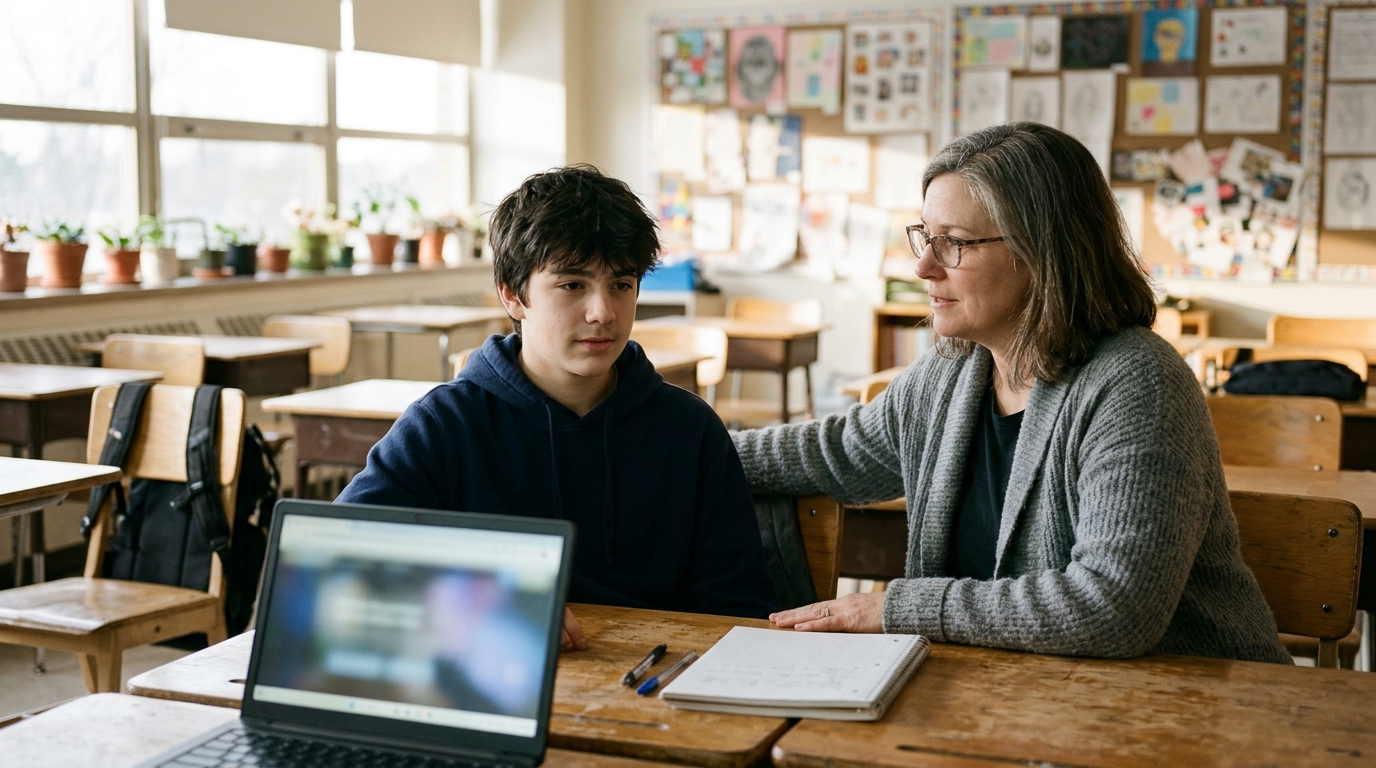
Schools should respond to teen AI offload by combining explicit rules for each assignment, AI literacy teaching, and checks on students’ own process, because blocking tools alone has clear limits. Each approach does different work, and the table below compares them.
| Approach | What it does | Main limit |
|---|---|---|
| Bans and blocks | Restricts AI tools on school networks and devices | Students can route around restrictions on personal devices |
| Explicit permitted-use rules | States which AI uses are allowed for each task | Works only if teachers write clear, task-specific rules |
| AI literacy teaching | Builds understanding of how AI produces output and when to question it | Requires class time and teacher training |
| Process-based assessment | Looks at drafts, reasoning steps, and unaided explanations | Takes teacher time to review work closely |
Blocking is the most visible response, but its reach is limited. Among teen AI users, 44% said an AI tool had been blocked on a school network or device, and 59% of that group said they switched to a personal device to access AI. A block changes where students use AI, not whether they use it, which is why it works best alongside rules and teaching.
Explicit permitted-use rules put the expectation on the assignment itself. A history teacher might allow AI to suggest search terms for a source hunt while requiring that the thesis, the first draft, and the citations come from the student. Stating the rule on the assignment sheet works better than a general policy, because students cannot follow a rule nobody has spelled out.
AI literacy gives those rules a reason. UNESCO’s 2024 AI Competency Framework for Students sets out 12 competencies across four dimensions: human-centred mindset, ethics of AI, AI techniques and applications, and AI system design. Its progression levels are Understand, Apply, and Create. A class might begin at Understand by examining why a chatbot can state errors confidently, move to Apply by checking an AI answer against a textbook, and reach Create only after students have built something without the tool.
Process-based assessment asks for evidence of thinking, not just a finished product. A teacher can review outlines and drafts, ask a student to explain a solved problem in their own words, or set a short unaided response on the same topic. This shows whether the student’s reasoning appears in the work, which is the question a finished essay alone cannot answer.
Federal guidance points toward the same questions. The U.S. Department of Education’s August 2026 classroom technology guidance says states and local communities should lead technology-use decisions and offers schools five selection questions. Among them are what learning problem a tool solves, for whom and how long it should be used, and what evidence shows learning has improved. Neither that guidance nor UNESCO’s framework is a universal legal requirement for U.S. schools, so each district decides how far to adopt them.
How We Compiled These Figures
Every statistic in this article comes from one of the five sources listed below. Each source is labeled below by its publication date, population, and question type, and the article keeps those labels when it uses the figure.
| Source | Date | Population | Question type |
|---|---|---|---|
| Common Sense Media teen survey | Published August 2026 | More than 1,000 U.S. teens, nationally representative | Reported use of AI for schoolwork, approaches among users, and perceptions |
| Pew Research Center | Published February 2026; fieldwork 2025 | 1,458 U.S. teens ages 13 to 17; fieldwork September 25 to October 9, 2025 | Reported chatbot use for schoolwork |
| RAND American Youth Panel | Published March 2026; surveys May and December 2025 | Students from middle school through college (usage); 1,214 youth ages 12 to 29 (belief item) | Reported homework use; agreement with a statement about harm |
| Digital Promise | Published December 2025 | Evaluation guidance from 32 U.S. states and Puerto Rico | Document review, not a survey |
| U.S. Department of Education | July 2025 and August 2026 | Federal guidance for states and schools | Policy announcements, not surveys |
The article reports each figure as its source published it. It does not re-analyze raw survey data, and it does not adjust for differences in wording or sampling. Percentages from different surveys are never combined, averaged, or ranked against one another, because their populations, dates, and questions differ. When two numbers from different sources appear side by side, they show the range of what has been measured, not a single estimate.
Within one source, some percentages overlap by design. In the Common Sense Media survey, teen AI users could select more than one approach to schoolwork, so those shares do not sum to 100%. Treat such rows as separate counts from the same group.
If you reuse a figure, keep its label with it: the source, the date, the population, and the question. A percentage stripped of those details can easily be read as a measure it was never designed to capture.
Which Assessment Approach Shows Real Thinking?

The assessment approach that shows real thinking looks at how a student reached an answer and what the student can still do without a tool, not only at the finished product. A polished essay can hide who did the reasoning, so pair it with evidence from the work itself. Ask for a dated outline, a first draft, and a short reasoning note explaining why the student chose a source or a method. Then check whether the student can explain the same reasoning aloud. A two-minute oral explanation, in which the student walks you through one solved problem or defends one paragraph, shows quickly whether the reasoning belongs to the student.
Pair that process evidence with independent performance tasks completed without AI. Schedule a short, unaided task on the same skill every few weeks, such as a timed paragraph or a problem set with devices put away. Comparing those results with the AI-supported work shows where support helped and where a student still depends on it.
You can also use UNESCO’s Understand, Apply, and Create levels to sequence tasks. At Understand, students use AI to explain a concept and then restate it in their own words. At Apply, they work through an AI-generated example and then solve a new problem with different numbers. At Create, they produce an argument or solution with no tool, and that unaided version is the work you grade as final evidence.
Before adopting any classroom AI tool or policy, ask the selection questions in the U.S. Department of Education’s August 2026 guidance. The guidance offers five questions, and three of them are: what learning problem does this tool solve, for which students and for how long should it be used, and what evidence shows that learning improved? If nobody in the adoption discussion can answer that last question, treat the tool as unproven for your classroom.
Your next step is small. This week, choose one upcoming assignment and add two checkpoints: a dated draft and a five-minute oral explanation. Add one unaided task on the same skill in that unit, then compare what students produce with and without AI before you decide what to keep.
Choosing Assessment Methods That Show Real Thinking
Start with the assignment you give most often, and write its rules on a single sheet before your next class. For each task, name the AI use you allow, the step that must come from the student, and the unaided check that follows. An essay on the causes of a war might allow AI to suggest possible sources, while requiring students to write the thesis and opening paragraph in class, followed by a five-minute oral explanation the next week.
Then take that sheet to your department and ask colleagues to test it on their own assignments. The key question is whether a student could pass the unaided check without the tool. If the answer is no, the permitted use is probably too broad, and the rule needs narrowing before students rely on it.
Finally, keep a simple log for one term. Record each student’s unaided result beside the grade for the AI-supported work, and note every place the two diverge. The log shows you which skills students still need support to perform and which they can perform alone. That record gives your next policy conversation something specific to examine.
Frequently Asked Questions
1. Do schools have to ban AI tools for students?
No. Neither UNESCO’s AI Competency Framework nor the U.S. Department of Education’s guidance is a universal legal requirement for U.S. schools. The department’s August 2026 classroom technology guidance says states and local communities should lead technology-use decisions, so schools choose their own mix of blocking, permitted-use rules, AI literacy teaching, and process-based assessment. Blocking alone has limits, since 59% of teen AI users whose tools were blocked said they switched to a personal device.
2. Can students still use AI for schoolwork without offloading their thinking?
Yes, as long as the AI use is limited to steps that leave the reasoning with the student. A teacher might allow AI to explain a concept, suggest search terms, or check an answer against a textbook, while requiring the thesis, first draft, and problem-solving to come from the student. Pairing that rule with a short unaided check, such as a two-minute oral explanation, shows whether the thinking is actually the student’s.
3. How can parents tell whether their teen is handing their thinking to AI?
The simplest check is to ask your teen to explain an AI-assisted assignment in their own words. A student who understands the reasoning can usually say why an answer works and which parts they changed, while a student who has offloaded that work often struggles. Asking to see an early outline or draft also shows whether the ideas developed over time or appeared all at once.