
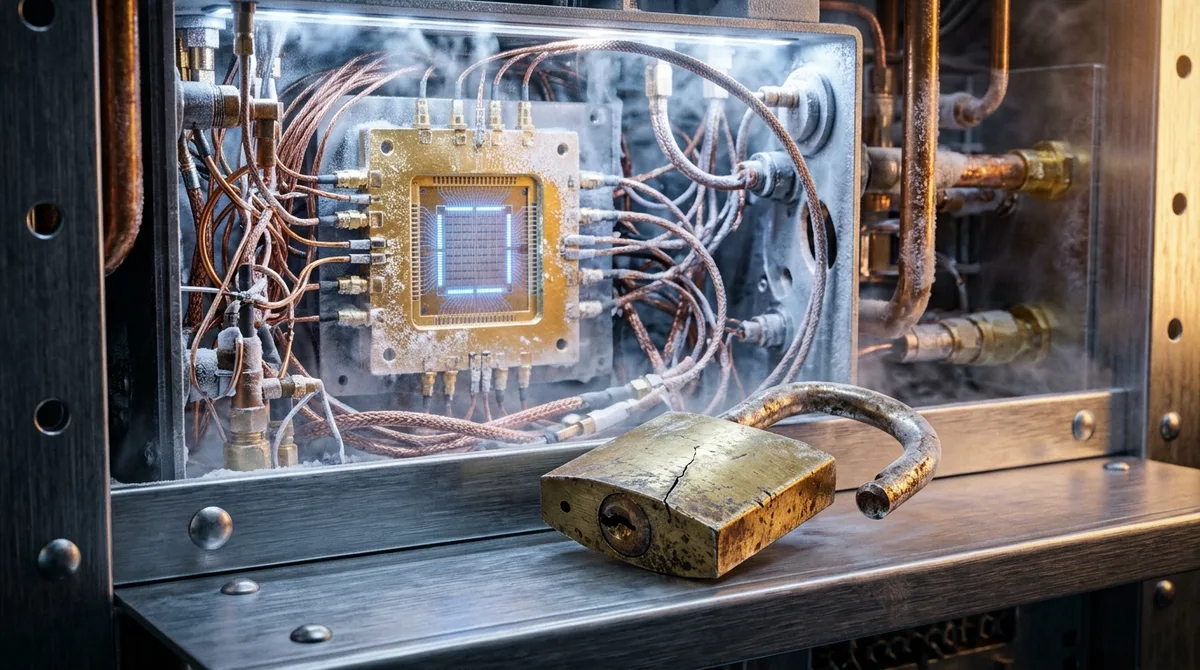
Quantum computing security risks center on one uncomfortable fact: a sufficiently large quantum computer could break the public-key encryption that protects most online traffic today, including systems built on RSA and elliptic-curve cryptography. No one knows exactly when such a machine will exist, so the real question is not only when it arrives but which of your data and systems must stay secure until then. Symmetric encryption, which protects the bulk of stored data, is weakened rather than broken, so public-key systems are the main concern.
The most urgent part is “harvest now, decrypt later.” The National Institute of Standards and Technology (NIST) describes this as capturing encrypted data today in the hope that a future quantum computer will be able to decrypt it. That makes long-lived sensitive information, such as health records, government files and financial archives, the first priority. Data encrypted today may still need protecting many years from now, so waiting is not a neutral choice. NIST finalized its first post-quantum standards, FIPS 203, 204 and 205, on August 13, 2024. For UK organizations, the National Cyber Security Centre sets targets of an initial plan by 2028, priority migration by 2031 and completion by 2035, while US federal agencies face a December 31, 2030 deadline for key establishment on high-value systems under a June 2026 executive order.
Key Takeaways
- Your symmetric encryption, such as AES, can be strengthened by moving to larger key sizes within the systems you already run.
- Any connection still negotiating TLS 1.2 or earlier will gain no quantum protection, so move to TLS 1.3 as soon as possible.
- Treat the arrival date of Q-Day as a planning variable rather than a forecast to bet on.
- Digital signatures, not just encryption, face quantum risk, because a forged signature can make a fake update look genuine.
- You should inventory long-lived embedded devices first, because a controller that cannot take new algorithms may need replacement.
Why Does Quantum Computing Threaten Today’s Encryption?
Quantum computing threatens today’s encryption because the public-key systems that protect most online traffic rely on mathematical problems that ordinary computers find extremely hard to solve, while a large enough quantum computer could solve them efficiently. Consider the padlock icon in your browser. Before your data travels, your device and a website agree on a shared secret key, and public-key cryptography lets them do that without sending the secret across the open internet.
RSA and elliptic-curve cryptography are the two families most widely used for this job. RSA rests on the difficulty of factoring a very large number into its two prime components. Multiplying two primes is easy, but reversing the process becomes so slow for classical machines at real key sizes that it is impractical. Elliptic-curve cryptography relies on a different problem, the discrete logarithm on elliptic curves, which is also easy to compute in one direction and very hard to reverse. Both families also support digital identity. Through digital signatures and certificates, they let your browser confirm that a bank’s website or a software update really comes from the party it claims to be.
The reason this matters is Shor’s algorithm. Mathematician Peter Shor devised a method showing that a quantum computer could factor large numbers and solve discrete logarithms efficiently. A machine capable of running it at scale would undermine the mathematics behind both RSA and elliptic-curve systems at their root. No such machine exists yet, and the date of its arrival is uncertain, but the weakness lies in the underlying math rather than in any particular product, which is why the problem is so serious.
Grover’s algorithm works differently, and the difference is important. It speeds up brute-force search, the method of trying candidate keys one after another until the right one turns up. Symmetric encryption, such as AES, depends on a shared key rather than on a hard mathematical problem, so Grover’s algorithm does not break it. Instead, it reduces the effective strength of the key. The usual response is to use larger key sizes, which keeps the required search out of reach.
That distinction shapes how you should plan. Public-key systems are broken in principle, which means the math that protects them will no longer hold, so they must be replaced with algorithms designed to resist quantum attacks. Symmetric encryption is weakened, so it can generally be strengthened by moving to larger keys within the systems you already run. Treating the two problems as the same would lead you to spend effort in the wrong places.
It is also worth being precise about what is at risk. The threat is to the cryptography, not to the quantum computer itself. A quantum machine does not automatically read your files. The danger is that, once the math behind key exchange fails, an attacker could recover the session keys protecting a communication and read it, or forge a digital identity so that a fake certificate or signed message looks genuine. Protecting against that means changing the cryptography your systems depend on.
Harvest Now, Decrypt Later: Why the Risk Is Already Here
An attacker does not need a quantum computer to start the attack. They only need to copy encrypted data today and keep it. Harvest now, decrypt later means capturing encrypted traffic or files now, in the hope that a future quantum computer will be able to open them. Anyone positioned along a network path, such as an internet provider, a compromised router or a hostile intelligence service, can record scrambled data without breaking anything. The ciphertext looks like noise, but storage is cheap, so an attacker can keep it for years.
Not all data is equally exposed. The greatest danger falls on information whose secrecy lasts for decades. A stolen card number can be cancelled, but a medical history, a patent design, a diplomatic cable or a personal financial record stays sensitive long after it was written. These are the records a patient, an inventor or a government would want protected for the rest of their lives, which is exactly why attackers would target them.
Historical backups carry the same risk. Suppose your organization keeps an encrypted archive for ten years. If the key exchange that protected that archive used RSA or elliptic-curve cryptography, and an attacker recorded that exchange at the time, the archive can be opened later once a capable quantum machine exists. The data itself was never copied in plain form, but the key that unlocks it was exposed at the moment it was agreed.
Transport security is part of the same picture. In October 2026, the UK National Cyber Security Centre said that TLS 1.3 is the only version of Transport Layer Security that supports post-quantum cryptography, and it recommended moving from TLS 1.2 or earlier to TLS 1.3 as soon as possible. If your systems still negotiate older versions, the connections they carry today may never gain quantum-resistant protection at all.
You also cannot tell in advance whether someone has already copied your traffic. A passive copy usually leaves no trace in the logs you keep, so an organization may have no evidence of a breach even when its data has been captured. That is why the exposure begins before any quantum machine exists. Every message sent with vulnerable key exchange adds to a store that an attacker may open in a few years.
For that reason, waiting is not a neutral choice. The UK National Cyber Security Centre estimates that large organizations, and those running their own IT infrastructure, may need two to three years for discovery, assessment and initial planning, followed by another two to three years of early migration. Data you protect with today’s methods may still need protecting when that migration finally finishes.
When Could Quantum Computers Break Encryption?
No one can name the year, because Q-Day, the point at which a cryptographically relevant quantum computer could break widely used public-key encryption, has not arrived, and its timing depends on how quickly the underlying technology matures. Some researchers think such a machine could appear relatively soon, while others place it much further away. Both camps are serious, and both are working from real evidence.
The disagreement comes from different assumptions about three things. The first is hardware progress: how quickly engineers can increase the number of qubits, the basic units of quantum information, on a single machine. The second is error correction. Today’s qubits are fragile and make frequent errors, so a reliable calculation may need many physical qubits to behave as one stable logical qubit. Estimates of that overhead vary widely, and small changes in the assumed overhead can shift the date by years. The third is engineering difficulty, including cooling, control electronics and manufacturing at scale, which is easy to underestimate.
When a question has several serious answers, we aim to explain the disagreement rather than hand you a single conclusion. Picking the most optimistic forecast, or the most alarming one, means adopting one set of assumptions and ignoring the others. A better approach is to read the range as information. If your organization’s plans only work when Q-Day is far away, they are fragile. If they work across the whole range, they are much more useful.
Uncertainty about timing matters most because migration takes time. Replacing public-key cryptography is not a single software update. You must find every place your systems use it, test replacement algorithms, update certificates and libraries, and coordinate changes with vendors and with partners who depend on your connections. Large organizations with older equipment need years to complete this work. That lead time means planning has to begin before the date is known, because waiting for certainty means you will only start once the threat is already here.
Uncertainty also cuts in both directions. If Q-Day arrives late, the harvest-now risk does not disappear. Data captured today can still be opened decades from now, so a distant machine still threatens information that must stay secret for a long time. If Q-Day arrives early, there may be little time left to act. An organization that has not yet started migration would then be racing to replace systems it has not even inventoried.
Taken together, these points mean you should treat the arrival date as a planning variable rather than a forecast to bet on. Plans that protect long-lived data and begin the work early hold up whether the machine arrives sooner or later.
What Happens to Digital Signatures, Certificates and Blockchains?
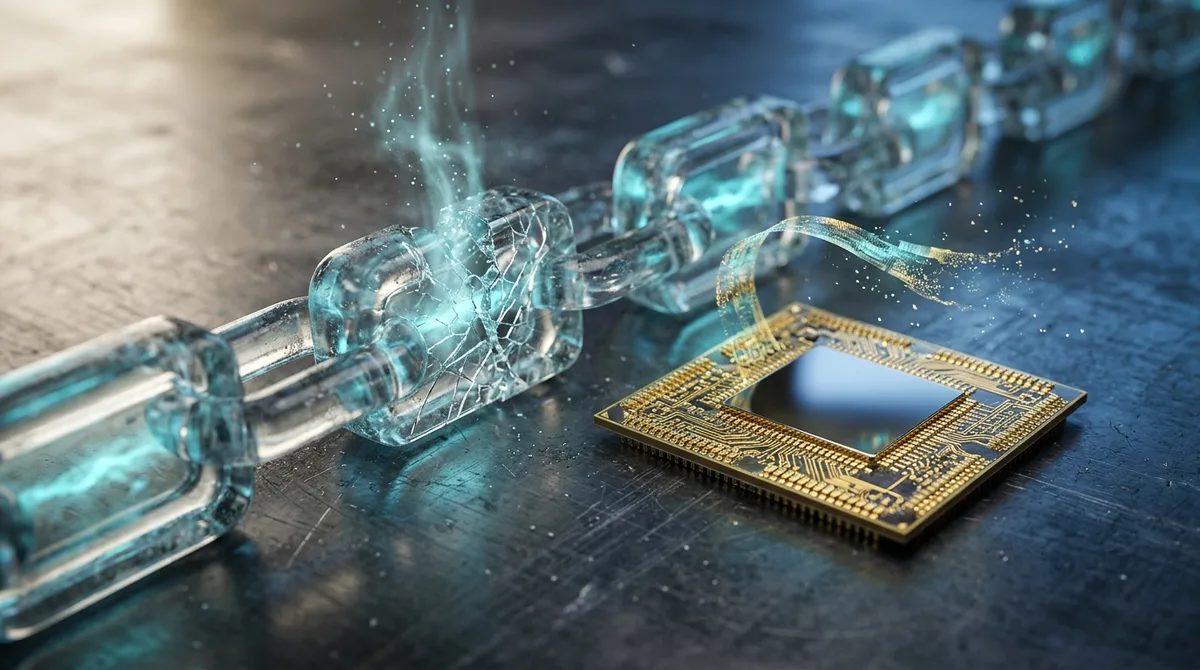
A quantum attack on the public-key mathematics behind digital signatures would let an attacker forge them, so a fake document, software update or transaction could appear to come from its real owner. Encryption hides data from prying eyes, but a signature answers a different question: who created this, and has it been altered since? Both jobs rely on the same families of algorithms, so the integrity side of the quantum threat matters as much as the confidentiality side.
A signature works like this. The signer holds a private key that nobody else can see and uses it to produce a signature over some data. Anyone with the matching public key can check that signature, and a valid result tells them the data came from the key holder and has not changed. If a quantum computer could recover the private key from the public one, which RSA and elliptic-curve systems would allow, the check would still pass for the attacker’s forgeries.
Certificates are where this touches daily life most directly. When your browser connects to a bank, a certificate vouches that the server really belongs to that bank. The certificate is itself a signed statement, built on RSA or elliptic-curve cryptography. A forged certificate would let an attacker impersonate a trusted service and present a convincing padlock for a site you never intended to visit.
Secure boot shows the stakes at the lowest level of a device. When a computer starts, secure boot checks that the firmware and boot components carry a signature from a trusted party before they run. If those signatures could be forged, an attacker could load malicious code before the operating system starts. Security software running inside the operating system would already be working on compromised ground, and the malware would sit beneath everything that might detect it.
Software updates face the same risk. Vendors sign their updates so that your devices accept only code they produced. A forged signature would let an attacker distribute a harmful update that looks routine, which is why update signing is such an attractive target.
Blockchains and cryptocurrency wallets depend on signatures in much the same way. A transaction is authorized when its owner signs it with the private key that controls the funds. On some networks, the public key becomes visible on the chain once funds are spent from an address, so funds whose public keys are already exposed belong to the quantum conversation. How serious this is depends on each network’s design and on whether it can adopt new signature schemes through an upgrade. A network with a clear path to post-quantum signatures faces a very different problem from one that cannot change its rules easily. If you hold digital assets, ask not only which signature method your wallet uses but who can change it, and how quickly they could do so.
Which Legacy Systems and Assets Are Most Exposed?
The most exposed systems are the ones that are hardest to change and that stay in service the longest. In practice, that means embedded devices in factories, hospitals and vehicles, financial ledgers that must stay trustworthy for years, and any asset your organization has never listed. How long a system runs matters more than how important it looks on paper.
Legacy Internet of Things (IoT) and embedded devices deserve the most attention. A programmable controller running a production line, an infusion pump on a hospital ward, or the control unit inside a vehicle may be installed once and then run for many years. Many were built around a fixed set of cryptographic algorithms in their firmware. A software update can add features, but it cannot always add an algorithm the chip was never designed to run. Replacing the hardware may mean halting a production line, recertifying a medical device or redesigning a vehicle platform, so the work is slow and costly.
Financial ledgers present a different problem. Banks, insurers and payment processors keep transaction records that must remain verifiable long after they were written, sometimes well beyond the life of the software that created them. Exposure builds over time because every year of records signed or encrypted with today’s methods adds to the material a harvest-now attacker could keep. If only part of a ledger is migrated, older entries remain protected by signatures a quantum computer could forge, so the integrity of the whole record depends on its weakest segment.
AI changes the speed of the problem rather than creating a separate quantum threat. Attackers can use AI tools to scan networks for weak configurations, identify unpatched systems and draft exploit code much faster than before. Defenders can use the same tools to inventory assets, read configuration files and test systems under realistic conditions. Treat AI as an accelerant that shortens every timeline. An organization that is slow to find its own cryptography may find that automated attackers reach it first.
Organizations with many legacy systems face the largest migration effort, because the work is done asset by asset. Each device, platform and vendor relationship may need its own plan, its own testing and its own window for change. Vendor support can decide what is possible. A controller whose manufacturer no longer issues updates cannot be migrated by its owner alone, and that dependency may force a replacement decision rather than a configuration change. A company with a handful of systems faces a manageable list, while a large enterprise spread across many sites faces a very large number of separate decisions.
That is why inventory comes first. The U.S. Quantum Computing Cybersecurity Preparedness Act directs federal agencies to inventory their vulnerable information technology, and the Act exempts national security systems. The lesson applies well beyond government. You cannot prioritize what you have not found, and hidden devices are often the ones most likely to keep running unchanged for years.
Which Post-Quantum Standards Should You Plan Around?

Plan around the three finalized standards, FIPS 203, FIPS 204 and FIPS 205, together with the additional key-encapsulation algorithm selected to back them up. These give you a concrete target instead of a research goal. The standards were finalized on August 13, 2024, so the question is no longer whether usable post-quantum algorithms exist but which ones fit your systems.
FIPS 203 specifies ML-KEM, which handles key establishment, the step where two parties agree on a shared secret for a session. FIPS 204 specifies ML-DSA for digital signatures, the tool that proves a document, certificate or software update is authentic. FIPS 205 specifies SLH-DSA, a second signature option built on hash functions rather than on the lattice mathematics behind ML-DSA. SLH-DSA produces larger signatures and runs more slowly, but its security rests on a different and well-studied foundation, which makes it a useful choice for high-value signing keys.
Diversity matters because a single mathematical approach could turn out to have a weakness. On March 11, 2025, HQC was selected for standardization as an additional key-encapsulation algorithm. HQC is built on error-correcting codes rather than on lattices, so it offers a second route to quantum-resistant key exchange. Planning around it now means your key-exchange design will not depend on a single family of problems.
During the transition, many organizations use hybrid approaches, which combine a classical algorithm such as elliptic-curve Diffie-Hellman with a post-quantum algorithm in the same exchange. The session key is derived from both, so an attacker would have to break both to recover it. Hybrid designs protect against a flaw in the new algorithms while keeping the proven classical protection in place. They also let you move forward before every partner, browser and device supports the new algorithms alone.
Transport security is the most practical place to start. In practice, that means checking every web server, load balancer, API gateway and internal service for the protocol versions it negotiates. Where older clients still connect, you will need to decide whether to upgrade them or isolate them, because a connection that falls back to TLS 1.2 gains no quantum protection at all.
Crypto-agility is the design principle that makes all of this manageable. A crypto-agile system is built so its algorithms can be swapped through configuration or a library update, without rewriting the application around them. Systems that hard-code a single algorithm into software or firmware force a rebuild every time the standards change. Agility lets you adopt ML-KEM, add HQC later, or replace a weakened algorithm on your own schedule.
Crypto-agility depends on knowing what you have, which is why a cryptographic inventory comes first. An inventory records which systems use which algorithms, which key lengths and protocol versions they negotiate, where certificates and signing keys live, how long the protected data must stay secret, and which vendor controls each component. Without that record, you cannot tell which connections face harvest-now exposure or which devices can accept a software update. Each entry also tells you whether a system can take a hybrid configuration, needs a protocol upgrade, or must be replaced. The inventory is therefore the first step of any migration, and every later decision about standards, hybrid designs and TLS upgrades depends on it.
Migration Deadlines, Mandates and Migration Costs
The Quantum Computing Cybersecurity Preparedness Act of 2022 directs federal agencies to inventory their vulnerable information technology and requires guidance from the Office of Management and Budget (OMB) for prioritized migration planning. The Act exempts national security systems, so its requirements reach civilian agencies and their systems rather than the most sensitive military and intelligence networks.
The timeline tightened in June 2026, when a White House executive order set firmer dates. Agencies must move their high-value assets and high-impact systems to post-quantum key establishment by December 31, 2030, and to post-quantum digital signatures by December 31, 2031. If your organization sells to the federal government, the same order matters to you. It directs the Federal Acquisition Regulatory Council to publish a proposed rule requiring covered contractors to comply with applicable NIST FIPS, including the post-quantum algorithms, by December 31, 2030. That is a proposal, not a finalized contractor rule, so watch for the final text before treating it as settled law for your contracts.
OMB memorandum M-26-15 turns those goals into agency work. It requires agencies to prioritize migration of their cryptographic systems, with the objective of mitigating as much quantum risk as feasible by December 31, 2030. Each agency must also submit a migration plan within 120 days of the memorandum. A plan is only as good as the inventory behind it, which is why the earlier inventory requirement matters so much.
NIST’s October 2026 transition report, NIST IR 8547, sets a separate track. It establishes 2030 to 2035 phaseout milestones for specified quantum-vulnerable algorithms under NIST standards and guidelines. Those milestones tell you when older algorithms stop being acceptable, so a system that still depends on them will eventually fail a compliance review.
The UK timelines come from National Cyber Security Centre guidance. They describe targets that organizations are expected to plan toward, which differs from the fixed dates set for US federal agencies. Comparing the two helps you see that quantum readiness is being written into both public procurement and industry expectations at the same time.
Cost is the hardest part of the picture to pin down, and the best evidence is candid about that. A 2025 report commissioned by the UK government recorded interviewees’ rough estimates. In their view, a “plug and play” transition could cost about £100,000, while a more radical change could cost millions of pounds. These are interview estimates, not a universal price, so read them as a sense of range rather than a budget line.
The spread between those figures is itself informative. A plug-and-play change assumes that your systems already accept new algorithms through configuration or a library update. A radical change assumes that hardware, protocols and vendor relationships must all be rebuilt. Organizational scale multiplies the effect, because a company with a few servers faces a very different job from a bank running a large number of applications across many sites. Legacy systems add to the expense. A factory controller or hospital infusion pump may need physical replacement, recertification or a vendor’s cooperation before it can move at all. Budget for the migration you actually have, not the one a general estimate describes.
Taking the First Step Toward Quantum Readiness

Start with a cryptographic inventory, and treat it as a working document rather than a one-time audit. List every place your organization uses encryption, digital signatures and key exchange, including the less obvious places: firmware inside devices, remote management interfaces, backup systems and certificates embedded in vendor products. For each entry, record the algorithm, the key length and the protocol version it negotiates.
Next, rank those systems. Place first the ones whose data must stay secret for the longest time and the ones that are hardest to update, such as a controller on a factory floor that cannot easily accept new software. A patient archive that must stay confidential for decades belongs ahead of a brochure website, even if the website is more visible to customers.
Then turn to your suppliers. Ask each vendor for its post-quantum migration roadmap, including dates for each product, and ask whether its systems support crypto-agility, meaning algorithms can be swapped through a configuration change or library update. A vendor that cannot answer either question clearly is telling you how expensive your next upgrade may be.
Finally, build a calendar around the government and standards dates that apply to your sector and region. Treat each date as a minimum milestone rather than a finish line. Organizations that start early have room to adjust when standards, vendor support or the threat itself changes.
Turning the Plan Into Action
Start by naming one accountable owner for your cryptography program this week. Quantum readiness tends to fail when it falls between security, procurement and operations, and nobody holds the inventory, the vendor questions and the calendar at the same time. Give that person the authority to request logs, pull configuration files and speak directly with suppliers.
Then choose one pilot. Pick an internal service that carries long-lived data, such as an archive replication link or an internal API, and move it to TLS 1.3 with a hybrid key exchange. A single working example gives your team a tested pattern, shows which load balancers, libraries or client builds need upgrades, and produces a measured cost you can compare with the broad interview estimates.
Finally, put the commitment in writing. Ask leadership to approve a funded plan with a named date for your first migration report. Ask procurement to add a clause to every renewal requiring each supplier to state its post-quantum roadmap and whether its products support crypto-agility. Once those decisions are signed, you have moved from reading about the threat to managing it, and you can take the next step in your own systems.
Frequently Asked Questions
1. What is quantum-safe cryptography?
Quantum-safe cryptography, also called post-quantum cryptography, refers to algorithms designed to resist attacks from quantum computers while running on ordinary, everyday computers and devices. Its goal is to replace the RSA and elliptic-curve methods that a large quantum machine could break, without requiring anyone to build quantum hardware. Because these algorithms rely on different mathematical problems, they are meant to remain hard even for Shor’s algorithm.
2. Do small businesses need to worry about quantum computing security risks?
Yes, if your business stores customer records, medical or financial details, or other information that must stay confidential for many years, because harvest-now attacks do not depend on company size. Small organizations usually have fewer systems to inventory, so the migration list may be far shorter than a large enterprise’s. Many small businesses, however, depend heavily on software and devices from outside vendors, so their timeline will often be set by whether those suppliers offer quantum-resistant options.
3. How can I find out which systems in my organization use vulnerable encryption?
Start by checking the public-facing and internal web services, since they reveal the TLS protocol version and key exchange they negotiate when a client connects. A standard TLS scanning tool can report these details, and your IT team can review certificates to see which algorithm and key length each one uses. Then ask staff and vendors about embedded devices, remote management tools and backup systems, because those components are the easiest to overlook.
4. How fast can a quantum computer break encryption?
Nobody can give a reliable speed, because no quantum computer large and stable enough to run Shor’s algorithm on real key sizes has been built yet. Once such a machine exists, the time needed to break a key depends on how many stable logical qubits it can sustain and how long it can run without errors overwhelming the calculation. Shor’s algorithm needs far fewer steps than classical methods, which is why a task that would take ordinary computers an impractical length of time could be completed in a practical timeframe by a capable quantum machine.