

The ethics of space colonization asks who should benefit from building permanent human settlements on the Moon and beyond, and who should carry the risks if those settlements fail, cost too much, or damage the places they occupy. The question is no longer purely speculative. Article II of the Outer Space Treaty, drafted in 1967, says that no nation may claim the Moon or any other celestial body through sovereignty claims, use, or occupation. That treaty was written long before government agencies and private companies began planning to work, mine, and live off Earth. The gap between that old agreement and today’s plans is where the moral debate begins. You will meet three groups in this debate: policymakers who write the rules, investors who fund the projects, and the wider public whose resources, environments, and futures are at stake.
Timing makes the discussion urgent. NASA’s Artemis IV mission is targeted for an early-2028 crewed lunar landing, with two astronauts expected to spend about a week near the Moon’s South Pole. Plans like these turn old science fiction questions into practical ones: who decides how land and resources are used, who gets to take part, and who pays if things go wrong. Serious thinkers disagree sharply on these points, and philosophy rarely offers a single verdict. When a question has several serious answers, our aim at Philosopedia is to explain the disagreement clearly so that you can weigh the arguments yourself.
Key Takeaways
- Judging a lunar settlement fairly means weighing commercial opportunity against safety, scientific, environmental, or distributive risks all at once.
- You can judge settlement spending fairly only by counting benefits across all affected people, including future generations.
- Under U.S. law, companies may sell recovered space resources only after government authorization and continuing supervision.
- COSPAR’s planetary-protection policy does not protect the Moon for its own sake, so broader ethical reasoning must fill that gap.
- A space project can open access to everyone while still failing to share benefits or allocate risks fairly.
Why Is Space Colonization an Ethical Question at All?
Space colonization is an ethical question because it plans for people who will live and work on the Moon, Mars, or elsewhere, not just visit for a few days. An exploratory mission plants a flag, gathers samples, and leaves. A settlement stays, so its decisions about housing, power, water, waste, and mining shape the places it occupies for decades. Once people are meant to remain, questions of responsibility remain with them.
Moral questions arise because settlement spreads risk and benefit unevenly. The people who fund a program may gain from resource rights or national prestige, while the crews who live in a habitat carry the danger of a failed system. Policymakers must decide which rules apply and who enforces them. Investors weigh potential returns against the chance that costs rise or projects stall. The wider public, on Earth and in any future off-world community, has resources, environments, and futures at stake, yet often has little say in the decisions.
The question is current rather than hypothetical. NASA’s latest Artemis update plans Artemis III as a test flight in 2027, a year before Artemis IV is targeted to land on the Moon. Each step turns abstract principles into practical choices about where people go, what they do there, and who answers for the results.
Ethics here means weighing commercial opportunity against four kinds of risk: safety, scientific, environmental, and distributive. A company may see a valuable water supply near the South Pole, while scientists worry that mining could contaminate the environment they hope to study. Crews face hazards that must be managed, and communities may ask whether the benefits reach anyone beyond shareholders. A sound judgment has to hold all of these in view at once rather than optimizing for a single goal.
Existing law covers only part of this ground. The Moon Agreement describes the Moon and its natural resources as the “common heritage of mankind,” and it calls for an international regime once exploiting them becomes feasible. COSPAR’s planetary-protection policy, meanwhile, concentrates on biological contamination and states that it does not protect the Moon or other bodies for their own sake. Treaties tell us what states must avoid. They say far less about what a responsible settlement should look like.
Filling that gap requires moral reasoning that no treaty supplies. The sections that follow take up ownership, environmental protection, historical patterns, and access one at a time, so you can test each argument against the facts and decide where you stand.
Is Building Settlements Off Earth Worth the Cost?

Building settlements off Earth is worth the cost only if the benefits, counted fairly across everyone affected, outweigh the risks and the other good the same money could do. Thoughtful people disagree about whether that test is met. The strongest case for settlement begins with the existential risk argument. An existential risk is one that could destroy humanity or permanently cripple its future. Supporters argue that a species living on a single planet has all its eggs in one basket. A large asteroid strike, a pandemic, or a catastrophic war could threaten everyone at once, while a self-sustaining settlement elsewhere might survive and carry human life forward.
It helps to lay this argument out as premises and a conclusion. The first premise says that humanity’s survival matters enormously, because the future it could hold is vast. The second says that a population confined to one world faces catastrophes that could end it entirely. The third says that a settlement beyond Earth would reduce that risk. The conclusion is that spending on settlement is justified. The asteroid example illustrates the second premise, but it does not prove it alone. You need to ask how likely such events are and whether a settlement would really survive them.
The utilitarian version asks you to weigh costs and benefits directly. Utilitarianism judges an action by its total effect on well-being, so the question becomes whether settlement produces more good than the alternatives. That calculation has to include all affected people, not only today’s taxpayers or astronauts, and it must count future generations too. Here uncertainty matters a great deal. A tiny probability of preventing a catastrophe, multiplied by an enormous future population, can dominate the arithmetic. Yet small changes in the assumed probabilities, or in how heavily you weigh distant futures, can flip the result.
The costs are concrete. NASA’s Office of Inspector General projected Artemis campaign costs of $93 billion for fiscal years 2012 to 2025, with at least $4.2 billion per launch for the first four Artemis missions. That projection excludes $42 billion in earlier formulation and development costs for the systems.
The opportunity cost critique answers with a different premise. Resources are limited, so every dollar spent on a lunar program is a dollar not spent elsewhere. Critics argue that climate change is a documented, present threat to people now living, and that money could instead fund emissions reductions, flood defenses, and adaptation in vulnerable regions. Defenders may reply that space programs also produce technologies and scientific knowledge that help on Earth. Both sides are making empirical claims that can be checked, so each should be judged on its evidence rather than its rhetorical appeal.
To evaluate either argument, our editorial approach at Philosopedia is to separate its premises from its illustrations. Ask whether each premise is stated clearly, whether it is true or plausible, and whether the conclusion really follows. Then ask whether the vivid examples carry weight beyond their emotional force. A dramatic catastrophe or a striking cost figure can persuade without establishing the general claim.
Who Owns the Moon and Its Resources?
Under current law, no nation can claim the Moon as its own. That answer settles only the narrowest part of the question, though. It leaves open who may use lunar land and resources, who keeps the returns, and who gets a say in those choices.
Philosophers have long distinguished between shared and controlled forms of ownership. Shared ownership means that a resource belongs to a community, so decisions and benefits are held in common. Controlled ownership means that one party, whether a state or a company, decides how the resource is used and keeps most of what it produces. The space debate turns on which model fits the Moon. John Locke argued that property arises when a person mixes their labor with something unowned, but he attached a condition: enough and as good must be left for others. A company that extracts water ice from a crater might claim that its labor justifies ownership, while critics ask whether that claim respects the others who were never consulted.
The Moon Agreement tried to settle this in favor of shared ownership. Its common heritage principle treats lunar resources as belonging to humanity as a whole, not to whoever reaches them first. The difficulty is that many spacefaring actors have not joined it. Its principle is therefore contested rather than settled, and a principle that many spacefaring actors have not accepted cannot yet function as a working rule for everyone.
Once you move past treaties, governance questions multiply. Who sets the rules for mining, habitation, and transport? Who enforces them when a dispute arises on a distant surface where no court sits nearby? And if a settlement profits from lunar resources, must those benefits reach people who took no part in the mission, such as citizens of countries that cannot afford to fly, or generations not yet born?
Practical arrangements already show the tension. NASA describes Artemis Accords safety zones as temporary, operation-specific areas set up for notification and coordination, meant to prevent harmful interference, and signatories commit to respect free access to all areas of celestial bodies. Those are policy commitments among signing states rather than a binding allocation of land. Yet a safety zone around a landing site is still a space that others may not enter for a time. Near the lunar South Pole, where the Artemis IV crew is expected to spend about a week, the choice of where that zone begins and ends could decide who gets access to the most valuable ice.
Ownership, in other words, is about more than legal title. It concerns use, access, and the authority to exclude others from a shared place. Whether the Moon should be treated as a commons, a frontier, or a set of claims is a question that requires moral argument, because the law has not yet answered it.
Can Companies Claim Space Resources Under U.S. Law?
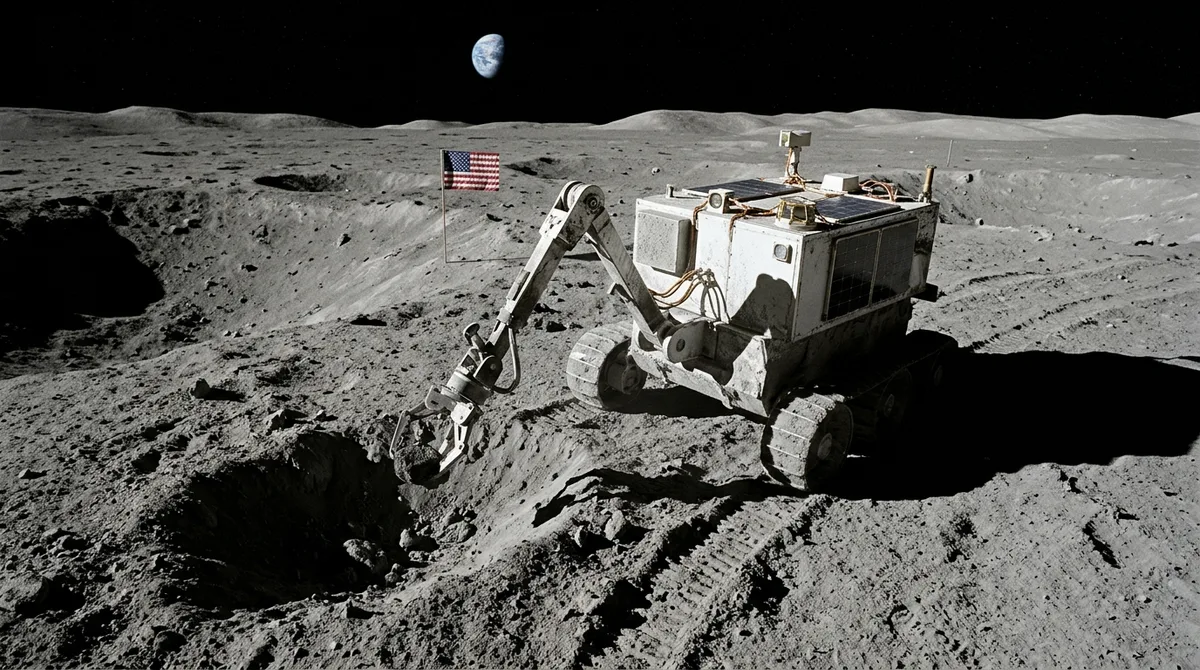
Yes, but only under conditions. U.S. law allows companies to hold and sell space resources they recover, provided the government authorizes the activity, keeps supervising it, and the activity respects the country’s international obligations. The Commercial Space Launch Competitiveness Act defines a “space resource” as an abiotic resource, meaning one that is not living, found in place in outer space. The definition explicitly includes water and minerals.
The statute then gives recovered resources a set of rights. They may be possessed, owned, transported, used, and sold, subject to applicable law and U.S. international obligations. Commercial recovery by U.S. citizens also requires authorization and continuing supervision by the Federal Government. These two provisions pull in different directions. The first gives companies the ownership that makes investment attractive, while the second keeps public authority involved. Ethically, the question is whether that balance protects the public or simply makes private gain look orderly. A company that owns the ice it extracts holds a lasting asset, while the public’s interest enters mainly through the supervision the statute requires.
Licensing is one place where that supervision takes shape. Commercial launch and reentry licensing is governed by 14 CFR Part 450, and the Federal Aviation Administration explains that a vehicle-operator license may authorize launch, reentry, or both. Payload review is normally part of launch or reentry authorization, so officials examine what a spacecraft carries before it leaves Earth or returns. That gives reviewers a moment when public concerns can be raised. The system, however, was built around vehicles and their cargo in transit. It is not clear that the same scrutiny reaches digging, processing, or storing resources on a lunar surface, and that gap matters to the people who would bear those risks.
Safety zones raise a subtler issue. NASA describes Artemis Accords safety zones as temporary, operation-specific areas set up for notification and coordination, intended to avoid harmful interference. Signatories also commit to respect free access to all areas of celestial bodies, as NASA’s description of the Accords explains. A safety zone is not a territorial claim, and it is meant to end with the operation it protects. Yet the ethical concern is practical. A zone drawn around a productive ice deposit could last for years of mining, grow with each new operation, and quietly become an exclusive area that others cannot approach, even though the stated commitment promises free access.
To test whether a zone is still doing its stated job, you can ask a few concrete questions. Who receives the notification, and who decides whether an activity is causing harmful interference? When does a zone end, and what happens if equipment stays behind after the operation finishes? Does the public that funded the mission learn anything about how the zone was used? Each answer shows whether a safety measure protects shared access or gradually narrows it.
Should We Protect the Environment of Other Worlds?
Article IX of the Outer Space Treaty requires states to avoid harmful contamination of celestial bodies. It also requires them to hold international consultations before a planned activity that may cause potentially harmful interference with another state’s peaceful space activities.
The main technical guideline is COSPAR’s Planetary Protection Policy, approved on June 17, 2020. It addresses organic-constituent and biological contamination, meaning the risk that a spacecraft carries Earth microbes to a place where they could confuse scientific results, or that returned samples bring something unknown back to Earth. Its reach is narrower than many readers expect. COSPAR states that the policy does not protect the Moon or other bodies for their own sake, and that it does not cover cultural heritage or space debris.
For many lunar missions, the technical constraints are light. COSPAR states that no technical planetary-protection constraints apply to one-way missions to the Moon or to lunar-resource sample returns. Missions to the lunar polar regions and permanently shadowed regions face more demands, including more thorough documentation and requests for organic inventories. Those areas are of special scientific interest and may preserve material that has changed little over long periods.
The deeper question is moral status. Environmental ethics has long asked whether nature matters only for what it provides to people, which is instrumental value, or also for what it is, which is intrinsic value. A lunar plain has no ecosystem to lose, so the instrumental case looks thin. Yet its unaltered surface and its record of the early solar system give many people reason to think it deserves protection regardless of human use. If that view is right, the burden of proof shifts. Those who would alter a place should have to justify the change, not those who would leave it alone.
Terraforming sharpens this question. Terraforming means deliberately changing a world’s atmosphere, temperature, or soil so that humans can live there without special protection, and Mars is the usual example. Supporters argue that a lifeless world gains value when it becomes a living environment. Critics reply that the change is effectively permanent, that it is made by a small group on behalf of many, and that it erases whatever the original world was. Asking whether a world’s intrinsic value can be outweighed by human benefit forces you to say which of those losses you think matters most.
Some researchers have pressed the point further. A peer-reviewed paper on ethical exploration, by Frank Tavares and colleagues, argues that planetary-protection policy should be reevaluated in light of colonial practices and the environmental consequences of in-situ resource use on the Moon and Mars. Treaties and guidelines can tell you what must be avoided. Deciding what is worth keeping still requires moral reasoning.
Is Space Settlement Repeating Colonial History?
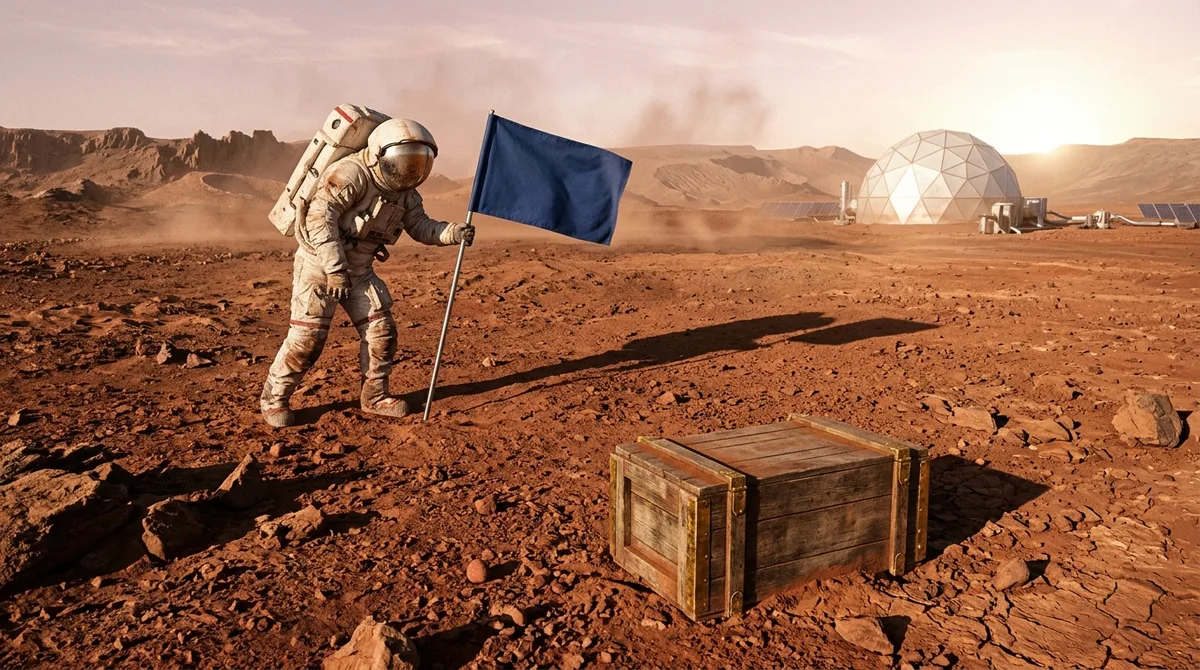
Critics say it can, at least in its language and in the habits it encourages. Settler colonialism on Earth often followed a familiar script: a territory was described as empty or unclaimed, its existing inhabitants were treated as obstacles, and newcomers backed their claims with the power to enforce them. The word “frontier” carried that script for centuries by framing displacement as progress. When agencies and companies speak of pioneers, new worlds, and claiming resources, critics hear the same vocabulary and ask whether it will produce the same outcomes.
Indigenous perspectives press this concern with a sharper question: does anyone have the right to claim space as new territory at all? Many Indigenous thinkers have pointed out that the idea of land belonging to no one, known as terra nullius, was used on Earth to justify taking land that was already lived on and governed. They ask whether consent from Earth’s peoples matters to any claim made in humanity’s name, since the benefits and risks of off-world projects will eventually reach them too.
Defenders answer that space differs in a morally important way. No existing community lives on the Moon, so a landing does not uproot anyone’s home, language, or way of life. On this view, the wrongs that made colonialism unjust, such as dispossession and forced labor, have no obvious victims off Earth.
Critics respond that the absence of people does not settle questions of justice or stewardship. A place without residents can still matter to future generations, to the public that funds missions, and to people on Earth who will live with decisions made far away. Stewardship asks what we owe to a place for its own sake, not only to the people already standing on it.
A peer-reviewed paper on ethical exploration takes this point into policy. It argues that planetary-protection policy should be reevaluated in light of colonial practices and the environmental consequences of planned human exploration and in-situ resource use on the Moon and Mars. In-situ resource use means producing water, oxygen, or fuel from materials found on site rather than hauling them from Earth. The argument is that a policy built to keep Earth microbes away from scientific sites may also need to ask who a place’s future belongs to and how decisions about it are made.
The practical lesson many writers draw is that the ethics of Earth colonialism should shape off-world planning from the start, not after harm has been done. Settlements designed around consultation, shared access, and clear accounting of who bears the risk would address the patterns critics fear. Whether that happens depends on choices made now, while the rules for lunar operations are still being written.
Who Gets to Go? Fairness, Elites, and Access to Space
Distributive justice asks three questions about any large project: who gets its benefits, who bears its costs, and who is left out. Off-world settlement sharpens all three, because only a tiny fraction of humanity can afford a seat on a rocket. If the first settlers are chosen by wealth, skill, or government nomination, the benefits of a new frontier may flow to a small group, while most people on Earth pay through public budgets and carry the economic and environmental risks.
Critics call this danger an elite space aristocracy: wealthy individuals and states gaining a lasting foothold beyond Earth while everyone else remains behind. Such an outcome would repeat an old pattern of privilege in a new setting.
Philosophers distinguish three goals that are easy to confuse. Equal access asks whether anyone who wants to go can go on the same terms. Fair benefit sharing asks whether the value a settlement creates reaches people who never leave the ground. Fair risk allocation asks whether those who face danger are the ones who chose it and gain from it. A project can satisfy one goal while failing the others. A settlement open to all applicants but funded by a few investors who keep the returns meets only the first.
Benefit sharing can take several forms, and each carries tradeoffs. Shared scientific knowledge spreads discoveries widely, but it gives no one a material stake in resources. Open access to lunar ice or minerals lets many parties participate, yet it can start a race in which the fastest actors claim the best deposits first. An international regime, the kind the Moon Agreement anticipated, could distribute returns through common rules. It depends, however, on states being willing to join, and many active spacefaring nations have not.
Risk allocation is where fairness becomes most concrete. Early missions are dangerous, and their failures fall on crews and sometimes on nearby communities. If sponsors insulate themselves from losses while the people in the habitat absorb the hazard, the arrangement is lopsided. You can test any proposal by asking who would be compensated after an accident, who carries insurance, and whether crew members can refuse risks they do not fully understand.
Finally, consider who the eventual settlers would be and who decides. Today those choices sit with agencies, companies, and a few governments, while the people who will live with the results are rarely asked. Fairness may require recruiting settlers from a wider range of countries, backgrounds, and incomes, and giving affected publics a real voice before the rules are written.
What Would Life in Space Do to Human Dignity and Identity?
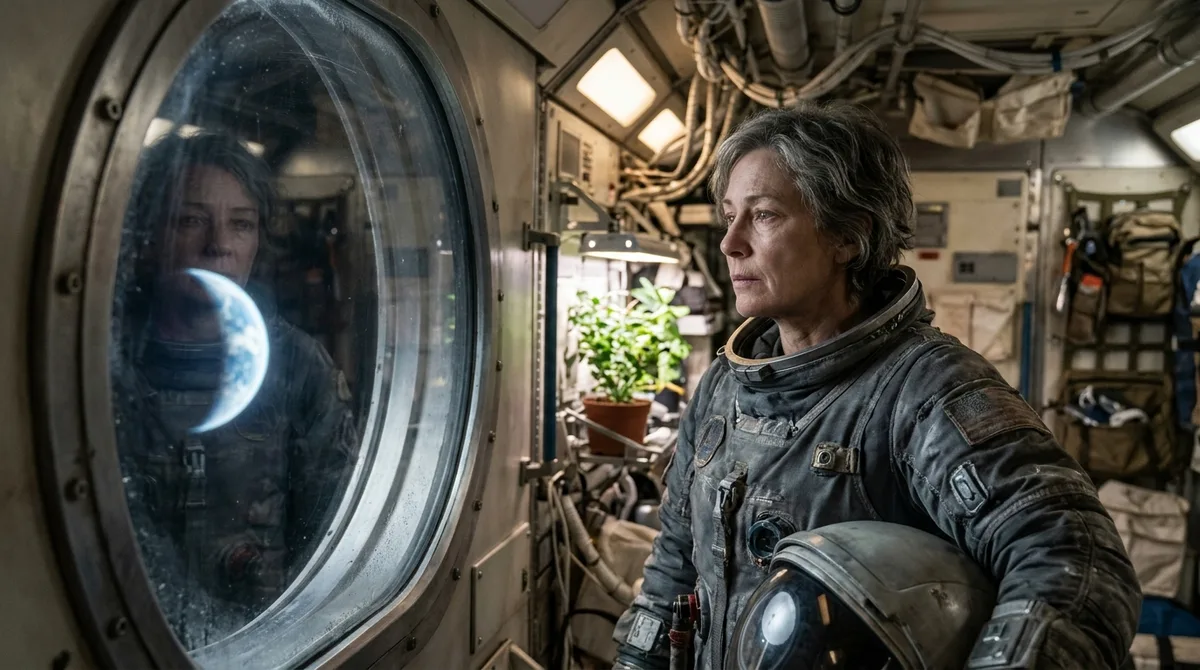
Settlers keep their full human dignity only if they retain the rights they hold on Earth, including the freedom to leave, to dissent, and to govern their own lives. Whether they will is an open question, and the answer depends as much on daily living conditions as on formal law.
Isolation is the first pressure point. A small crew sealed in a habitat, far from help and from familiar faces, faces stresses that can affect mental health, sleep, and the quality of relationships. Small, cut-off communities also depend on a narrow pool of people with the skills to repair equipment, grow food, and treat illness. If social bonds fray in one generation, the community’s ability to sustain itself may fray with them. Aristotle would frame this as a question of flourishing, not just survival: a life that keeps people alive while starving their friendships and their capacity for choice falls short of what human life can be.
Dignity also raises harder questions about rights. On Earth, a citizen can usually move away, criticize the government, and vote for change. Off-world, leaving may mean a long, costly, and dangerous journey, so the right to leave can exist on paper while remaining out of reach in practice. The right to dissent is tested when a single authority controls the air, water, or supply chain that everyone depends on. Those who write settlement rules must decide whether the rights to leave and to dissent travel with the settler or are suspended by distance.
Cultural identity changes more slowly, but it may change most deeply. Languages, religious practice, holidays, and memories of Earth weaken when no one alive has lived there, while new customs grow out of shared hardship. Some would count that as loss, since a community cut off from its origins may forget why its traditions mattered. Others see gain, because a new culture may be shaped by values that Earth never had to test under such conditions. Both outcomes can happen at once, and the ethical question is who gets to decide which traditions to keep.
Governance pressure may be the most direct threat. Settlers could be asked to accept rules set by distant agencies or by the companies that funded their journeys. An employer who also owns the habitat, the food, and the air holds a kind of power few workers on Earth ever face. Consent given under those conditions is hard to call free. Fair settlement would need clear terms about who makes decisions, how disputes are heard, and whether settlers can choose their own leaders.
How Do Virtue and Stewardship Shape the Debate?
Virtue ethics answers this question by asking what kind of people and societies we become through the choices we make, not only what those choices produce. Applied to space, that shifts attention from the balance sheet of a single mission to the character it expresses. Stewardship, humility, and care for future generations can be treated as virtues that shape how a society approaches the Moon, rather than only as rules it must obey.
Stewardship splits in two directions. One reading treats it as a duty to care for the planet we already have, a home whose ecosystems and climate are under strain. On this view, a civilization that cannot yet look after Earth should not rush to remake other worlds, and humility means admitting how little we understand about what we would be changing. A second reading treats stewardship as responsibility for humanity’s long-term survival. Those who hold it argue that a careful steward must guard against the risk of losing everything, so spreading human life beyond Earth may be the more responsible course.
A purely calculative view asks a different question. It asks which available action produces the greatest total benefit, and it judges each proposal by its estimated outcomes. Virtue ethics asks whether the action reflects restraint, honesty, and care, even when the numbers look favorable. The two approaches can reach different verdicts on the same project. A calculator might support terraforming Mars if a habitable world would sustain far more lives, while a virtue-based critic may say that deliberately and permanently erasing a world’s original character reveals an arrogance that no projected benefit can justify. On resource use, the calculator asks whether mining lunar ice yields net value, while the virtue-based view asks whether the mining is carried out with the attentiveness a steward owes to a place it does not own.
Serious thinkers disagree about which framing is right, and the dispute is philosophical rather than merely technical. Engineers can estimate costs and risks, but they cannot settle whether humility should limit ambition or whether caring for the future requires leaving Earth. Those are questions about what we owe, to whom, and what kind of character we want our choices to display. Reasonable people can accept the same facts and still reach opposite conclusions.
Weighing the Ethics of Space Colonization for Yourself
If you advise a government, evaluate a space investment, or simply follow the news, start by testing one question from this article against a source you can check. Begin with risk. The Artemis IV mission page describes the targeted early-2028 crewed landing and the roughly week-long stay near the lunar South Pole. Use that plan to ask who answers for a failure, who would be compensated, and whether crew members could refuse risks they do not fully understand.
Next, write the three fairness goals in your own words: equal access, fair benefit sharing, and fair risk allocation. Apply each one to a project you care about, such as a funding proposal, a company announcement, or a draft policy. Note where the answers are missing. Those gaps are usually where the real debate lives.
Finally, compare the calculative view with the virtue-based view. Decide which premise in each argument seems weakest, and check whether the conclusion truly follows from it. Then revisit your position after each major milestone, because a single mission can change which risks look acceptable.
Frequently Asked Questions
1. Can someone be skeptical of space colonization and still support space science?
Yes. Many people separate the question of whether humans should build permanent settlements from the question of whether robotic probes, telescopes, and sample-return missions are worth funding. Skepticism about settlement usually rests on cost, crew risk, and the opportunity cost of spending on problems on Earth. Those concerns apply far less strongly to instruments that gather knowledge without people aboard.
2. Are there ethical arguments for leaving space untouched altogether?
Yes. One argument holds that the Moon and other bodies preserve a record of the early solar system that cannot be recovered once it is mined or built over, so altering them destroys knowledge for every future generation. A second argument draws on the precautionary principle, which says that when the long-term consequences of a permanent change are poorly understood, the cautious choice is to wait. Critics reply that restraint has its own costs, since a species that never leaves Earth may leave its future exposed to catastrophes that a settlement could have survived.
3. How can I tell whether a claim about space settlement is a factual claim or a value judgment?
A claim is factual when evidence could confirm or refute it, such as a stated launch date or a measured amount of water ice at a site. A claim is a value judgment when it depends on how you weigh risks, costs, and whose interests count, as in statements that a settlement is worth the expense or is fair to the public. Watch for words like “should,” “responsible,” and “fair,” which often signal a value position hidden inside a report that sounds technical. A useful test is to ask what evidence would change the claim. If no evidence could, you are probably reading a value judgment.
4. Which philosophers have written most directly on the ethics of off-world settlement?
Nick Bostrom’s work on existential risk is often the starting point for arguments that settling space could protect humanity’s future. Hans Jonas, whose writing on responsibility toward future generations shaped environmental ethics, is frequently cited by thinkers who urge caution about remaking other worlds. Readers who want to go further can also follow the continuing scholarly debate over the common heritage principle, which the Moon Agreement made central to lunar governance.
5. Is space colonization possible?
No one has yet built a self-sustaining settlement beyond Earth, so the answer is not settled, but the first steps are underway. NASA plans crewed lunar landings in 2028, with a short stay near the South Pole. Sustained habitation would require reliable supplies of air, water, and food over long periods, and that engineering remains the main obstacle. The answer therefore depends largely on how much time and money societies are willing to commit.