
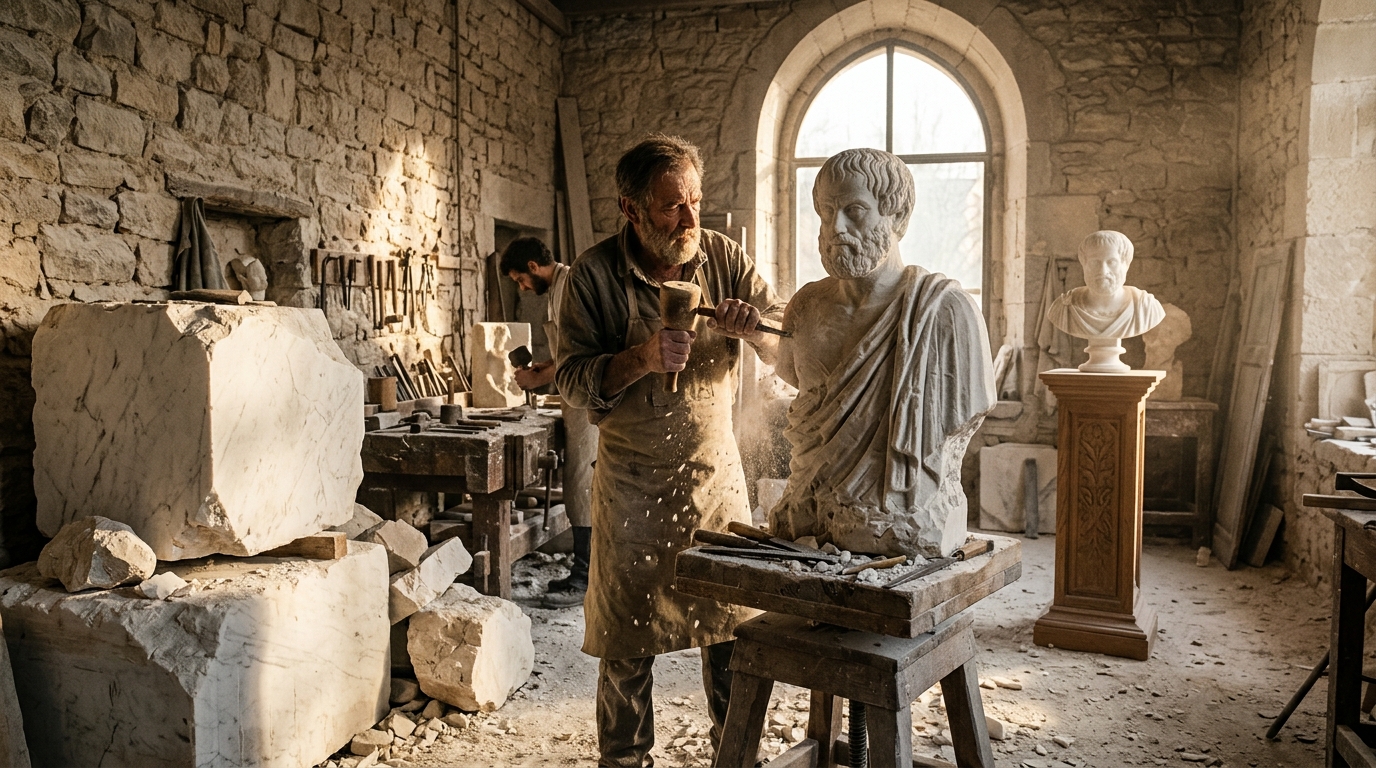
Have you ever looked at a finished project and wondered what truly brought it into existence? While you might often credit a single spark of inspiration or a specific action, the Greek philosopher believed that understanding the world requires a much deeper investigation into the aristotle four causes. By looking beyond the surface, you can uncover a comprehensive framework that explains not just how something happened, but why it exists in its specific form and for its unique purpose.
Imagine you are standing before a magnificent bronze statue; to truly know it, you must look past the metal itself. You need to consider the vision of the artist, the physical labor that shaped the form, and the ultimate reason the work was commissioned in the first place. This ancient system of aitia offers you a powerful lens to analyze everything from personal goals to the complexities of the natural world with intellectual rigor.
Key Takeaways
- Aristotle’s four causes—material, formal, efficient, and final—provide a comprehensive framework to understand the physical makeup, structure, origin, and purpose of any object or situation.
- Distinguishing between an object’s material cause (its physical substance) and its formal cause (its blueprint or essence) allows you to see how raw potential is organized into a specific, recognizable reality.
- The efficient cause acts as the active trigger or agent of change, while the final cause, or ‘telos,’ defines the ultimate goal that directs a process toward a meaningful conclusion.
- Applying this ancient philosophical system to personal goals and modern technology helps you identify the resources, plans, and actions necessary to transform abstract visions into successful, purpose-driven realities.
The Material And Formal Dimensions Of Existence
To understand why anything in your world exists, you must first look at the material cause, which is the physical substance that makes up an object. Think of this as the raw potential or the literal stuff that allows a thing to take up space, such as the bronze in a statue or the wood in a sturdy table. Without this underlying matter, there would be no physical foundation for reality to manifest in a way you can touch and see. Aristotle suggests that identifying the material is the first step in deconstructing the complexity of the universe around you.
Once you identify the matter, you have to consider the formal cause, which acts as the blueprint or the specific essence that defines what a thing is. While the material provides the substance, the formal cause provides the structure and the what-it-is-to-be that differentiates a pile of scrap metal from a magnificent sculpture. This dimension explains why matter behaves in a certain way, as it is being guided by a specific pattern or set of characteristics. By understanding this relationship, you can see how the physical and the structural work in tandem to create the distinct entities you encounter every day.
By viewing existence through these two lenses, you gain a professional and structured guide to the metaphysical why behind the world. You begin to see that objects are not just random collections of atoms, but are purposeful combinations of physical potential and organized design. This framework allows you to move beyond a surface level observation of your surroundings and into a deeper appreciation of the intrinsic building blocks of reality. Recognizing how these dimensions interact is essential for anyone seeking to master the foundational principles of ancient philosophy and modern logic.
Efficient And Final Causes As Drivers Of Change
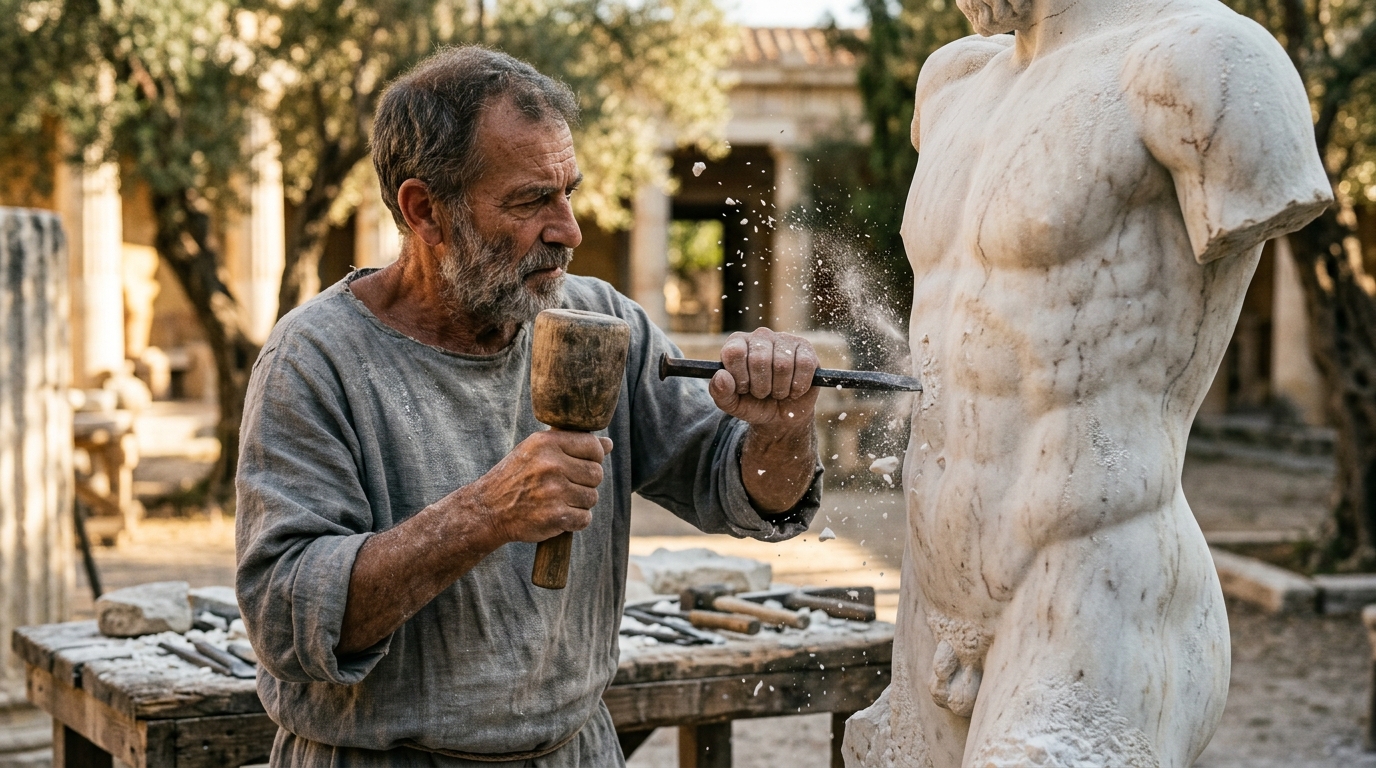
To understand how anything in our world actually happens, you must look toward the efficient cause, which acts as the primary trigger for change. This is the external force or agent that initiates the transition from potential to actual understanding of a finished reality. If you think about a sculptor working with a hammer and chisel, you are seeing the efficient cause in action as they physically shape the bronze statue. Without this active energy and direct intervention, the potential within the material would remain dormant and unchanging. By identifying the person or force behind a process, you gain a clearer picture of the mechanical forces that drive our physical world forward.
While the efficient cause provides the initial push, Aristotle introduces the concept of the final cause to explain the ultimate why behind an object’s existence. He refers to this as the telos, or the specific purpose and end goal that pulls a thing toward its destiny. You can see this clearly in nature, such as when an acorn grows with the inherent goal of becoming a mighty oak tree. The final cause acts like a magnetic north, ensuring that change is not just random movement but a directed journey toward a meaningful conclusion. Understanding this purpose allows you to see the world as an intentional place where every object and being has a unique role to fulfill.
Applying The Four Causes To Modern Life
You can apply the Four Causes to your personal goals to gain a clearer understanding of why some ambitions flourish while others stall. When you look at a major project through this lens, you start by identifying your material cause, which includes the time, energy, and physical resources you have available. Next, you must define your formal cause by creating a structured plan or blueprint that gives your efforts a specific shape. Without a clear efficient cause, such as your daily habits and the actual work you put in, your goal remains a mere idea. Finally, by connecting with your final cause, or the ultimate purpose behind your labor, you find the lasting motivation needed to see your vision through to completion.
This framework also offers a powerful way to analyze the human creations and modern technology you interact with every single day. Consider your smartphone not just as a gadget, but as a collection of glass and silicon that represents its material cause. Its formal cause is the sophisticated software architecture and sleek industrial design that makes the device functional and intuitive. The efficient cause involves the complex manufacturing processes and the engineers who assembled the components into a working whole. Most importantly, the final cause is the human desire for global connectivity and instant access to information, which explains why the device was created in the first place.
Using Aristotle’s logic allows you to move beyond surface level observations and truly grasp the deeper reality of the natural world. When you observe a majestic oak tree, you can see the soil and water as its material cause and the genetic code within the acorn as its formal cause. The efficient cause is found in the biological processes of photosynthesis and growth that actively push the tree toward maturity. By recognizing the final cause, which is the tree’s inherent drive to reach its full potential and produce new life, you gain a profound appreciation for the interconnectedness of nature. This systematic approach transforms how you perceive existence, helping you find clarity and meaning in both the mundane and the extraordinary.
Applying the Four Causes to Your Life
Integrating the four causes into your daily perspective transforms the world from a collection of random objects into a structured map of meaning. By looking at your environment through these metaphysical lenses, you begin to see that everything possesses a specific substance, a unique design, a clear origin, and an ultimate goal. This framework allows you to move beyond the surface level of existence to understand the deeper layers of reality that govern how things change and grow. When you recognize the material, formal, efficient, and final causes at play, you gain a professional level of clarity regarding the complex systems surrounding you.
Applying this ancient wisdom helps you identify the purpose behind both natural phenomena and human creations. You can look at a simple architectural structure and instantly distinguish its physical materials from the architect’s blueprint or the labor that brought it to life. Most importantly, identifying the final cause, or telos, gives you a profound sense of the intentionality behind every object and action. This unified worldview doesn’t just explain why things exist, but it also provides you with a clear, structured guide for navigating your own life with greater focus. You are now equipped to see the profound why behind everything in your environment with intellectual rigor and newfound depth.
Frequently Asked Questions
1. What exactly are Aristotle’s four causes?
The four causes represent a comprehensive framework used to explain why any object or situation exists. By examining the material, formal, efficient, and final dimensions, you can move beyond surface level observations to understand the true nature of reality.
2. How do I distinguish between the material and formal cause?
You can think of the material cause as the physical stuff or raw matter, like the wood used to build a chair. The formal cause is the blueprint or the specific shape and essence that defines that wood as a chair rather than a table. This distinction is vital when exploring identity and change in objects over time.
3. What role does the efficient cause play in this system?
The efficient cause is the primary source of change or the actual force that brings something into being. It is the action or the person, such as a carpenter or a sculptor, whose labor transforms raw potential into a finished reality. This concept is central to how art merely imitates life by translating a vision into a physical form.
4. Why is the final cause considered the most important?
The final cause identifies the telos or the ultimate purpose for which a thing exists. It is the why behind the entire process, guiding every other cause toward a specific goal or function.
5. Can I apply these ancient philosophical concepts to my modern life?
You can absolutely use this framework to analyze your personal goals and professional projects with greater intellectual rigor. By identifying the purpose and the steps needed to reach it, you gain a clearer perspective on how to bring your visions to life.
6. Do all four causes have to be present for something to exist?
Aristotle argues that a complete understanding of any object requires you to account for all four dimensions. While you might focus on one aspect at a time, every created thing relies on this interplay of matter, form, agency, and purpose.