
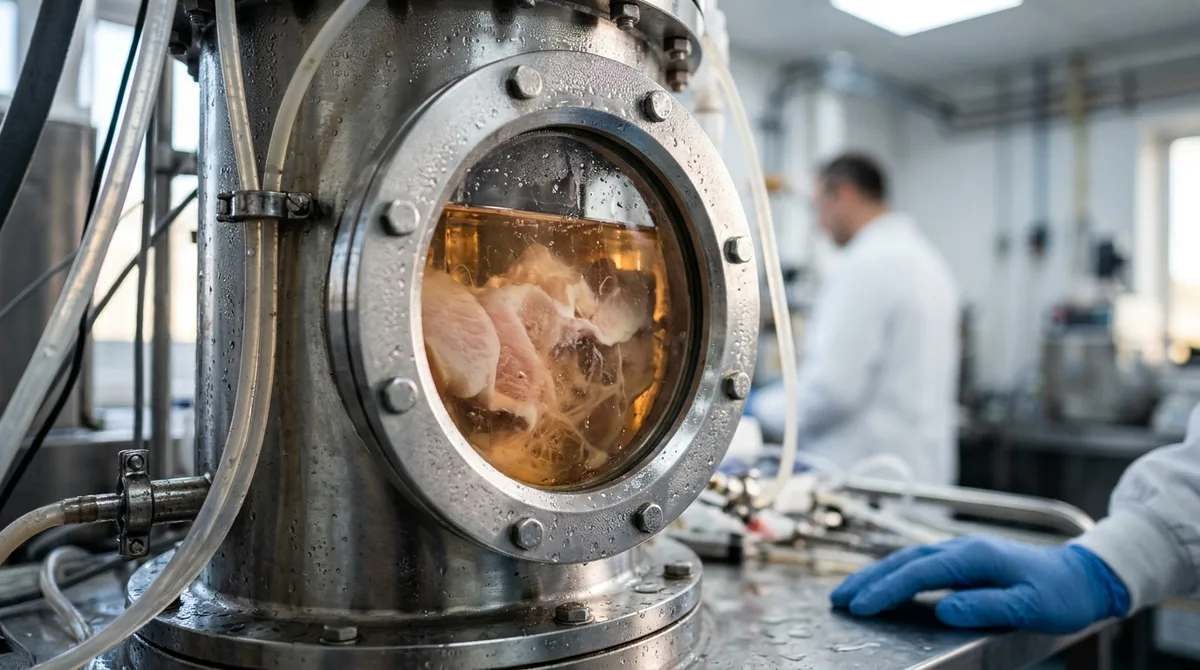
The bioethics of lab-grown meat turns on whether cultivated meat, grown from a small animal-cell sample in a controlled setting, can reduce animal suffering and environmental harm without creating new moral problems of its own. Those problems are real. A central question is whether production uses animal-derived inputs such as fetal bovine serum, and modeled cost estimates vary widely, from US$6.20 per pound to US$63 per kilogram, depending on facility size and assumptions.
Regulation and price are moving too. The U.S. Food and Drug Administration and the USDA share oversight, Singapore requires pre-market approval for novel foods, and Aleph Farms’ beef steak has been cleared there, with a restaurant launch planned for the first half of 2027. Early prices also tell a different story from production costs. The USDA Economic Research Service reported that Good Meat sold a cultivated-chicken salad for about US$14 while losing money on each one.
Key Takeaways
- Lab-grown meat is only likely to be better for animals if the whole growth-medium recipe avoids animal-derived inputs such as fetal bovine serum, because replacing a single ingredient does not guarantee an animal-free process.
- The climate advantage of cultivated meat over conventional chicken and pork, as shown in a 2023 ex-ante assessment, depends on the electricity powering the facility, so you should ask what energy source a producer uses before trusting its environmental claims.
- The US$6.20 per pound figure for cultivated chicken comes from a 2024 techno-economic model of projected production cost, not a shelf price, so you should not expect that cost at the grocery store.
- Regulatory approval, such as Singapore’s pre-market clearance of Aleph Farms’ beef steak for a restaurant launch in the first half of 2027, comes before sales, so you should confirm whether a cultivated meat product is approved where you live before buying it.
What Makes Lab-Grown Meat an Ethical Question?
Cultivated meat is animal cells grown in a controlled setting, and it raises moral questions because it asks whether food can be produced without raising and slaughtering animals. The U.S. Food and Drug Administration describes the process as starting with a small animal-cell sample, growing those cells in a controlled environment, and harvesting the resulting cellular material for food processing. The product comes from living animal tissue but not from a whole animal, so it does not fit neatly into familiar food categories.
The moral weight rests on what cultivated meat would replace. Its supporters point to potential gains for animal welfare and the environment, while open questions remain about inputs, energy use, scale, cost, and consumer acceptance. One input stands out. A 2025 research review identifies fetal bovine serum, an animal-derived culture ingredient, as a source of ethical concern, and it treats developing animal-component-free media as a central goal for the field.
Here the decision takes a different shape. A simple product comparison asks which package costs less or tastes better. A moral comparison asks what the alternative is: an intensive factory farm, a small pasture, or a process that still depends on animal inputs. Your verdict depends on that baseline.
Consumers already feel this tension. In a Food Standards Agency survey from 2024 in the United Kingdom, 85% of participants reported some concern about cell-cultivated meat. Safety and unnaturalness were each chosen by half of respondents, and the impact on farmers by 46%.
Serious moral frameworks do not agree on the verdict. Some focus on consequences, some on rights and duties, and others on the character a practice cultivates. The sections that follow trace where these frameworks part ways rather than settling the matter early.
Is Lab-Grown Meat Better for Animals?
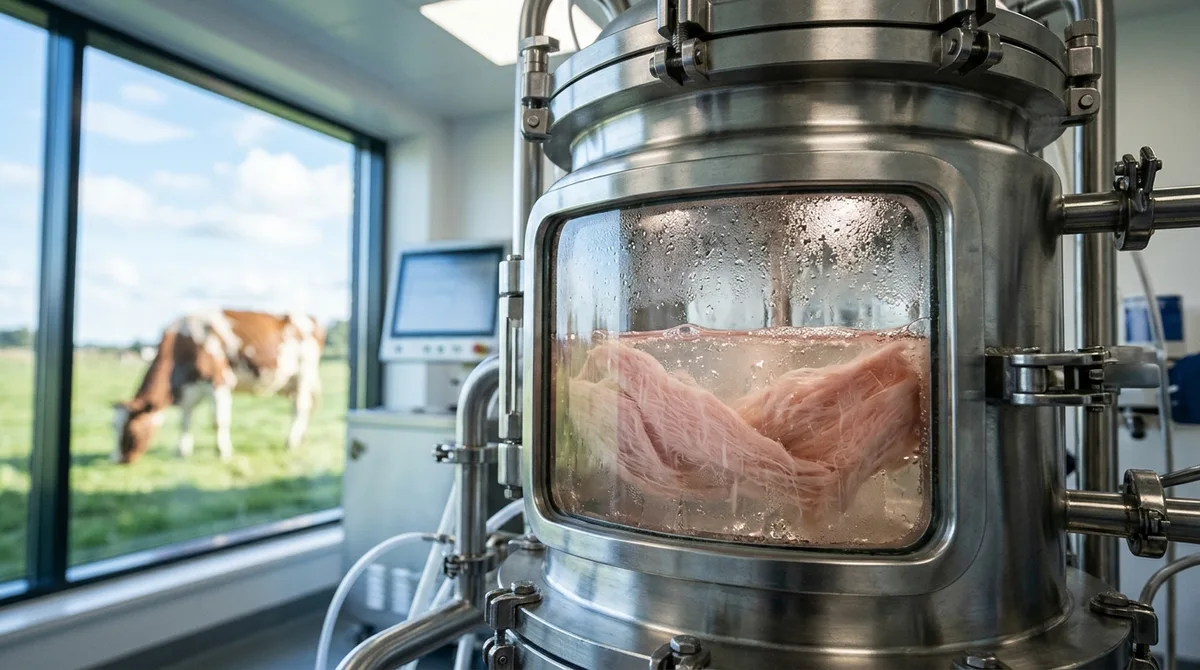
Partly, and only if production avoids animal-derived inputs. Conventional farming confines large numbers of animals and slaughters them for meat, while cultivated meat aims to skip that cycle of raising and killing whole animals. But the process still starts with cells taken from an animal, so the welfare gain is not automatic.
The inputs matter because cells grown in a lab need nutrients and growth signals to multiply. Fetal bovine serum, a fluid collected from calf blood, has been widely used for this purpose, and that origin is the source of the ethical concern. Developing animal-component-free media is therefore a central goal for the field.
Serum-free alternatives exist, but avoiding animal-derived materials is not automatic. A producer may replace one ingredient and still rely on another that comes from animals, so the ethical result depends on the full recipe, not a single swap.
Regulators also treat the recipe as a controlled matter. The Singapore Food Agency states that changes to cultivated-meat inputs, such as cell lines or culture-media components, may require a new approval. A move to animal-free media is therefore a formal step, not a quiet change.
Early products show how much the details matter. Friends & Family Pet Food put cultivated-meat treats on Singapore retail shelves on April 28, 2026, but those products are for cats and dogs, not people. The animal-welfare case for cultivated meat rests on the same kind of detail: what the cells were grown in, and what the growth medium contained.
How Do Environmental and Animal Outcomes Weigh in the Balance?
Judged by outcomes, cultivated meat looks promising for animals and the climate, but the evidence is still provisional. A consequentialist asks what actually happens to animals, to the climate, and to land under each system. The answer depends heavily on how the product is made and at what scale.
Life-cycle assessment is the main tool for this comparison. It tracks the energy, materials, and emissions of a product from start to finish. Studies of cultured meat follow the ISO 14040 and ISO 14044 standards, which set common rules for how such studies are designed and reported.
A 2024 peer-reviewed assessment in Environmental Science & Technology treated its core scenario as minimum impacts. The reason is that its data were incomplete, and it left out the energy and materials needed to scale production up. The real footprint of a large commercial plant could therefore be higher than the headline figures.
A 2023 ex-ante assessment projects a future industry rather than measuring one that exists. It found lower impacts than conventional benchmarks for most indicators. Its comparison with chicken and pork, however, depended on the energy mix, meaning the electricity powering the facility. Clean power strengthens the case, while carbon-heavy power can erase much of the advantage.
The verdict therefore shifts with assumptions about energy, scale, and process. Change the power source, the facility size, or the growth medium, and the ranking of cultivated meat against conventional farming can change with it. Outcome-based conclusions remain provisional until production data from full-scale plants replace projections.
What Do Duties and Rights Say About Eating Cultivated Meat?
Deontological views judge an action by whether it respects duties and rights, not only by whether its results are good. Applied to cultivated meat, the question is whether the way the food is made is right in itself, even if its outcomes look better than factory farming.
The first question is whether raising and killing animals for food is wrong in itself. If it is, a product that ends the slaughter of whole animals may satisfy a duty that conventional meat violates. Yet cultivated meat still starts with cells taken from a living animal, so a critic can ask whether using an animal’s cells counts as using the animal, even when no slaughter occurs.
Duties also run to people. Rural communities that depend on livestock have a claim that buyers should weigh, and consumer researchers have documented concern about their livelihoods. Consumers are owed honest information as well. In the United States, labels for cultivated meat require USDA-FSIS preapproval, a checkpoint meant to make sure the product is described accurately before it reaches shoppers.
Some thinkers also hold that the means of production matter in their own right. On this view, a process that relies on fetal bovine serum collected from calf blood may be objectionable even if its climate impact is small, because the wrong lies in the method.
Duty-based reasoning therefore cuts both ways. If you weigh duties to animals most heavily, cultivated meat looks like a strong moral step. If you weigh duties to farmers, to honest labeling, or to the animal inputs used in production most heavily, the same product may look like a new problem. Deciding which duty ranks highest is the choice you have to make.
Does Virtue Ethics Change the Question?
Virtue ethics changes the question by shifting attention from the product alone to the character of the person eating it and the industry making it. Instead of asking only whether an outcome is good, it asks what kind of person eats cultivated meat, and what habits that choice builds. Aristotle held that a good life grows from habits that form traits such as moderation, and modern virtue theorists add compassion and honesty to that list.
Motives matter in this framework. Cultivated meat is being developed for several reasons, including animal welfare, environmental goals, and food security, meaning a more reliable supply of protein as the population grows. A company driven mainly by profit and a researcher driven mainly by concern for animal suffering may build the same product, yet a virtue-based reading asks whether each one carries its stated aims through in labeling, pricing, and production choices.
Veganism sharpens the debate. Some vegans see cultivated meat as a step toward ending animal exploitation, since it could make the slaughter of animals less necessary. Others argue that it keeps the appetite for animal products alive and normalizes eating meat, so it continues the practice they reject.
Moral values also shape how people react. Consumer research suggests that personal values, not only price or taste, influence whether people are willing to try the product. Studies in the United Kingdom reported 16%–41% willingness to consume cultivated meat, but those studies used different methods and product descriptions, so the numbers reflect how questions were framed as much as what people believe. Your own reasons for choosing or refusing the product may differ as much as the product itself.
Should Lab-Grown Meat Be Supported?
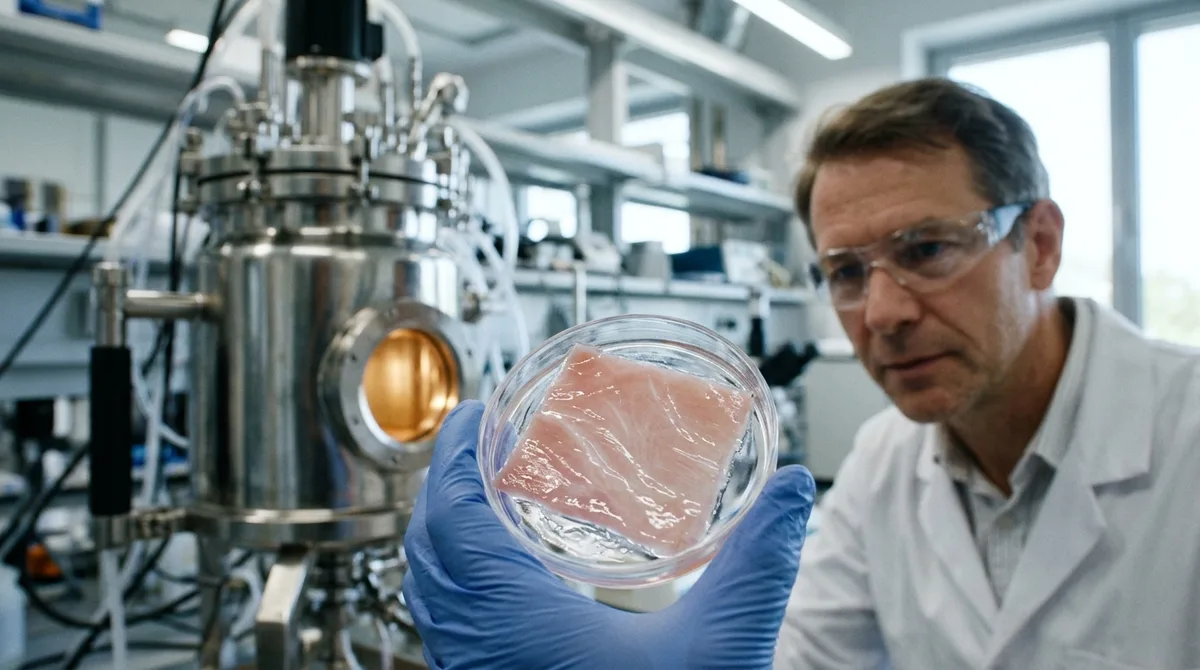
Supporting cultivated meat is reasonable only if three conditions hold: it can feed more people at a price they can afford, it can be made without depending on animal inputs, and it can pass oversight that protects buyers. Each condition is still open, so support can be conditional rather than unconditional.
The case for support starts with feeding a growing population. If demand for protein keeps rising, cultivated meat could add supply without expanding herds and flocks. That argument needs cost to fall a long way. A 2024 techno-economic analysis modeled cultivated chicken at US$6.20 per pound in a theoretical 50,000-liter facility using perfusion technology. That figure is a projected production cost, not a price on a shelf.
Another modeled estimate shows how much the answer depends on scale. A 2022 study put production at US$63 per kilogram for a large facility making 540,000 kilograms a year, with results shifting as facility and process assumptions change.
The case against support rests on trust and uptake. A 2025 UK review found studies reporting 16%–41% willingness to eat cultivated meat, and a 2024 Food Standards Agency survey found 85% of participants had some concern. A product that most people hesitate to buy cannot reach the volumes that would make the animal and environmental arguments meaningful.
Oversight is the third test. In the United States, the FDA’s framework covers cell collection, banking, and growth, while USDA inspection begins at harvest. Singapore requires pre-market approval, and Aleph Farms’ beef has cleared that step, with a restaurant launch planned through selected partners in the first half of 2027. Approval is a regulatory milestone, not yet a product on ordinary grocery shelves.
Supporters need cost to approach conventional prices, animal-free inputs to work at scale, and clean energy to power production. Critics need only one of those conditions to fail to keep their doubts.
Where Do Consequences and Rules Fall Short?
Consequences and rules each fall short in different places, and neither settles the question alone. Consequentialism depends on forecasts, and the forecasts for cultivated meat rest on assumptions about scale and energy. A life-cycle estimate that assumes clean electricity may favor the product, while the same plant running on carbon-heavy power may not. A consequentialist who must decide now has to choose which projection to trust, and that choice is itself a judgment.
Deontology faces the opposite problem. A rule such as “do not treat a living being merely as a means” can say whether a practice is wrong, but it gives little guidance on how much a large reduction in animal suffering or emissions should count against a violation of that rule. Some deontologists hold that duties come first and outcomes matter only once they are met. Others allow large enough gains to outweigh them.
Virtue ethics and questions of justice add a further layer. They ask who controls production, who owns the facilities and the know-how, and whether farmers and workers share in any gains.
Thoughtful people weigh these approaches differently, and the disagreement is serious because it concerns what morality is for. If you treat animals as beings whose interests must never be overridden, you will weigh the process heavily. If you judge by welfare across millions of animals, you will weigh the results. When the two point in different directions, you have to decide which one governs.
Weighing Cultivated Meat Against Conventional Farming
Start by deciding which test matters most to you, because that choice tells you what to check. If animal welfare drives your thinking, look for a producer’s published statement that its growth medium is free of fetal bovine serum, and ask whether that claim covers every input, not just one ingredient. If climate matters most, ask what power runs the facility, since the 2023 ex-ante assessment’s comparison with chicken and pork depended on that answer. If cost matters most, remember that a figure such as US$6.20 per pound is a projected production cost, not a shelf price, and that a 2022 estimate of US$63 per kilogram changes with facility size.
Before you buy anything, check whether the product is approved where you live. Approval is a regulatory milestone that comes before sales, so a cleared product may still be months away from restaurants or stores.
Then test your own reasoning. Write down which framework, whether consequences, duties, or character, you find most persuasive, and name the evidence that would change your mind. If you find a factual error in an article, use the site’s contact form to send a correction. The editors handle corrections separately from differences in philosophical interpretation.
Frequently Asked Questions
1. Is lab-grown meat safe to eat, and how is it checked before sale?
In the United States, cultivated meat goes through review at more than one stage before it reaches shoppers. The U.S. Food and Drug Administration oversees cell collection, banking, growth, and differentiation, while USDA-FSIS takes over at harvest. Processing establishments need a USDA grant of inspection, sanitation controls, and HACCP systems (Hazard Analysis and Critical Control Points), and product labels require FSIS preapproval.
2. Why is lab-grown meat allowed to be sold at all?
Cultivated meat is sold only in places where a regulator has reviewed and approved it. Singapore requires pre-market approval for a novel food before it can be supplied, manufactured for supply, or cultivated there, and the Singapore Food Agency says changes to cell lines or culture-media components may require a new approval. Approval in one country does not open the market everywhere, so each jurisdiction applies its own review.
3. Would cultivated meat replace conventional farming, or would the two sit side by side?
Replacement depends on whether cultivated meat can reach volumes large enough to matter, and that depends on three things. Production cost must fall far below current modeled estimates, animal-free inputs must work at industrial scale, and consumers must be willing to buy the product in large numbers. Until those conditions are met, cultivated meat is more likely to add to protein supply than to displace herds and flocks.