

Imagine standing in a medieval lecture hall where the pursuit of truth was a rigorous mental workout. You might think of the Middle Ages as a time of unquestioning dogma, yet the marriage of scholasticism and reason reveals a sophisticated world where logic was used to sharpen the tools of faith. By embracing the motto fides quaerens intellectum, which means faith seeking understanding, thinkers of this era transformed the university into a laboratory for the mind. This approach proves that your intellect and your convictions do not have to live in separate worlds.
When you look closer at this intellectual tradition, you discover a brilliant synthesis where ancient philosophy meets theological inquiry. You do not have to be a medieval scholar to appreciate how figures like Thomas Aquinas used Aristotelian logic to bridge the gap between what we observe and what we believe. This method of dialectical reasoning invites you to weigh opposing arguments and draw fine distinctions, treating every difficult question as an opportunity to deepen your understanding of the world.
Key Takeaways
- Faith and reason are harmonious partners rather than rivals, operating under the principle of fides quaerens intellectum (faith seeking understanding) to reach a unified truth.
- The Scholastic method utilizes dialectical reasoning to resolve complex contradictions by presenting opposing arguments and applying precise logical distinctions.
- The synthesis of Aristotelian logic and theology established the foundations of modern academic inquiry, emphasizing structured debate, evidence, and systematic categorization.
- Natural theology demonstrates that the universe is an orderly, intelligible system that can be explored and understood through human senses and rational deduction.
The Aristotelian Synthesis And Divine Logic
You can think of the Scholastic period as a massive intellectual bridge where the rigid logic of ancient Greece met the spiritual depths of medieval theology. When the works of Aristotle were rediscovered in the West, thinkers like Thomas Aquinas did not see his philosophy as a threat to their faith. Instead, they embraced the idea that truth is universal, whether that truth is found in scripture or through the natural observation of the world. By adopting Aristotle’s rigorous logical frameworks, these scholars aimed to show you that your mind is a gift designed to explore the mysteries of the universe. This synthesis transformed the university into a place where rigorous argumentation and divine revelation walked hand in hand.
As you explore the Scholastic method, you will notice that it relies heavily on a process called dialectical reasoning to resolve complex contradictions. This approach required scholars to present a question, offer every possible objection, and then use precise logical distinctions to reach a definitive resolution. For Aquinas and his peers, reason was not a replacement for faith, but rather a tool that could provide a solid foundation for it. They argued that while some truths are known through revelation, many others can be proven through the careful application of human logic. This meant that you could use your intellect to understand the world while simultaneously deepening your spiritual convictions.
This era of fides quaerens intellectum established the groundwork for how we approach academic inquiry and systematic thought today. By treating logic as a vital instrument, the Scholastics proved that intellectual rigor does not have to come at the expense of personal devotion. You are seeing the birth of a tradition that values clarity, evidence, and structured debate as pathways to a higher reality. This legacy reminds us that the pursuit of knowledge is most effective when it balances the precision of the mind with the aspirations of the heart. Through this lens, the Aristotelian synthesis remains a powerful example of how different worldviews can be harmonized to reach a more complete version of the truth.
Dialectical Methods In The Medieval Classroom
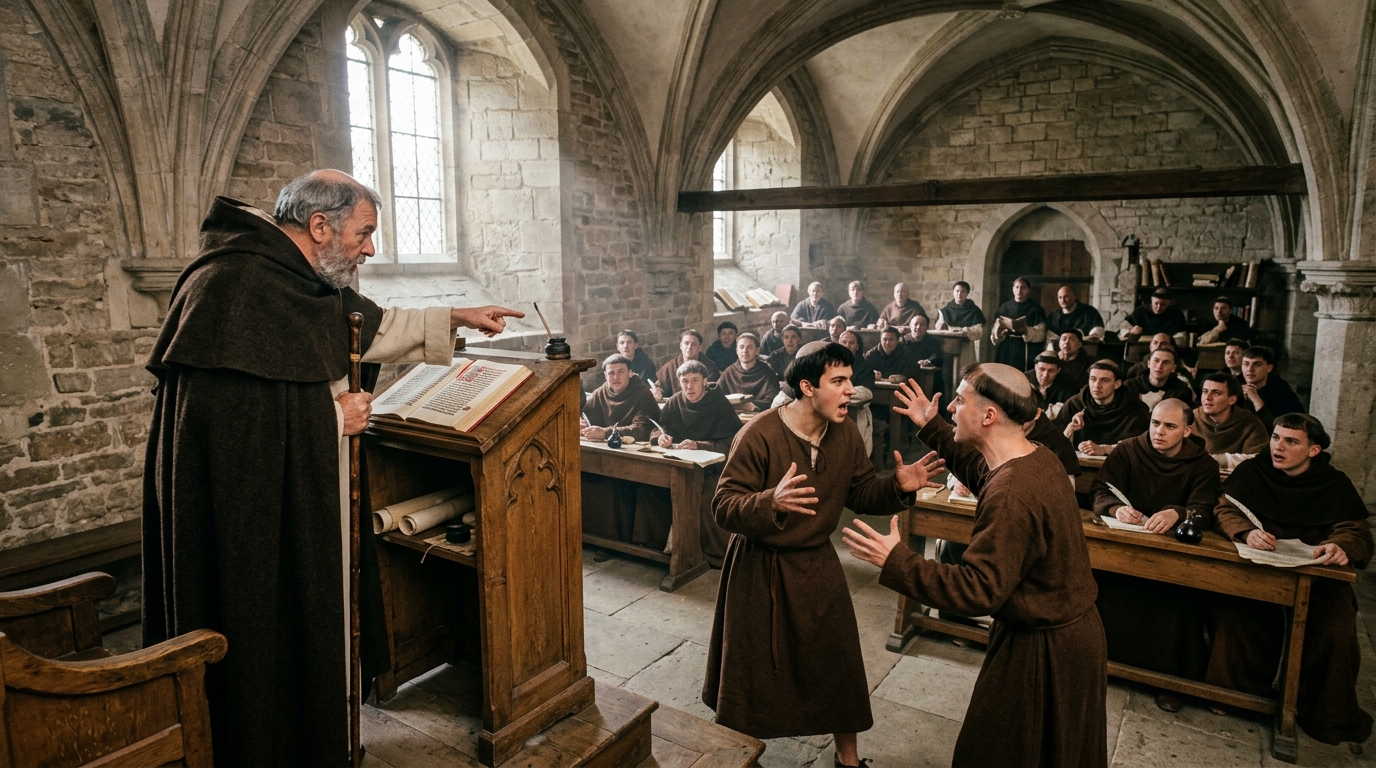
When you step into a medieval classroom, you encounter a world where faith and logic are not rivals but partners in a grand intellectual dance. You will find that the Scholastic masters did not simply ask you to accept doctrine on blind authority, but rather invited you to test it through the rigorous art of logic. This method transformed the university into a laboratory of the mind, where students learned to dissect complex theological questions using the sharp tools of Aristotelian logic. By engaging in these disciplined debates, you begin to see how the synthesis of Greek philosophy and religious dogma created a robust framework for understanding the universe.
One of the most influential tools you will explore is the Sic et Non approach, famously championed by Peter Abelard to harmonize seemingly conflicting authorities. You might find it surprising that medieval scholars intentionally sought out contradictions in sacred texts, presenting yes and no arguments side by side. Instead of ignoring these tensions, you learn to resolve them by making precise logical distinctions and clarifying the definitions of key terms. This process ensures that your faith is supported by a clear, rational foundation, proving that deep inquiry can actually strengthen conviction rather than diminish it.
As you master these dialectical techniques, you gain a deeper appreciation for the Scholastic belief that all truth is unified. You will discover that because both revelation and reason are thought to originate from the same source, they must ultimately point toward the same reality. This rigorous training in argumentation did more than just settle theological disputes, as it actually laid the groundwork for modern academic inquiry. By participating in this historical tradition, you are practicing a form of faith seeking understanding that prizes intellectual honesty and the relentless pursuit of clarity.
Natural Theology And The First Cause
You can think of natural theology as the bridge where your human curiosity meets the vastness of the divine. Scholastic thinkers argued that while certain truths require spiritual revelation, you can discover a great deal about the universe simply by using your senses and logical deduction. By observing the physical world, you are participating in a rigorous intellectual exercise that assumes the cosmos is orderly and intelligible. This approach suggests that your capacity for reason is not a distraction from your faith, but rather a tool designed to unlock the mysteries of creation. It allows you to build a foundation of knowledge based on what is visible and measurable before moving from potential to actual understanding of the supernatural.
When you explore the concept of the First Cause, you are stepping into a classic synthesis of Aristotelian logic and medieval doctrine. The Scholastics utilized Aristotle’s principles to argue that every effect in the physical world must have a prior cause, creating a chain that eventually leads back to a necessary starting point. You can follow this logical progression to understand reality and the fact that there must be an uncaused mover who set the universe in motion. This rigorous argumentation transforms a theological claim into a philosophical certainty that you can defend through systematic debate. By establishing this starting point, the Scholastics proved that human reason is powerful enough to touch the hem of the infinite without abandoning its logical integrity.
How Scholastic Logic Shaped Your Modern Mind
You can see how the Scholastic commitment to systematic argumentation did far more than just settle theological debates. By insisting that faith must be supported by rigorous logic, these medieval thinkers transformed the classroom into a laboratory for the mind. You are witnessing the birth of modern intellectual standards every time you encounter a peer reviewed journal or a structured university debate. This legacy of faith seeking understanding ensured that reason was not seen as an enemy of truth, but as its primary tool.
When you look at the development of the scientific revolution, you can trace its roots directly back to the Aristotelian synthesis perfected by the Scholastics. Their obsession with categorizing knowledge and resolving contradictions through dialectical reasoning provided the essential framework for empirical inquiry. By treating the universe as a rational creation that could be decoded through logic, they paved the way for future scientists to explore the natural world with confidence. You are standing on the shoulders of medieval giants who believed that a clear, disciplined mind was the best way to honor the truth.
Modern academic life still carries the DNA of these medieval masters in its emphasis on evidence and critical analysis. You experience this whenever you are asked to defend a thesis or provide a logical basis for your conclusions in a professional setting. The Scholastic method taught us that any claim, no matter how sacred, should be able to withstand the scrutiny of careful thought and precise distinction. By bridging the intersection of faith and ancient Greek philosophy, these scholars built the very foundation of the Western intellectual tradition that you use today. This rigorous framework even allows us to address profound questions like worldly suffering through the lens of structured philosophical inquiry.
Frequently Asked Questions
1. What exactly is Scholasticism and how does it relate to reason?
Scholasticism is a medieval method of learning that emphasizes dialectical reasoning to reconcile faith with logic. You can think of it as a rigorous mental framework where you use your intellect to better understand and defend your spiritual convictions.
2. Does Scholasticism suggest that faith and reason are in conflict?
Not at all, as the Scholastic tradition views faith and reason as two harmonious paths leading to the same ultimate truth. You are encouraged to use your rational mind as a tool to explore and clarify the mysteries of your belief system rather than choosing one over the other.
3. What does the phrase fides quaerens intellectum mean for you?
This motto translates to faith seeking understanding, which serves as your invitation to engage your mind in your spiritual journey. It suggests that your belief is not a stopping point but a foundation that inspires you to ask deeper questions and seek logical clarity.
4. Why was Aristotle so important to Scholastic thinkers like Thomas Aquinas?
Aristotle provided a sophisticated system of logic and natural observation that you can use to organize and validate complex ideas. By synthesizing his ancient philosophy with theology, Scholastic scholars showed you that the laws of nature and the truths of faith are part of a single, coherent reality.
5. How does the dialectical method help you solve difficult problems?
The dialectical method involves weighing opposing arguments and making fine distinctions to arrive at a logical conclusion. This approach teaches you to respect the complexity of a question and ensures that your final understanding is tested against the strongest possible objections.
6. Can you apply these medieval concepts to your modern life?
Yes, because the Scholastic tradition reminds you that your intellect is a gift meant for exploring the world with both curiosity and rigor. You can apply this mindset today by refusing to leave your critical thinking at the door when you encounter matters of deep personal conviction.